
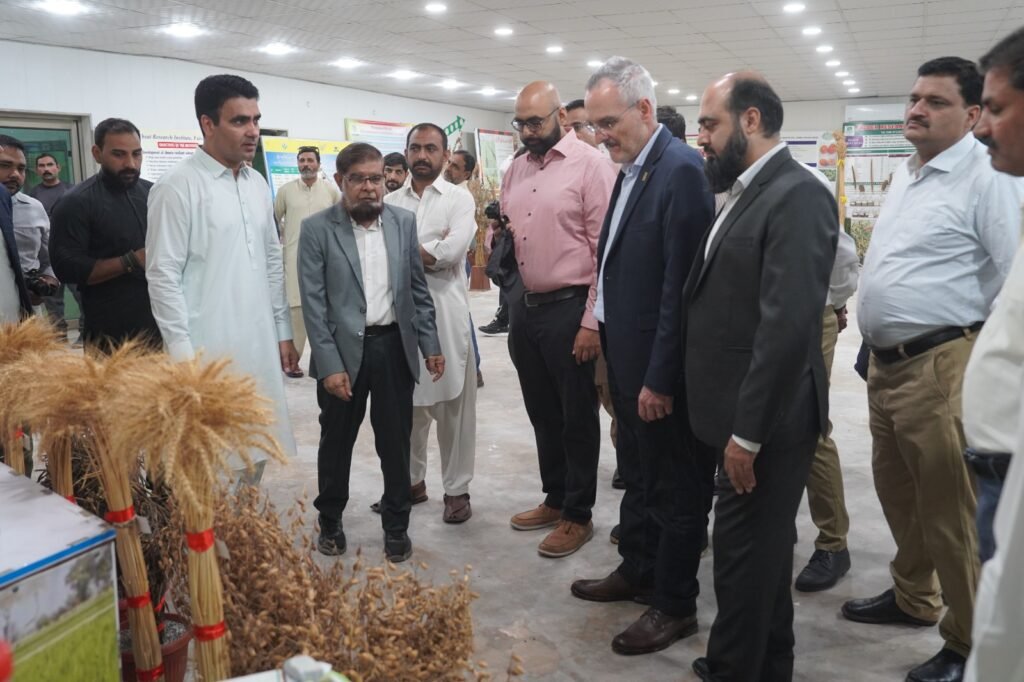
FAISALABAD, Oct 13 — The International Maize and Wheat Improvement Center (CIMMYT), in collaboration with the Government of Pakistan, has provided laboratory equipment and farm machinery to national agricultural research institutions to strengthen wheat breeding, improve seed processing and support climate-resilient crop research.
The initiative was marked by the inauguration of a dedicated laboratory and working area at the Wheat Research Institute, Ayub Agricultural Research Institute (AARI), Faisalabad, as Pakistan and CIMMYT celebrate six decades of cooperation in wheat research and germplasm exchange.
Under the programme, three seed cleaner-cum-graders, 10 zero-tillage seed-cum-fertilizer drills and experimental threshing equipment are being provided to research partners, while laboratory facilities and dedicated working areas are being upgraded at five institutions across the country.
The laboratory support includes digital weighing scales, seed counters, pH meters, vertical deep freezers, spectrophotometers and canopy temperature meters to improve the measurement, storage and analysis of research material and field data.
Dr Javed Ahmad, Chief Scientist and Director of the Wheat Research Institute at AARI, said stronger research institutions and scientific capacity were essential for Pakistan’s food security.
He said the new facilities and equipment would help researchers address challenges faced by wheat farmers and strengthen national crop improvement efforts.
The five institutions receiving laboratory and working-area support are the Wheat Research Institute in Faisalabad, Regional Agricultural Research Institute in Bahawalpur, National Agricultural Research Centre in Islamabad, Barley and Wheat Research Institute in Tandojam, and Cereal Crops Research Institute in Nowshera.
Seed cleaner-cum-graders will be used to remove impurities and sort seed by size and thickness, helping improve purity and uniformity.
The equipment is particularly intended for institutions producing foundation seed of nutrient-enriched wheat varieties aimed at tackling micronutrient deficiencies.
Research threshers, including single-head, single-plant and Vogel threshers, will allow scientists to process individual wheat heads, small plant samples and experimental seed lots with less manual labour and reduced grain damage and losses.
CIMMYT is also providing zero-tillage seed-cum-fertilizer drills, which allow crops to be sown directly into untilled soil.

The technology can help conserve soil moisture, reduce fuel and labour costs and support timely sowing, particularly in rice-wheat systems, while also reducing the need for burning rice residues.
Dr Flavio Breseghello, Director of CIMMYT’s Global Wheat Program, said reliable field trials and careful handling of breeding material were critical to wheat improvement.
He said the equipment would strengthen the ability of national research partners to evaluate promising wheat lines and develop climate-resilient varieties for farmers.
Dr Sajid Ali, CIMMYT Country Representative for Pakistan, said the organisation’s focus was on helping national partners convert research into practical solutions for farmers.
He said improved facilities and equipment would complement wider efforts to expand seed access, strengthen scientific skills, support data-driven decision-making and improve climate resilience.
CIMMYT’s collaboration with Pakistan dates back to the 1960s and contributed to the Green Revolution through the exchange of germplasm, joint research and training of Pakistani scientists.
The partnership continues to support the development of wheat and maize varieties with improved climate resilience, disease resistance and nutritional traits.
CIMMYT currently works with 29 national partners in Pakistan, with interventions reaching 88 districts.
Its 2026 programme also includes the establishment of 21 community seed banks across 20 districts in all four provinces, along with national and international training for Pakistani scientists.
Current research areas include biological nitrification inhibition to improve fertilizer-use efficiency and hybrid wheat research to explore potential productivity gains.
CIMMYT has also proposed the establishment of a Himalayan Agricultural Futures Centre in Islamabad, envisaged as an international research and screening facility to help anticipate emerging crop disease threats, including yellow rust, across Pakistan and the wider region.