
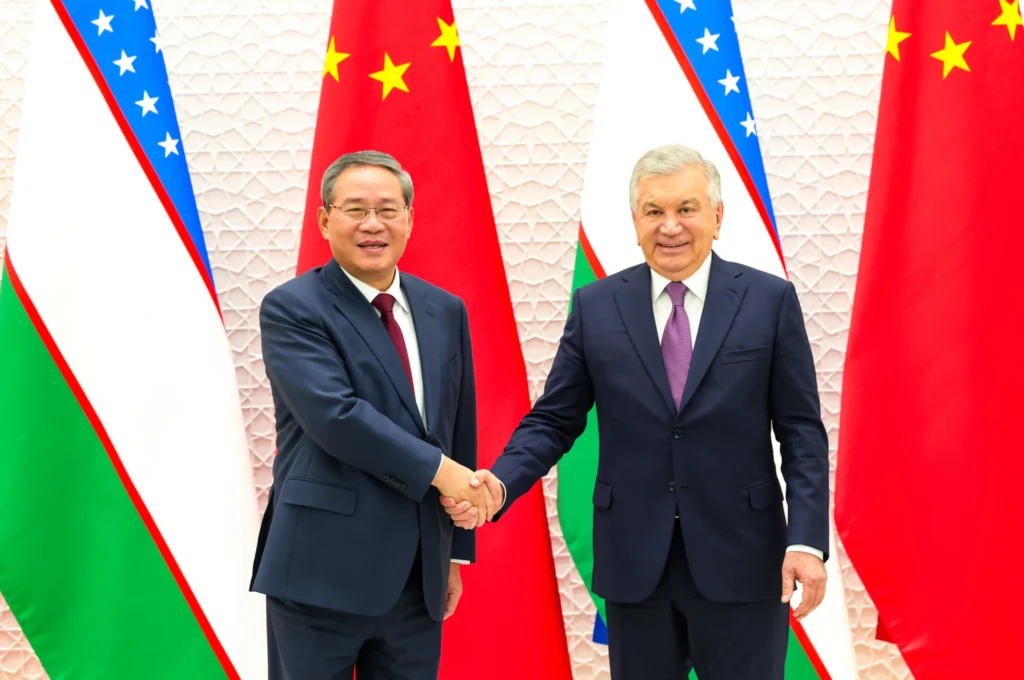
TASHKENT, Oct 17: China and Uzbekistan signed a series of cooperation agreements covering trade, education, customs, healthcare and poverty reduction on Saturday as Chinese Premier Li Qiang began a two-day official visit aimed at expanding economic ties, investment and regional connectivity.
Li met Uzbek President Shavkat Mirziyoyev and held talks with Prime Minister Abdulla Aripov in Tashkent, where both sides agreed to strengthen cooperation in traditional industries and emerging sectors, including artificial intelligence, green energy and aerospace technology.
During his meeting with Mirziyoyev, Li expressed China’s willingness to expand bilateral trade, diversify its composition and encourage more Chinese companies to invest in Uzbekistan.
He also called for a favourable business environment for Chinese enterprises operating in the Central Asian country.
In talks with Aripov, the Chinese premier said Beijing was prepared to increase imports of high-quality and specialised Uzbek products. He encouraged Uzbekistan to use platforms such as the China International Import Expo to explore opportunities in the Chinese market.
China remains one of Uzbekistan’s leading economic partners. Bilateral trade reached $16.1 billion in 2025, an increase of 17.9 percent from the previous year, according to Chinese official figures.
Uzbek government data showed that China accounted for 23 percent of the country’s total foreign trade during the first eight months of 2026, making it its largest trading partner. More than 6,000 joint ventures involving Chinese participation are operating in Uzbekistan.
Agreements cover trade, technology and climate cooperation
Following their discussions, Li and Aripov witnessed the signing of several cooperation documents covering economic and trade relations, education, customs, healthcare and poverty reduction.
Additional agreements were signed in areas including e-commerce and climate cooperation.
The two leaders also watched a presentation highlighting existing bilateral projects and their contribution to economic development.
Li said China was ready to align its development priorities more closely with Uzbekistan and build on the complementary strengths of the two economies.
He identified artificial intelligence, aerospace technology and the green economy as promising areas for further cooperation.
Eldor Tulyakov, executive director of Uzbekistan’s Development Strategy Center, told Xinhua that expanding ties with China had supported the country’s development priorities, particularly through investment in electric vehicle manufacturing and renewable energy.
“Political trust creates favorable conditions, and practical work gives it substance,” Tulyakov said.
Chinese-backed solar and wind power facilities are already supplying electricity to regional grids in Uzbekistan, supporting the country’s transition towards cleaner energy sources.
In August, a China-supported wind power project was completed in the Bostanlyk district of the Tashkent region.
Once fully operational, the project is expected to save approximately 12 million cubic metres of natural gas annually and reduce carbon dioxide emissions by about 24,000 tonnes a year.
China-Kyrgyzstan-Uzbekistan railway remains a priority
Regional transport connectivity was another major focus of the Chinese premier’s discussions with Uzbek leaders.
Both countries reaffirmed their commitment to advancing the China-Kyrgyzstan-Uzbekistan railway, a major infrastructure project under the Belt and Road Initiative.
The railway, officially launched in December 2024 and currently under construction, is intended to strengthen transport connections between China and Central Asia while supporting regional trade and logistics.
Chinese President Xi Jinping recently called for high-quality construction of the railway during his visit to Bishkek for a state visit to Kyrgyzstan and the Shanghai Cooperation Organization Summit 2026.
Xi described the project as an important transport corridor reflecting the region’s shared development aspirations.
Tulyakov said the railway would bring several countries together through a common infrastructure initiative and could encourage the development of logistics facilities and digital trade systems along the route.
He noted that the benefits of China-Uzbekistan cooperation were increasingly visible in operational businesses, completed infrastructure projects and new employment opportunities.
The latest agreements and investment discussions reflect efforts by Beijing and Tashkent to expand their comprehensive strategic partnership, with trade, technology, clean energy and regional connectivity emerging as major priorities for future cooperation.