
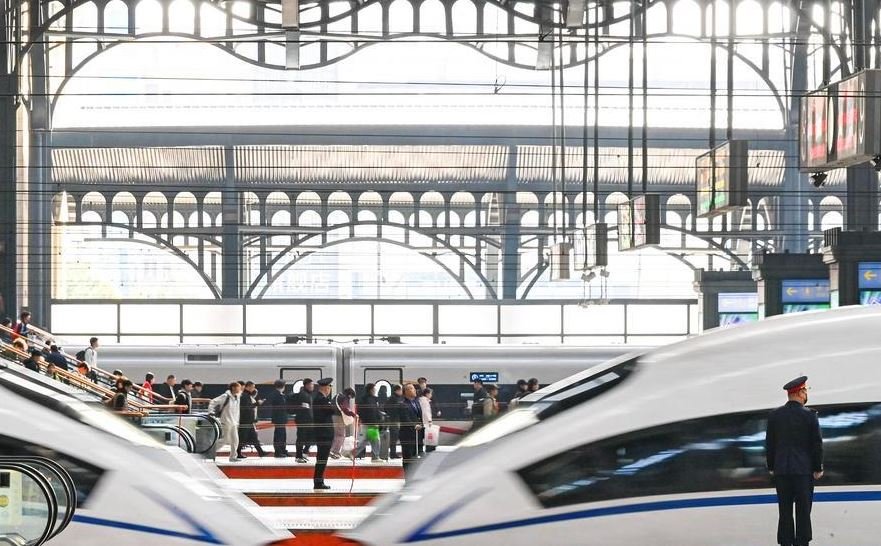
BEIJING, Oct 18: China’s railway network recorded a record 3.71 billion passenger trips during the first nine months of 2026, an increase of 4.8 percent from a year earlier, as domestic tourism, international travel and expanding high-speed rail services continued to drive passenger demand.
According to China State Railway Group Co., Ltd. (China Railway), the network operated an average of 11,511 passenger trains daily between January and September, up 5.3 percent year on year.
Tourism-related rail services also expanded significantly during the period. Railway authorities operated 2,860 dedicated tourist trains, a 25.5 percent increase from the corresponding period last year, catering to growing demand for sightseeing, wellness tourism and educational trips to sites associated with China’s revolutionary history.
Another 947 special trains were introduced for passengers attending concerts and sporting events, supporting travel demand linked to hospitality, entertainment and cultural tourism.
Cross-border railway travel records strong growth
International railway services also reported higher passenger volumes during the first three quarters.
The China-Laos Railway handled 265,000 cross-border passenger trips, marking a 37.8 percent increase compared with the same period in 2025.
Meanwhile, the Guangzhou-Shenzhen-Hong Kong high-speed railway recorded more than 25.8 million cross-border passenger trips, up 11.8 percent year on year.
China’s visa-free transit policy also contributed to increased demand from international travellers.
According to China Railway, foreign passengers made more than 19 million railway trips during the January-September period, representing a 33.4 percent increase from a year earlier.
China expands high-speed rail network
The increase in passenger traffic comes alongside the continued expansion of China’s railway infrastructure, particularly its high-speed rail network.
By the end of 2025, China’s operational railway network had reached 165,000 kilometres, including more than 50,000 kilometres of high-speed rail lines.
On September 28, the country opened four additional high-speed railway sections, strengthening transport connections across several regions.
The new sections connect Xiongan in Hebei Province with Shangqiu in Henan Province, Xi’an with Ankang in Shaanxi Province, Yichang with Xingshan in Hubei Province, and Harbin with Yichun in Heilongjiang Province.
The additions form part of China’s long-term railway development programme aimed at improving connectivity between major cities and regional economic centres.
China plans to expand its high-speed railway network to 70,000 kilometres by 2035.
The planned system will feature eight major north-south corridors and eight east-west corridors, linking key metropolitan areas, urban clusters and economic regions.
The latest passenger figures reflect growing demand for rail transport across domestic and international routes as China continues to expand railway capacity and improve connections between cities and regions.