
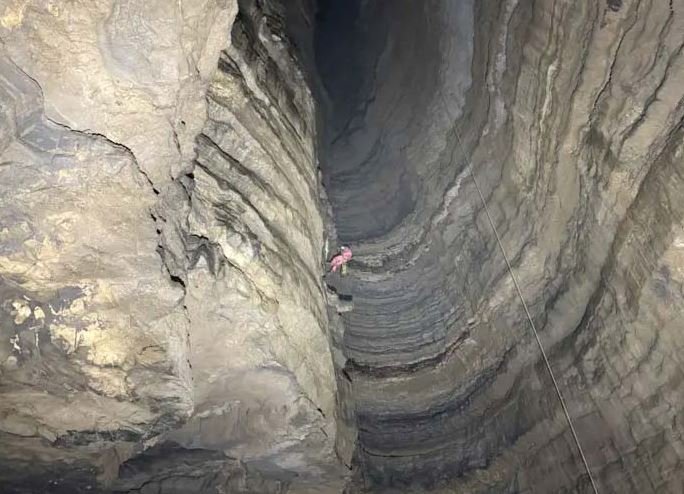
GUIYANG: China’s Shuanghe Cave system in southwest Guizhou Province has expanded to 481.5 kilometres of mapped passages after an international scientific expedition added another 41.8 kilometres and uncovered new fossils, giant panda remains and evidence of ancient climate change.
The latest findings from the 25th international cave scientific expedition were announced in Suiyang County, where researchers said the cave now extends to a vertical depth of 912 metres and has 124 interconnected entrances. Shuanghe Cave is the longest cave system in Asia and the third-longest in the world.
The expansion marks another major step in a 25-year international exploration effort that began with a China-France expedition in 2001. Since then, the known cave network has grown from several dozen kilometres to more than 480 kilometres.
Giant panda fossils add to Shuanghe discoveries
Researchers found nine additional individual giant panda fossils during the latest expedition, raising the total number discovered in Shuanghe Cave to 61.
Most of the new remains were found in recently explored passages.
Scientists also identified two sites containing clear giant panda claw marks.
Wang Deyuan, an associate research fellow at the Institute of Mountain Resources under the Guizhou Academy of Sciences, said the marks and cave structure may help explain how some of the animals died.
According to Wang, the pandas appear to have moved more than 10 metres into the cave before falling into a vertical shaft. Some survived the first fall and left claw marks while attempting to move onward, before becoming trapped after falling into a deeper shaft.
The expedition also uncovered fossils of other ancient animals, including a giant tapir and a clouded leopard. Researchers said both species were identified in Shuanghe Cave for the first time.
Cave preserves clues to ancient climate
Scientists say Shuanghe Cave is significant not only because of its size but also because it preserves evidence of geological, biological and climatic change in southwest China.
Researchers have been using uranium-series dating on calcite deposits to reconstruct past climate conditions.
French caver Jean Bottazzi, who has spent more than two decades exploring the system, said calcite samples of different ages can help produce records of climate change extending back hundreds of thousands of years.
This year, researchers also used uranium-lead isotope dating to determine that some secondary carbonate deposits inside the cave are more than five million years old.
The finding extends the known timeline for the development of Shuanghe Cave and may also improve understanding of other large cave systems in the karst regions of southwest China.
International teams continue mapping underground maze
Bottazzi has been involved in Shuanghe exploration since the early years of the China-France cooperation.
During one recent expedition, his team failed to connect several caves at the northern end of the system but instead discovered a large wall of gypsum crystals.
He described such unexpected discoveries as part of the appeal of cave exploration, where scientific value can emerge even when an original objective is not achieved.
The international research effort has also become a long-running example of scientific cooperation.
Bottazzi said exploration data and cave maps are shared among researchers working on the project.
In recent years, he has settled in Shuanghe Village in Wenquan Township, Suiyang, where local residents know him as “Lao Rang,” or “Old Jean.”
Researchers say the cave’s combination of underground rivers, large chambers, waterfalls, dry fossil galleries and unexplored passages means Shuanghe is likely to remain an important site for future scientific work.