
BEIJING: China’s National Day travel market has opened strongly, with more travelers combining the Mid-Autumn Festival and National Day holidays with annual leave to take longer trips, visit multiple cities and spend more on experience-focused travel.
The extended break is reshaping travel patterns across China, boosting demand for long-haul flights, multi-city itineraries, hotels and immersive attractions while spreading tourism activity over a longer period.
With only three working days separating the Mid-Autumn Festival and National Day holidays this year, some travelers used three days of annual leave to create a 13-day break.
Trip.com Group data showed that about one in 10 travelers combined the two holidays in this way.
Cao Shuai, CEO of Tongcheng Travel’s destination business division, said the longer break had extended the tourism consumption cycle and released more demand for long-distance and in-depth travel.
Multi-city and long-haul travel rise
Data from online travel platform Qunar showed that by October 1, the first day of the National Day holiday, 20% of travelers had already reached the second city on their itineraries.
Nearly 30% had booked hotels in at least two cities, while bookings involving stays in four or more cities increased 53% from a year earlier.
Longer breaks are also encouraging travelers to cover greater distances.
According to Meituan, flight bookings for trips of more than 2,000 kilometres rose 76% year on year during the Mid-Autumn Festival and National Day period, accounting for more than a quarter of total flight bookings.
China Railway said the national rail network handled 25.204 million passenger trips on October 1, setting a new single-day record.
Wang Peng, an associate researcher at the Beijing Academy of Social Sciences, said longer holidays were encouraging people to start trips earlier and spread travel over more days instead of concentrating journeys around a few peak dates.
He said the trend could sustain demand for accommodation, catering and other tourism-related services for longer periods.
Travelers seek more immersive experiences
The increase in mobility is also being reflected in what travelers want to do once they reach their destinations.
At the National Maritime Museum of China in Tianjin, 19,000 visitors entered the museum on the opening day of the National Day holiday.
Among the attractions was “Echoes of the Whale Song,” a full-sensory virtual reality experience in which visitors take part in a simulated rescue of a whale trapped in fishing nets while learning about marine debris.
Similar experience-based products are gaining popularity elsewhere.
Fliggy data showed that domestic attraction ticket bookings on October 1 rose nearly 30% year on year, while the number of users buying products linked to natural scenic areas and villages increased by almost 50%.
Searches on Qunar for immersive performances, fireworks displays and night tours also rose by more than 50% from a year earlier.
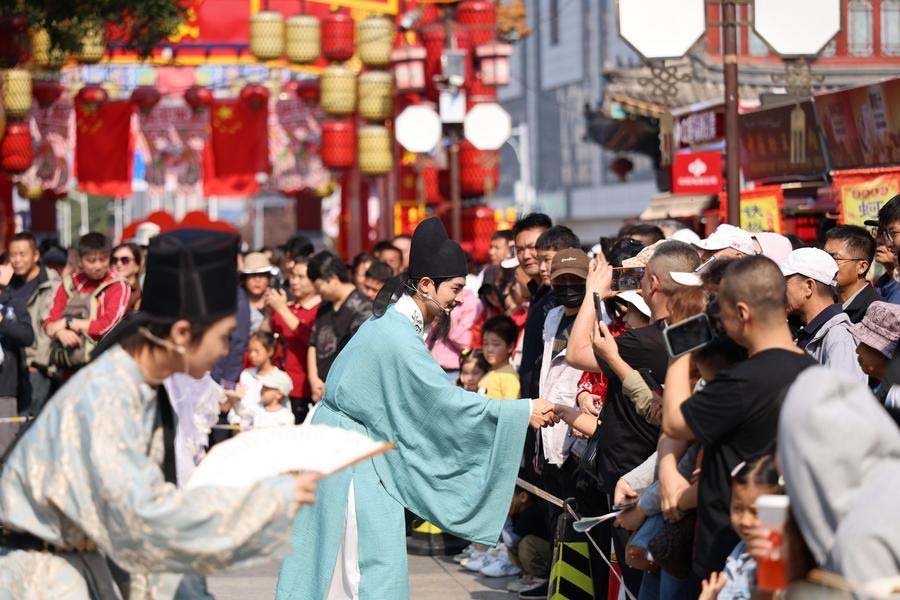
At Changchun Zoological and Botanical Park in Jilin Province, an immersive night show inspired by the Chinese classic “Journey to the West” has drawn large crowds, with costumed performers interacting directly with visitors.
Yang Han, a researcher with Qunar’s big data research institute, said travelers were increasingly looking to “enter a story” rather than simply view scenery.
Tourism shifts from speed to experience
Researchers say the latest holiday trend reflects a broader change in Chinese tourism habits.
Bu Xiting, an associate researcher at the School of Cultural Industries Management at Communication University of China, contrasted the current pattern with earlier trends such as “special forces-style tourism,” which focused on visiting as many attractions as possible in a short period.
By combining public holidays with annual leave, travelers now have more time to plan trips around the quality and variety of experiences rather than simply maximizing the number of places visited.
Bu said tourism consumption is increasingly shifting from “time efficiency” toward greater “experience density.”