
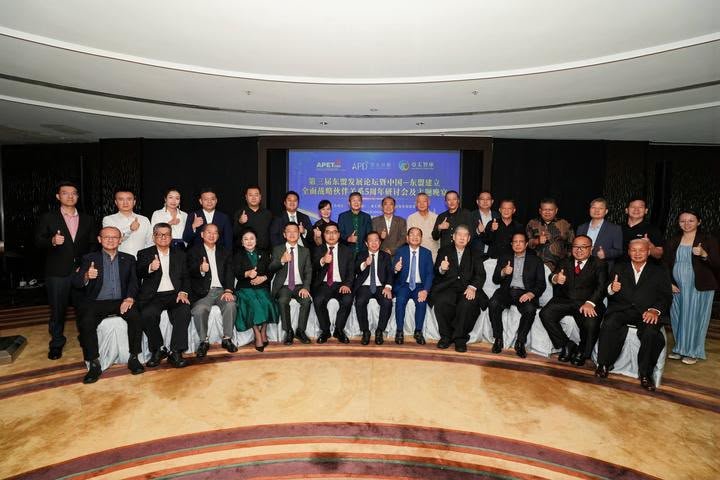
KUALA LUMPUR, November 5, 2026: Regional leaders, business representatives and policy experts gathered in Kuala Lumpur for the Third ASEAN Development Forum, calling for stronger China-ASEAN trade relations, deeper industrial cooperation and greater regional economic integration while emphasising the importance of ASEAN’s independence in international affairs.
The forum, held alongside a seminar marking the fifth anniversary of the China-ASEAN Comprehensive Strategic Partnership, focused on expanding investment, strengthening regional supply chains and translating diplomatic cooperation into practical economic projects.
Organised jointly by Asia Pacific Daily, the Asia-Pacific Think Tank and the Asia-Pacific Economic and Trade Development Alliance, the event also marked 35 years of dialogue relations between China and the Association of Southeast Asian Nations (ASEAN).
Liu Lili, Editor-in-Chief of Asia Pacific Daily, hosted the forum and highlighted the role of media organisations in facilitating dialogue and cooperation between China and ASEAN countries.
She said Asia Pacific Daily would continue serving as a platform connecting regional stakeholders and supporting efforts to turn shared policy objectives into concrete initiatives.
Former Nepalese Prime Minister Jhalanath Khanal sent a congratulatory letter, praising the organisers for creating a platform focused on constructive dialogue, trade cooperation and industrial development.
He said stronger mutual trust and closer economic coordination could help regional countries address common challenges and pursue shared prosperity.
Former Thai Deputy Prime Minister and National Assembly President Pokin Polakul also conveyed congratulations through a video message.
In his written remarks, Polakul emphasised ASEAN’s strategic independence, saying the regional bloc should not become an instrument of major-power competition.
He stressed that ASEAN’s strength lay in bringing together countries with different political systems and levels of development through consultation rather than confrontation.
Former Malaysian Special Envoy to China Tan Kok Wai highlighted the importance of maintaining ASEAN centrality in regional cooperation.

He said stronger coordination among ASEAN member states and respect for ASEAN-led mechanisms by external partners were essential for regional stability and development.
Tan added that closer Malaysia-China relations should contribute to ASEAN unity and generate wider benefits for regional cooperation.
Heng Vuthy, President of the Cambodian National Federation for Trade, Investment and Economic Promotion, called for stronger commercial ties between China and ASEAN.
He identified trade and investment as central pillars of the partnership, saying improved market access, investment flows and supply-chain connectivity could support productivity, employment and economic competitiveness.
Thongloun Ousotthilam, Dean of the Thailand Belt and Road Economic and Education Development Research Institute, said regional cooperation should remain open, inclusive and mutually beneficial despite changes in the international environment.
He argued that ASEAN countries should retain the flexibility to cooperate with different international partners without being forced to choose sides in major-power competition.
The forum also highlighted planned investments in digital trade infrastructure and logistics.
Tian Hengyu, Chairman of China Zhongchi International, announced plans for substantial investment in international digital trade industrial parks and logistics facilities in Hong Kong, Guangdong, Hainan, Thailand and other locations.
He said the proposed projects were intended to reduce barriers to cross-border trade, improve industrial connectivity and support broader economic integration between China and Southeast Asian markets.
Jin Wensheng, Chairman of Asia Pacific Daily, said the Kuala Lumpur forum was designed to connect policymakers and business leaders, facilitate investment partnerships and move regional cooperation from discussions towards project implementation.
He also highlighted the importance of advancing the China-ASEAN Free Trade Area 3.0 framework and developing a more resilient and competitive regional market.
A roundtable discussion examined the future of China-ASEAN relations across political, economic and cultural fields.
Participants included Goh Hin San, Chairman of the Malaysian Chinese Cultural Centre; Hao Jinling, Executive Chairman of the World Chinese Association; Thongloun Ousotthilam; and Koh Keng Chee, Chairman of the Malaysian New Asia Strategic Research Centre.
The discussions explored opportunities for strengthening regional partnerships, expanding economic exchanges and maintaining cooperation amid shifting international conditions.
The event concluded with a networking dinner, where participants continued discussions on trade, investment and cultural cooperation, reaffirming their support for stronger China-ASEAN relations.