
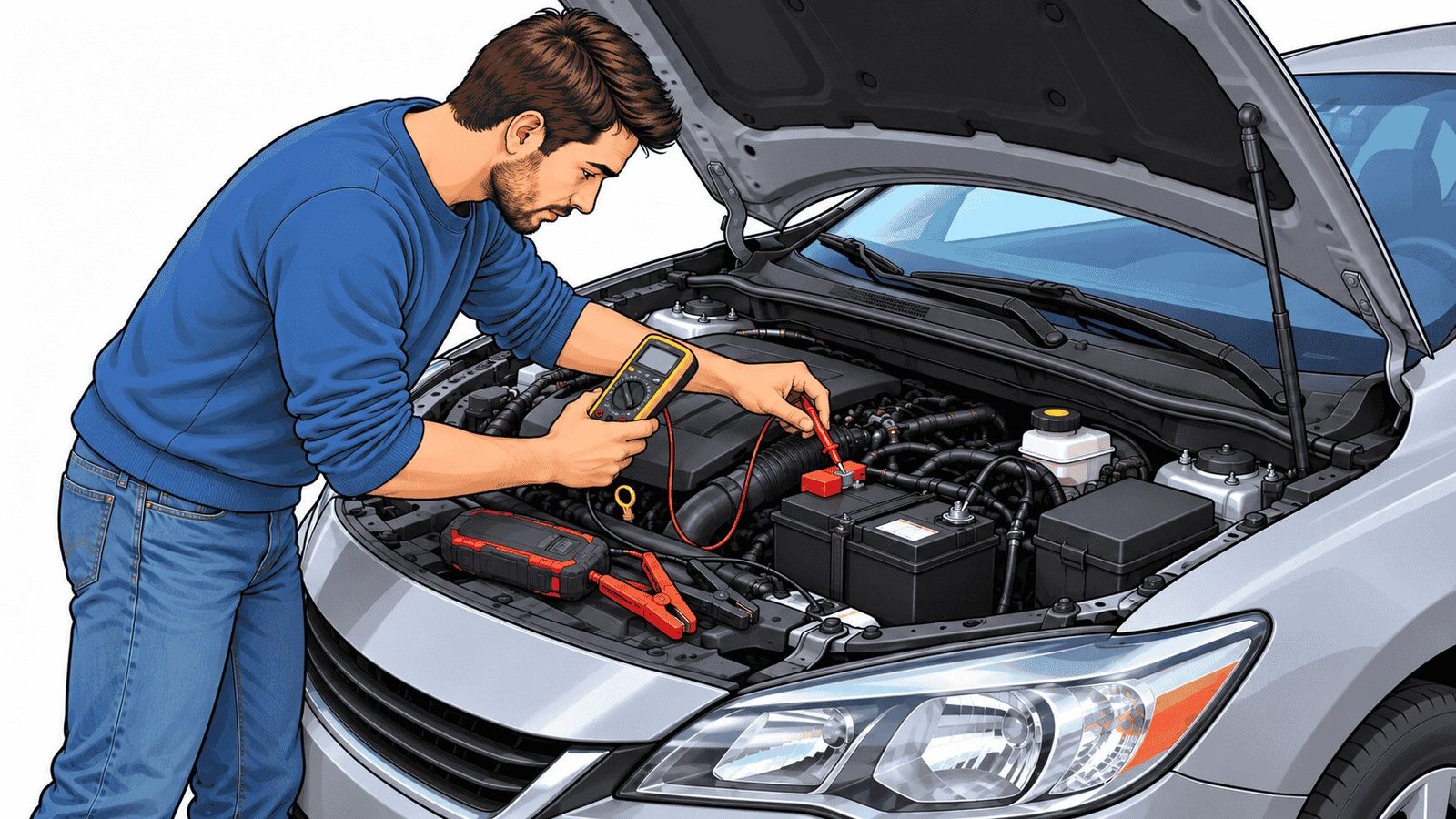
If your car only clicks, cranks slowly or loses all electrical power when you turn the key, do not rush to connect a jump starter.
A discharged battery can cause all three symptoms, but so can loose terminals, a worn battery, a faulty starter or a problem with the charging system. Before connecting any external power source, it is worth checking what has actually failed.
Inspect the Battery First
Open the bonnet and examine the battery casing before trying to start the car again.
Do not attempt a jump-start if the battery is:
- Cracked
- Leaking
- Visibly swollen
- Unusually hot
- Frozen or suspected to be frozen
- Smoking or producing an unusual smell
A damaged battery needs inspection or replacement rather than additional current. If the casing appears normal, move on to the terminals.
Check the Battery Terminals
Even a healthy battery can fail to start the car if the electrical connection is poor.
Check both terminal clamps and make sure they are firmly attached to the battery posts. They should not rotate easily by hand.
Look for white, blue or green corrosion around the terminals and cable ends. Also inspect the battery cables for loose connections or visible damage.
If a terminal is loose or badly corroded, correct the connection before using a jump starter.
Try One Start and Listen to What Happens
Attempt to start the engine once and pay close attention to the sound and electrical response.
| What the car does | What it may indicate |
|---|---|
| Rapid clicking | Low battery charge or poor terminal connection |
| Engine cranks very slowly | Weak battery, discharged battery or poor connection |
| Dashboard lights become very dim | Battery voltage dropping heavily under starter load |
| One solid click while lights remain bright | Starter motor or starter circuit fault |
| No dashboard lights or electrical response | Deeply discharged battery or main electrical connection problem |
| Engine cranks normally but does not start | Fuel, ignition or another engine-related fault |
If the engine is already cranking at normal speed, a jump starter is unlikely to fix the no-start condition.
Avoid repeated starting attempts because each one draws more power from an already weak battery.
Measure Battery Voltage With a Multimeter
A digital multimeter can provide more useful information than dashboard lights alone.
Switch off the engine, lights, air conditioning and other electrical accessories.
Set the multimeter to DC voltage, place the red probe on the positive battery terminal and the black probe on the negative terminal.
For a conventional 12-volt lead-acid starting battery, these readings can be used as a practical guide:
| Resting voltage | What it suggests |
|---|---|
| Around 12.6V or higher | Well charged |
| Around 12.4V | Partially discharged |
| Around 12.2V | Significantly discharged |
| Around 12.0V | Heavily discharged |
| Around 11.9V or lower | Effectively discharged |
Do not measure the battery immediately after switching off an engine that has been running, as recent charging can temporarily raise the voltage.
Normal Voltage Does Not Always Mean a Healthy Battery
A multimeter has limits.
A worn battery may still show an acceptable resting voltage but fail when the starter motor demands high current.
Resting voltage mainly indicates state of charge. It does not fully measure the battery’s ability to start the engine.
If the battery repeatedly struggles despite being charged, it should undergo a proper battery health or load test.
Find Out Why the Battery Lost Charge
Low voltage confirms that the battery is discharged, but it does not explain the cause.
Common reasons include:
- Headlights or parking lights left on
- A cabin or boot light remaining on
- Accessories used while the engine was off
- The vehicle being parked for a long period
A one-off mistake can drain an otherwise usable battery. Repeated discharge requires further investigation.
Check Whether the Alternator Is Involved
The battery supplies the current needed to start the engine. Once the engine is running, the charging system replenishes that energy.
This is why a vehicle can start after a jump and still have an electrical fault.
If the battery repeatedly goes flat after being recharged, the alternator, wiring or charging control system should be checked.
A battery-shaped warning light that remains illuminated while the engine is running also needs attention. It does not automatically mean the battery itself has failed.
Do not replace the battery simply because the vehicle keeps losing charge. The charging system should also be tested.
When a Jump Starter Makes Sense
A portable jump starter may be appropriate when:
- The battery is physically undamaged
- The terminals are secure
- The symptoms point to insufficient battery power
- The battery is discharged
- The jump starter supports the vehicle’s battery voltage and type
- The vehicle manufacturer allows the procedure
Always check the owner’s manual before connecting the clamps.
Some vehicles use dedicated jump-start points under the bonnet, and the battery itself may not be the recommended connection point.
The jump starter’s own instructions are also important because connection sequence, engine-size limits, battery compatibility and low-voltage modes can vary between units.
When You Should Not Use a Jump Starter
Do not connect a jump starter simply because the engine will not start.
Stop if the battery is cracked, leaking, swollen or otherwise damaged.
A jump starter is also unlikely to solve the problem if the engine already cranks normally.
The same applies when the battery appears reasonably charged but the starter produces one strong click. That points more towards a starter or starter-circuit fault than a lack of battery power.
If you are unsure about the battery type fitted to the vehicle, confirm the specification before connecting another device.
What If the Car Starts After the Jump?
Do not assume the problem is solved just because the engine starts.
A successful jump only confirms that additional electrical power helped the starting process.
If the headlights were left on overnight, the reason for the discharge is fairly obvious.
But if the battery went flat without a clear cause, the battery and charging system should be tested.
If the same battery needs another jump shortly afterwards, possible causes include:
- A battery that can no longer hold sufficient charge
- Alternator or charging-system trouble
- Poor battery connections
- An electrical drain while the car is parked
Repeated jump-starts should lead to proper testing rather than becoming routine.
When the Battery Needs Replacement
A battery should not be replaced simply because it discharged once.
Replacement becomes more likely when proper testing shows that it can no longer deliver adequate starting performance or retain charge.
Before fitting a replacement, check the vehicle’s requirements for:
- Battery size
- Terminal orientation
- Capacity
- Cold-cranking specification, where applicable
- Battery technology
Do not choose a battery based only on physical size or price.
What to Check When Buying a Jump Starter
Once you have confirmed that a jump starter is appropriate, make sure the unit is compatible with your vehicle.
Check:
- Supported battery voltage
- Compatible battery type
- Petrol or diesel engine-size rating
- Clamp construction
- Reverse-polarity protection
- Short-circuit protection
- Charge-status indicator
- Procedure for deeply discharged batteries
The highest peak-amp figure on the box should not be the only buying consideration. The better choice is a unit that matches the vehicle and includes clear protection against incorrect connections.
Dead Battery, Bad Battery or Another Fault?
Before using a jump starter, this final check can help narrow the problem:
| What you find | What to do next |
|---|---|
| Battery is cracked, swollen or leaking | Do not jump-start it |
| Terminals are loose or badly corroded | Correct the connection first |
| Battery voltage is low and engine cranks slowly | A jump starter may help |
| Battery voltage looks normal but cranking remains weak | Test the battery under load and inspect the starter |
| Engine cranks normally but does not fire | Diagnose a non-battery fault |
| Battery goes flat again after charging | Test the battery and charging system |
| Battery warning remains on while driving | Diagnose the charging system |
A car that refuses to start does not automatically need a jump.
Check the battery casing, terminals, starting behaviour and voltage first. If those checks point to a safely discharged battery, use the jump starter according to the vehicle and device instructions.
If the battery repeatedly loses charge or the symptoms suggest another fault, identify the electrical problem before replacing parts.