
ISLAMABAD: The Centre for Aerospace & Security Studies (CASS) has highlighted the need for sustained research, industrial collaboration, and policy support to strengthen Pakistan’s indigenous aerospace capabilities amid changing global technology landscapes and supply chain challenges.
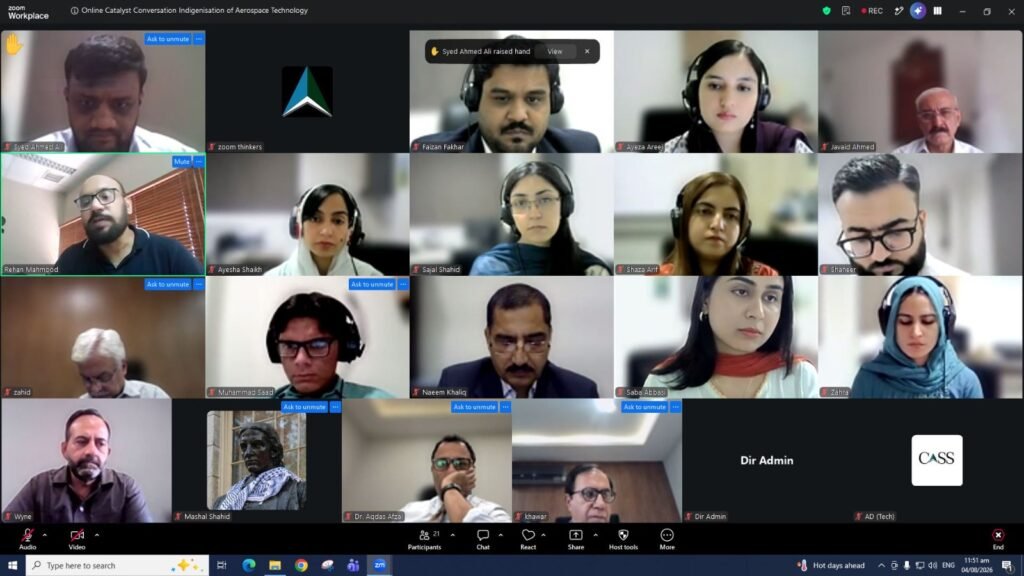
CASS hosted an online Catalyst Conversation on “Indigenisation of Aerospace Technology” on August 4, 2026, bringing together experts to discuss the strategic, technological, and industrial requirements for developing a self-reliant aerospace ecosystem.
The discussion focused on the importance of local research and development, skilled human capital, advanced testing infrastructure, and stronger cooperation between government institutions, academia, and industry.
Experts Highlight Need for Long-Term Aerospace Strategy
Moderating the session, CASS Director Air Vice Marshal Nasser Wyne (Retd.) said developing indigenous aerospace technology should be treated as a long-term national priority.
He stressed the importance of continuous investment in research and development, institutional stability, and coordinated efforts among key stakeholders to build a resilient aerospace sector.
Wyne said technological self-reliance requires consistent policy support, investment in expertise, and a realistic roadmap aligned with national objectives.
Pakistan Needs Stronger Aerospace Research Ecosystem
Delivering the keynote address, Dr Rehan Mahmood, Director of the Institute of Space Technology (IST) and Assistant Professor of Satellite Technology and Communication Engineering, said Pakistan has the talent and strategic motivation required to advance its aerospace capabilities.
He identified sustained research and development, specialised suppliers, testing facilities, and dedicated aerospace companies as key areas requiring further strengthening.
Dr Mahmood said successful technology development depends on building strong institutions rather than relying on individual projects. He advocated a controlled indigenisation approach that balances capability development with operational requirements.
He added that technology partnerships, procurement decisions, and transfer agreements should contribute to national learning by enabling Pakistan to develop capabilities in repairing, testing, modifying, documenting, and eventually exporting aerospace components.
The expert also called for developing a network of specialised subsystem suppliers and adopting a phased localisation strategy focused on technologies with faster learning cycles while maintaining long-term goals for advanced capabilities.
CASS Calls for Public-Private Collaboration
In his closing remarks, CASS President Air Marshal Javaid Ahmed (Retd.) said indigenous aerospace capability is vital for strengthening Pakistan’s technological resilience and strategic independence.
He emphasized that sustained institutional commitment, coherent industrial policies, and stronger collaboration between public and private sectors are essential for building a competitive aerospace ecosystem capable of supporting both defence and civilian needs.
The session formed part of CASS’s ongoing efforts to facilitate informed discussions on strategic, technological, and national development issues.
Also Read: CASS Lahore Discusses India’s Strategic Culture, Ideological Shifts and Regional Security Challenges