
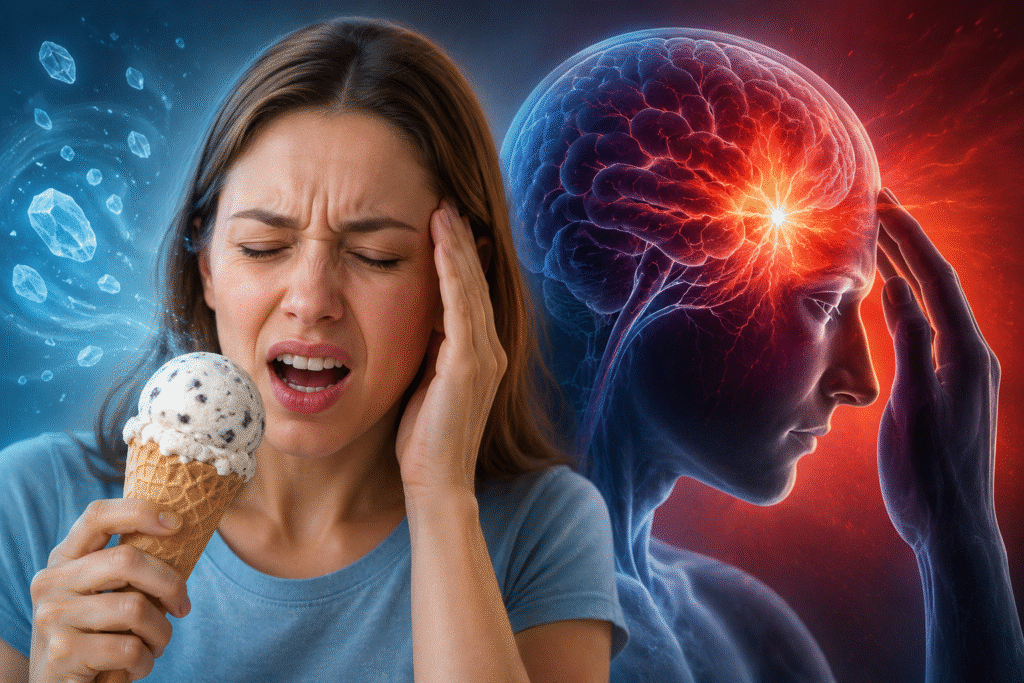
Ice cream headaches, commonly known as brain freeze, are usually harmless and short-lived, but researchers say they may offer insights into a person’s broader headache health, particularly the risk of migraines.
A brain freeze occurs when cold food or drinks rapidly cool the roof of the mouth or the back of the throat, triggering a sudden, sharp headache. Neurologists say the sensation is caused by rapid changes in blood vessel size, which activate the trigeminal nerve responsible for transmitting pain signals from the face and forehead.
According to researchers, brain freeze is one of the most common types of headaches and typically resolves on its own within seconds or minutes. While the condition is not considered dangerous, studies suggest some people may be more susceptible than others.
Research reviewed by scientists at the University of Padua in Italy found evidence that brain freeze may run in families. Multiple studies conducted in countries including Taiwan, Germany and Canada indicated that people whose parents experience ice cream headaches are more likely to develop them as well.
Researchers also found a notable connection between brain freeze and migraine disorders. Studies suggest that people who suffer from migraines are more likely to experience ice cream headaches and often report more intense pain when they occur.
Neurologists believe this link may be related to increased sensitivity of the trigeminal nerve, which plays a central role in both migraine attacks and cold-stimulus headaches. Because both conditions involve similar pain pathways, scientists have used brain freeze as a model to better understand how migraine-related pain develops.
Link to migraine research
For decades, researchers have intentionally induced brain freeze in volunteers to study headache mechanisms. Unlike migraines, which can occur unpredictably, cold-stimulus headaches can be triggered on demand using ice water, ice chips or frozen foods.
This has allowed scientists to observe how blood vessels and nerves respond during headache episodes, helping improve understanding of migraine biology. Researchers say these studies contributed to early discoveries about the role of blood flow and nerve activation in head pain.
Although newer migraine research methods are now available, experts say brain freeze remains a useful example of how the nervous system responds to sudden temperature changes.
When to seek medical advice
Health experts say occasional brain freeze is generally nothing to worry about. However, people who frequently experience severe ice cream headaches may benefit from discussing their overall headache history with a healthcare professional, particularly if they also experience recurring migraines or unexplained headaches.
Doctors recommend slowing down when consuming very cold foods and drinks to reduce the likelihood of brain freeze. Warming the roof of the mouth, such as by pressing the tongue against it or drinking something warm, may help shorten an episode once it begins.
Researchers emphasize that people who experience migraines do not need to avoid ice cream or other frozen treats entirely. Instead, they suggest eating and drinking cold items more gradually to reduce the chances of triggering discomfort.