
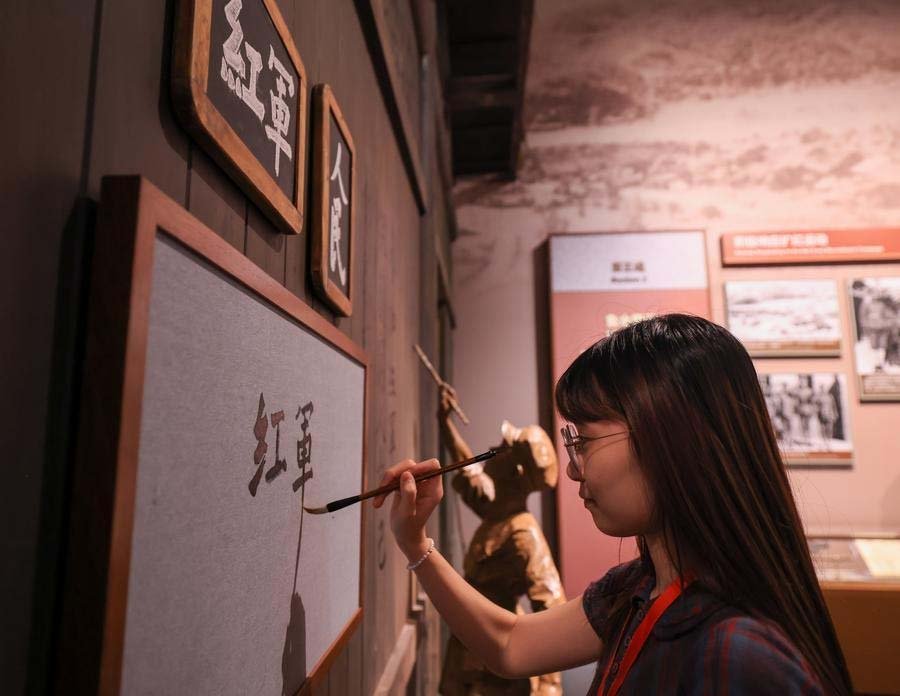
BEIJING: More than 300 artifacts and historical documents linked to China’s Long March are being displayed publicly for the first time at the Military Museum of the Chinese People’s Revolution, as the country marks the 90th anniversary of the campaign’s victory.
The exhibition brings together newly shown manuscripts, personal belongings, military items and historical records that shed fresh light on the Long March, the 1934-1936 military campaign that helped preserve the Red Army and reshape the course of the Communist Party of China.
The Long March covered roughly 12,500 kilometres and ended in October 1936 when major Red Army forces regrouped in northwest China after breaking through Kuomintang encirclement.
New manuscripts reveal frontline experiences
Among the most notable exhibits are handwritten and oral-history manuscripts describing battles, radio communications, daily life and other experiences from the journey.
One manuscript recounts how a division tried to hold back opposing forces at the Xiangjiang River in late 1934.
Historical records show the Central Red Army emerged from that campaign with just over 30,000 troops, down from more than 86,000 at the start of the Long March.
Museum curators said the newly displayed material, along with personal belongings of those killed in battle, provides additional source material for research into key military episodes.
Artifacts show extreme conditions faced by soldiers
The exhibition also highlights the severe conditions faced by Red Army soldiers as they crossed snow-covered mountains and marshlands.
Items on display include a thin blue coat, a knitted blanket, a fire-starting tool and a first-aid pouch used during the journey.
According to exhibition material, the main forces of the Red Army crossed more than 20 snow-covered mountains above 4,000 metres.
The route also passed through hundreds of kilometres of marshland, where soldiers faced illness, starvation, poisonous plants and dangerous terrain.
Among the newly displayed artifacts are half of a belt, with the missing portion reportedly eaten by a soldier, a fishing line used to catch food and straw sandals reinforced with cloth.
Objects also highlight ties with local communities
Other exhibits focus on interactions between Red Army troops and people living along the route.
They include a tablecloth given by Mao Zedong to a member of the Miao ethnic group in Guizhou, a volleyball left behind in Sichuan, and goggles presented to a local guide in Yunnan.
Black ramie cloth, scissors and a porcelain bowl are also among items linked to local communities that assisted soldiers during the march.
The museum says such objects help illustrate how the Communist Party and Red Army sought to build relations with local populations.
Exhibition spans more than 3,000 square metres
The exhibition covers about 3,300 square metres and includes 875 artifacts and sets, 186 historical documents, 357 photographs and charts, and 73 artworks.
In total, 1,061 individual items and sets are on display.
The exhibition also recreates major episodes from the Long March, including the seizure of Luding Bridge, the battle at Lazikou Pass and the 1935 Zunyi Meeting in Guizhou.
The museum previously held major Long March exhibitions in 1996, 2006 and 2016.
For the first time, the current exhibition includes English-language descriptions and will remain part of the museum’s permanent display.