
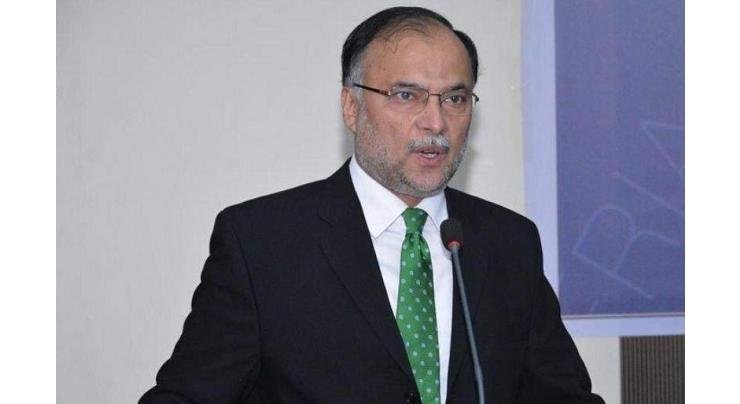
ISLAMABAD, October 19, 2026 (APP): Federal Minister for Planning, Development and Special Initiatives Professor Ahsan Iqbal has unveiled a strategy to increase Pakistan’s exports to $100 billion under the government’s Mission $100 Billion initiative, calling for export-oriented industrial clusters and stronger integration with global supply chains.
Addressing the 39th Annual Conference of the Pakistan Society of Development Economists (PSDE) at the Pakistan Institute of Development Economics (PIDE), the minister said Pakistan must develop an economy capable of generating its own resources, financing sustainable growth and making independent decisions about its economic future.
He said the government’s Uraan Pakistan initiative would focus on eight priority sectors to strengthen productivity, expand exports and reduce dependence on external financing.
Pakistan’s exports lag behind regional economies
Highlighting Pakistan’s export performance, Ahsan Iqbal said the country exported approximately $32.3 billion worth of goods in calendar year 2024, significantly below several competing Asian economies.
He noted that Bangladesh recorded merchandise exports of $47.2 billion, Malaysia $330.4 billion and Vietnam $404.8 billion during the same period. The figures excluded services exports.
The minister stressed that Pakistan must improve productivity and international competitiveness while maintaining macroeconomic stability to overcome persistent pressure on its external payments.
He said a sustainable economic model should enable Pakistan to finance its development through domestically generated resources rather than remain dependent on external support.
Eight priority sectors under Uraan Pakistan
Outlining the export expansion strategy, Ahsan Iqbal identified eight sectors that would receive particular attention under Uraan Pakistan.
These include agriculture, industry and manufacturing, services, information technology, mining, human resources and skills development, the blue economy, and creative industries.
He said export growth would require specialised industrial clusters connecting manufacturers with suppliers, skilled workers, universities, research laboratories, financial institutions, transport networks and international buyers.
According to the minister, these clusters should be designed around the requirements of global markets rather than domestic production capabilities alone.
Investment, workforce training, infrastructure development and quality standards must also be aligned with international demand to help Pakistani businesses compete more effectively.
CPEC’s next phase offers export opportunities
Ahsan Iqbal said Pakistan’s deeper integration into global supply chains could improve the capabilities of local suppliers, increase the value of Pakistani products and generate new employment opportunities.
He highlighted the potential of the next phase of the China-Pakistan Economic Corridor (CPEC), particularly opportunities to connect existing infrastructure and special economic zones with export-oriented manufacturing.
The minister said these linkages could help Pakistan strengthen its industrial base and improve access to international markets.
PIDE urged to develop practical export plans
Ahsan Iqbal called on PIDE researchers and conference participants to prepare actionable proposals for developing export clusters and strengthening production value chains.
He said the proposed plans should clearly identify priority products, target export markets, productivity gaps, responsible institutions, financial requirements and implementation timelines.
The minister also emphasised the importance of independent economic research capable of critically examining government assumptions and improving policymaking through evidence-based recommendations.
He said academic institutions and economic researchers had an important role to play in identifying practical solutions to Pakistan’s structural economic challenges.
Export growth must improve jobs and living standards
Concluding his address, Ahsan Iqbal said the success of Mission $100 Billion should not be measured solely by an increase in export earnings.
He stressed that the ultimate objective must be to improve employment opportunities and raise living standards across Pakistan.
The minister said building a competitive, export-driven economy would be essential for achieving long-term economic independence and generating the resources needed for sustainable national development.