
By Colonel (R) Sayed GB Shah Bokhari
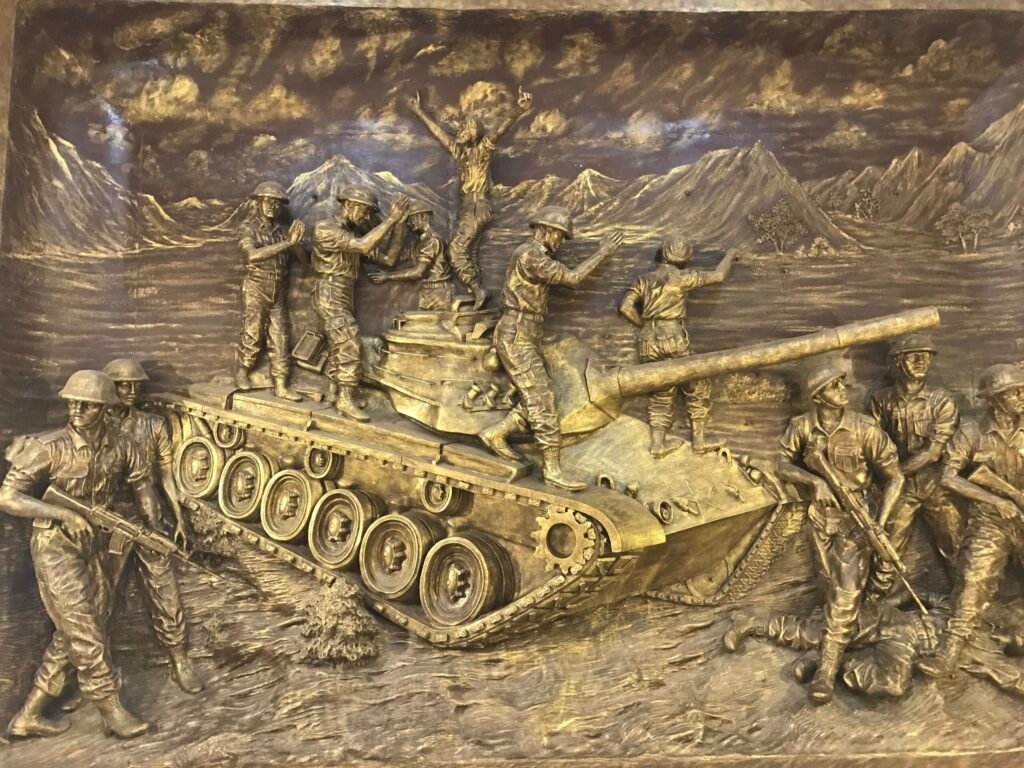
It is nearing midnight September 9, (1965), location Chawinda, a village near Sialkot. Indian and Pakistani forces are locked in the biggest post-World War II Tank battle. I am perching on a stool before a Battle Map, in my bunker, browsing over the ongoing battle situation, when I received a message from my Commanding Officer, Lt Colonel Mohammad Amin through Dispatch Rider, Sepoy Payo Jaan. The message, inter alia, reads:- “Captain Bokhari! GHQ has instructed us to rush up to Islamabad, one captured Indian tank. The tank must reach Gujranwala Railway as soon as possible, for onward journey by rail to the Capital.”
A thought flashed across my mind, that the government must have come up with the idea of displaying an Indian trophy in Islamabad, to prove Pakistan was on the winning side of the War. An Indian tank for public display in the serene ambient of Islamabad would definitely upswing morale of the nation, I pondered.
Searching for an Indian tank in the battle field was no problem. In the previous four days of battle our 6 Armoured Division, under the heroic command of Major General Abrar Hussain (later awarded Hilal-e-Jurrat) had turned the area into junkyard of damaged tanks, the Indian tank conspicuous by their outnumbers.
During the search my mission was to pick a piece, least damaged and the formation insignia, and other Indian markings conspicuously visible. With my battle torch that beamed out barest minimum light, and with four Jawaans the search begins. The flashes emanating from descending shells catapulted by the Indian artillery guns lit the area casually that facilitated the search. Going from one destroyed tank to another, I finally picked one British-made Centurion tank in almost show case condition, slightly pock marked by Pakistani-fired medium machine gun bullets. On this tank Indian Army marking were fully intact. The condition of the tank made me perceive; the Indian tank crew had abandoned this tank in the face of unprecedented resistance from Pakistani forces.
It was, indeed, a novelty to retrieve a destroyed arsenal in the thick of an ongoing battle. The retrieval operation had become knotty. The terrain had become difficult to negotiate. The Indian guns disgorging artillery shells of various caliber had caused deep craters on the ground, besides raising a permanent film of blinding dust; the metal chains of opposing tanks going in pursuit of each other had literally furrowed the surface; darkness of the night was another factor to hinder our operation. Consideration for personal safety against crisscross fire or cluster of bolts raining from the blue, had become of no consequence.
Working my way with the assistance of an ARV (Armoured Recovery Vehicle), night September 9-10, we dragged the Indian tank to a clump of trees in the nearby Pasroor graveyard. When we finally loaded the tank over a tank-transporter of the famous 22 Supply and Transport Battallion, ASC, the new day September 10 was about to dawn. It was an ideal time for the Indian Gnat aircrafts,then hovering over the sky, to shoot at an unusually conspicuous target, a tank perched over a giant tank-transporter; albeit, not knowing the “target” was their own arsenal. Interestingly, in the last four days of the battle we learnt by experience, that after dawn the Indian aircrafts seldom revisited the Pakistani air space for fear of a dog fight with Pakistani shaaheens.
Our journey from the Chawinda battle field to the Gujranwala railway station begins at 8 am. My Willy’s jeep leading as vanguard and the captured Indian Centurian tank perched over a huge tank-transporter vehicle following me, cruised on the mettle road that linked Pasroor with Gujranwala.
The stretch of a short journey spanning over a mere 40 miles, soon turned out to be a historical event highlighting the extraordinary fighting spirit of the Pakistani nation. The civilian population who lived in the vicinity of the Pasroor-Gujranwala Road had not seen, since September 6, flow of military vehicles homeward: the specific route earmarked for replenishment of supplies for War soldiers was another one. Surprisingly, our vehicle movement backwards from the battlefield, did not seek unusual attention from the surrounding population.
Equipped with anti-aircraft weapons our eyes were set on the sky to encounter any of the Indian aircraft that may swoop on us. The journey was smooth. Nonetheless, one disclosure by the Mujahid guarding a bridge which our convoy was to go over, changed the scenario. Before going over the bridge, we stopped. I disembarked from my jeep to assess if the bridge could bear the heavy combined weight of a tank and a transporter? In the meantime, the inquisitive Mujahid guard at the bridge learnt from my Bengali driver, Lance Naik Abu Islam Laskar that the tank was a captured piece from Indian forces. In a state of ecstasy, the Mujahid shouted slogans “Pak Army Zinda baad “and at the top of his voice, as a breaking news, announced, publicly, the presence of the Indian tank. The news spread like wild fire, attracted villagers from around the Road. In their jubilation, the crowd stopped our convoy, raised national slogans and forcibly hugged us all soldiers; some enthusiast climbed the Indian tank and thrashed its steel body with bare hands and slippers. I had to intervene to stop the crowd from causing damage to the captured trophy. Perforce our convoy had to inch the remaining journey to Gujranwala.
Imagine the national spirit of the population; the teeming crowd paced with our convoy until we reached Gujranwala railway station. Just, at the entrance of the Gujranwala town it appeared the entire local population had come out to welcome us leading a captured Indian tank. Security notwithstanding, the crowd broke out and, in frenzy, pulled out each of our soldiers from the vehicles, hugged and garlanded them from the ear-lobes down to the chest.
At the Gujranwala railway station, in the presence of eye-bulging teeming crowds, the Indian tank was loaded on an EVK wagon, while a special locomotive pulled it to its destination, Islamabad.
Back in the Chawinda battlefield, narration of our experience of the journey to Gujranwala, regaled our battle-inoculated comrades-in-arm, who felt assured of strong backing of everyone in Pakistan.
The writer was a Captain during 1965 War. He, after retirement, served as Director (Public Relations) WAPDA, Editor of an English daily Frontier Post, Member Federal Board of Film Censor, Islamabad and contributed articles in English, Urdu, Pashto to leading local/ international newspapers/ magazines and, regularly, appeared on Radio/TV talk shows. He can be contacted on 03009599392 and northpole716@gmail.com.