
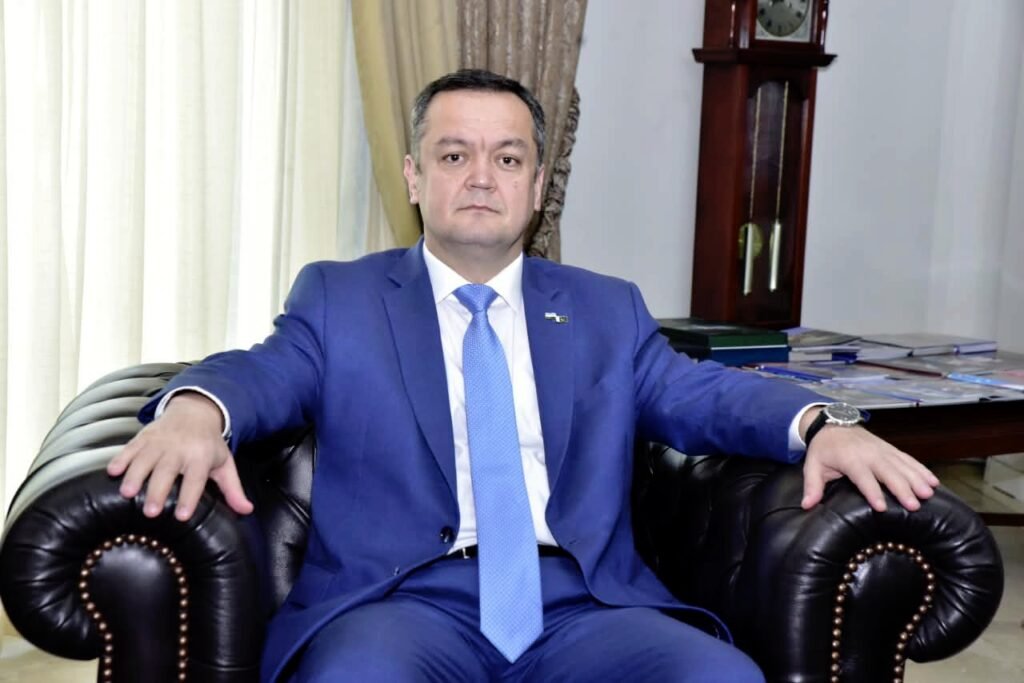
Interview by Adnan Arif
Uzbekistan’s Ambassador to Pakistan, Alisher Tukhtayev, in an interview with The Public Purview, discussed the outcomes of Uzbek President Shavkat Mirziyoyev’s state visit to Islamabad on February 5–6, 2026, and the evolving dynamics of Pakistan–Uzbekistan cooperation at bilateral and multilateral levels. The ambassador also highlighted key priorities, ongoing developments and future prospects in trade and economic cooperation, transport and logistics, tourism, and defence.
Q: President Shavkat Mirziyoyev’s February 2026 visit marked a significant expansion of bilateral cooperation, with numerous agreements signed across key sectors. Nine months later, which agreements have produced tangible results, and what are Uzbekistan’s immediate priorities for the next phase of relations with Pakistan?
First and foremost, it should be emphasised that President Shavkat Mirziyoyev’s state visit to Pakistan marked the beginning of a new stage in bilateral relations. Most importantly, the leaders of the two countries agreed on a clear roadmap for elevating their relations to the level of a strategic partnership.
As I have noted in previous interviews, this was indeed a historic visit. Naturally, the question arises as to what practical outcomes this visit has produced.
First and foremost, the state visit served to further strengthen the bonds of friendship and solidarity between Uzbekistan and Pakistan. In particular, it gave fresh impetus to the development of regular, trust-based political dialogue between our leaders.
During the visit, a Joint Declaration was signed by the President of Uzbekistan and the Prime Minister of Pakistan. In addition, more than thirty bilateral documents were adopted in the presence of the two countries’ leaders. This clearly demonstrates the effectiveness and significance of the visit. Important agreements were also reached in the areas of trade and investment.
Cooperation between our peoples in culture, the arts and science is also developing rapidly. This, in turn, is helping to further strengthen people-to-people diplomacy.
Most importantly, a clear target has been set for expanding trade and economic cooperation: increasing bilateral trade turnover to USD 2 billion within five years.
Today, our main focus is on translating these agreements into practical action. In particular, regular meetings are being held between the relevant ministries, agencies and business communities of the two countries. During my meeting in August 2026 with His Excellency Tariq Fatemi, Special Assistant to the Prime Minister of Pakistan on Foreign Affairs, we discussed the implementation of the signed documents, as well as priorities in the areas of trade, investment and transport. Negotiations continued in September and October with Pakistani officials responsible for industry and manufacturing.
Our main task at the next stage is to achieve practical results under each of the signed documents, establish new joint ventures, increase bilateral trade turnover and create favourable conditions for businesses in both countries.
Q: During your recent meeting with the Special Investment Facilitation Council (SIFC), discussions covered investment opportunities in textiles, food processing, agriculture, real estate and Special Economic Zones. Which sectors are attracting the strongest interest from Uzbek investors, and can we expect specific joint ventures or investment announcements in the near future?
The economies of Uzbekistan and Pakistan have considerable potential to complement one another. Therefore, I believe that we have broad opportunities for developing cooperation in the investment sector.
The interest of Uzbek entrepreneurs in Pakistan is primarily focused on textiles, food processing, agriculture, pharmaceuticals, the chemical industry, real estate and special economic zones.
In particular, Pakistan’s experience in cotton production, textiles and the food industry is of considerable interest to Uzbekistan as well. At the same time, I believe that the opportunities Uzbekistan has developed in manufacturing, processing and the export of finished products are equally attractive to Pakistani investors.
As you rightly mentioned, on November 10 this year, we held a productive meeting with the leadership of Pakistan’s Special Investment Facilitation Council (SIFC). The discussions were focused primarily on concrete objectives. In particular, we explored investment opportunities in textiles, food processing, agriculture, real estate and special economic zones.
Our objective is not merely to hold negotiations, but to translate them into concrete investment projects.
At present, a number of proposals and areas of cooperation aimed at implementing investment projects are under consideration. Business communities in Uzbekistan and Pakistan are actively working to develop mutually beneficial projects and bring them to fruition.
Q: Both countries have committed to increasing bilateral trade to $2 billion within five years, while the proposed Trans-Afghan Railway remains a major connectivity priority. What concrete steps are being taken to achieve this trade target, and how can both countries overcome transit and security challenges in Afghanistan?
Indeed, increasing trade turnover between our countries to USD 2 billion will require considerable effort and the mobilisation of substantial resources and opportunities. Nevertheless, this is an achievable goal.
As is known, at the end of 2025, bilateral trade turnover between Uzbekistan and Pakistan amounted to approximately USD 500 million. This means that our main task is to increase this figure several times over.
In this regard, particular attention is being paid to expanding the list of goods covered by the Preferential Trade Agreement between the two countries. This will provide our exporters with opportunities to access new markets.
We also intend to increase exports from Uzbekistan to Pakistan of textile products, fruit and vegetables, food products, chemicals and industrial goods. At the same time, we seek to expand imports from Pakistan of pharmaceutical products, textile raw materials, rice, seafood and other commodities.
Furthermore, efforts to strengthen direct contacts between entrepreneurs from the two countries will continue, alongside the organisation of business forums, exhibitions and trade missions.
At the same time, certain challenges continue to hinder the growth of bilateral trade. In particular, the closure of the borders with Afghanistan for more than a year has become a serious obstacle. This is because the principal export goods transported from Uzbekistan to Pakistan, and vice versa, are delivered by road through Afghan territory. This route is considerably more convenient in terms of both distance and transportation costs.
Of course, trade can also be conducted by air. However, air freight is significantly more expensive for businesses, and this option is not always economically viable.
For this reason, we are working together with our partners to establish alternative transport routes. We hope that concrete developments in this regard will emerge in the near future.
As for transport and logistics, the Trans-Afghan Railway project is of strategic importance to Uzbekistan. This railway could provide Uzbekistan with access to Pakistan’s seaports through Afghan territory.
Under the project, a railway line is planned from Termez to Harlachi in Pakistan via Mazar-i-Sharif and Kabul. In February 2026, Uzbekistan ratified a trilateral agreement on the preparation of the feasibility study for this railway. This means that the project’s technical and economic assessment has entered an important stage.
Throughout this process, Uzbekistan’s approach is focused on ensuring peace and stability in Afghanistan and integrating the country into regional economic processes.
Q: Pakistan’s Air Chief recently held high-level meetings with Uzbekistan’s defence leadership, focusing on joint exercises, professional exchanges and emerging technologies. How does Uzbekistan view the future of defence cooperation with Pakistan, and which areas could see practical progress following these discussions?
Cooperation in the fields of security and defence also occupies an important place in relations between Uzbekistan and Pakistan.
Our two countries are united not only by historical and cultural affinity, but also by a shared commitment to ensuring regional peace, stability and security.
The visit to Uzbekistan in November this year by the Commander of the Pakistan Air Force, Air Chief Marshal Zaheer Ahmad Babar Sidhu, and his meetings with the leadership of Uzbekistan’s defence sector helped take our cooperation to a new level.
During the negotiations, the parties discussed the development of military cooperation, the exchange of experience, the conduct of joint exercises, the training of specialists and the expansion of ties in the field of modern technologies.
We are committed to developing cooperation in this area primarily on the basis of mutual trust and respect for the national interests of both countries.
At the same time, there are broad opportunities for cooperation in the use of modern technologies and the enhancement of the professional skills and qualifications of military personnel.
Most importantly, such ties should contribute to strengthening peace and stability in our regions.
Q: Uzbekistan is becoming an increasingly attractive destination for Pakistani tourists, particularly for religious and cultural visits to Samarkand and Bukhara. With Uzbekistan Airways announcing additional Islamabad flights from October 26, what further steps are planned to improve air connectivity, ease travel requirements and encourage more Uzbek tourists to visit Pakistan?
Alongside other areas of cooperation with Pakistan, we are paying particular attention to tourism. After all, Uzbekistan and Pakistan possess tremendous potential and opportunities for mutually beneficial cooperation in this sector.
Uzbekistan is becoming an increasingly attractive tourist destination for Pakistanis. It is also worth noting that a simplified visa regime for tourists has been introduced between the two countries.
We support efforts to increase tourist exchanges and further expand cooperation among tour operators, hotel owners and businesses operating in the tourism sector as a whole.
Both Uzbekistan and Pakistan have considerable potential for developing tourism and attracting foreign visitors. As one of the major centres of Islamic civilisation, Uzbekistan has become an important destination for religious and pilgrimage tourism among Pakistanis, thanks to its ancient historical monuments and rich spiritual heritage.
Pakistanis also hold in high regard the legacy of our great scholars and religious figures, such as Abu Rayhan al-Biruni, Imam al-Bukhari, Imam al-Tirmidhi and Bahauddin Naqshband.
Alongside the unique historical monuments of our ancient cities, including Bukhara, Samarkand, Khiva, Shakhrisabz and Tashkent, the numerous pilgrimage sites in other regions of our country could also generate considerable interest among Pakistani tourists. From this perspective, developing transport links between the two countries is of particular importance.
The expansion of air services between Uzbekistan and Pakistan has been one of the important steps towards developing tourism. In particular, starting October 26 this year, Uzbekistan Airways, the national airline, increased the frequency of flights on the Tashkent–Islamabad–Tashkent route from twice to three times a week. In addition, flights are also operated on the Tashkent–Lahore and Tashkent–Karachi routes.
Overall, nine direct flight services have been launched between Uzbekistan and Pakistan over the past two years. As a result, nearly 20,000 tourists from Pakistan visited Uzbekistan in 2025. By the end of 2026, this figure is expected to approach 30,000.
Officials in the sector emphasise that we have considerable opportunities to jointly promote tourism products and services and implement collaborative projects in this area. In short, developing tourism ties between our countries has become one of the important items on our bilateral agenda.
Q: Looking ahead to 2027, which three areas of Pakistan–Uzbekistan cooperation do you believe offer the greatest potential for measurable progress, and what specific outcomes would you like to see achieved during your tenure as ambassador?
In my view, in 2027, the greatest potential for practical cooperation between Uzbekistan and Pakistan will be concentrated in three key areas. These are trade and investment; transport and regional connectivity; and tourism, education, and cultural and humanitarian ties.
My primary objective as Ambassador is to further enrich the strategic partnership between Uzbekistan and Pakistan with tangible practical results.
In particular, I consider it an important task to achieve concrete progress in increasing trade turnover between our two countries and opening up new markets for our exporters; facilitating the launch of new investment projects and joint ventures involving businesses from Uzbekistan and Pakistan; expanding transport and logistics opportunities and advancing the Trans-Afghan Railway project; developing air connectivity, tourism and pilgrimage travel; and strengthening exchanges in education, science, culture and youth affairs.
I am confident that the cordial relations, political trust and mutual interest established between the leaders of our two countries will continue to elevate our cooperation to even higher levels in the future.