
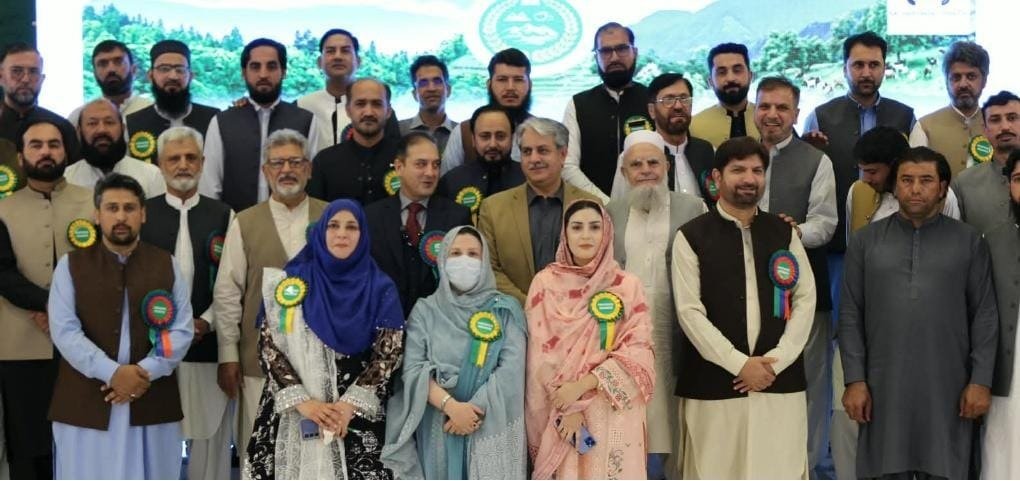
SWAT : The University of Agriculture Swat (UoAS) hosted the second International Conference on Climate-Resilient Mountain Agriculture (CRMA-26), bringing together around 350 researchers, academics, students, farmers, policymakers and development partners to discuss sustainable agriculture and the growing challenges posed by climate change in mountainous regions.
The three-day conference received 107 abstracts for online and in-person presentations and featured experts and participants from Kyrgyzstan, Tajikistan, Australia, Canada, the United Kingdom, the United States, Germany, China, Türkiye, Malaysia and the United Arab Emirates.
Representatives associated with the Aga Khan Rural Support Programme, the Food and Agriculture Organisation of the United Nations (FAO) and the International Centre for Integrated Mountain Development (ICIMOD) also contributed to the discussions.
Speaking at the inaugural session, Vice-Chancellor and chief organiser Prof Dr Dawood Jan welcomed the participants and highlighted the importance of research and innovation in addressing the impacts of climate change on mountain agriculture.
Conference organiser Prof Dr Mohammad Jamal Khan outlined the objectives and thematic areas of the event, stressing the need to strengthen agricultural research and promote sustainable development in mountainous regions.
Commissioner Malakand Division Iqbal Hussain, the chief guest, appreciated the university’s efforts and assured administrative and institutional support to transform it into a centre for problem-oriented research.
He emphasised the need for practical, research-based solutions to challenges faced by mountain communities. During an online presentation, he also discussed water resource management, flood-related challenges and the importance of strengthening climate resilience across the region.
The scientific sessions covered climate change adaptation, resilient farming practices, soil fertility management, soil and plant health, sustainable crop production and innovative approaches to improving mountain farming systems.
Participants exchanged research findings and practical experiences, with discussions focusing on translating scientific knowledge into practical measures that could improve agricultural productivity, protect natural resources and strengthen the resilience of mountain communities.
The conference was organised with support from the Higher Education Commission, FAO, HBL Microfinance Bank in Mingora, district and divisional administrations, the Khyber Pakhtunkhwa Agriculture Department, the Agricultural Research Institute in Mingora and other partner organisations.
The concluding ceremony was attended by Additional Deputy Commissioner Upper Swat Muhammad Amir Khan and Majeed Ullah, among others.
Prof Dr Mohammad Jamal Khan reviewed the conference’s activities and achievements and acknowledged the contributions of the organising committee, faculty, university staff, students and partner institutions.
In his closing remarks, Prof Dr Dawood Jan thanked the participants and collaborators and called for stronger research networks, institutional partnerships and joint initiatives to address emerging challenges in mountain agriculture.
Shields and certificates were presented to organisers and contributors in recognition of their services.
The conference concluded with renewed emphasis on collaborative research, sustainable agricultural development and practical solutions to improve the livelihoods of communities facing climate-related risks in Pakistan’s mountainous regions.