
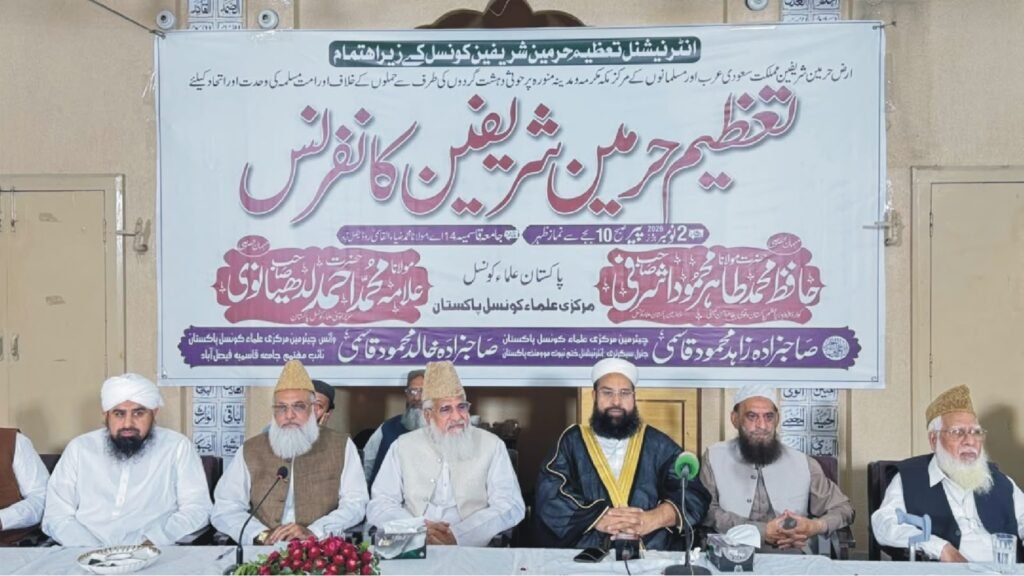
FAISALABAD, November 2, 2026: Religious scholars and spiritual leaders have reaffirmed their support for Pakistan’s defence cooperation with Saudi Arabia, declaring the protection of the Two Holy Mosques a collective responsibility of the Muslim world and expressing confidence in the country’s military leadership.
The declaration came during the Conference on the Sanctity of the Two Holy Mosques, organised at Jamia Qasimia in Faisalabad under the auspices of the International Council for the Sanctity of the Two Holy Mosques and the Central Ulema Council of Pakistan.
Addressing the gathering, Pakistan Ulema Council Chairman and Coordinator to the Prime Minister Hafiz Muhammad Tahir Mehmood Ashrafi said Pakistan’s armed forces remained committed to the defence of the holy sites in Makkah and Madinah and the security of Saudi Arabia.
He criticised those questioning Pakistan’s role in protecting the holy mosques, accusing them of promoting divisive narratives against the state and its armed forces.
Ashrafi said the Muslim world was facing extraordinary challenges requiring unity, dialogue and coordinated efforts to maintain regional stability.
He praised Saudi King Salman bin Abdulaziz and Crown Prince Mohammed bin Salman for their roles in promoting cooperation among Muslim countries and addressing regional tensions.
The religious leader alleged that certain elements were attempting to create political instability and internal divisions in Pakistan to divert attention from regional developments and joint peace efforts with Saudi Arabia.
He maintained that Pakistan’s national interests, internal stability and relations with Muslim countries should not become casualties of domestic political disagreements.
Ashrafi also condemned attacks by Yemen’s Houthi movement and expressed support for a defence arrangement involving Pakistan, Saudi Arabia and Türkiye.
He called for a unified strategy among Muslim countries to protect the Two Holy Mosques, strengthen Saudi Arabia’s security and address threats to regional peace.
Maulana Muhammad Ahmed Ludhianvi, head of the Sunni Ulema Council of Pakistan, said the holy mosques held a central place in the religious devotion of Muslims worldwide.
He said Pakistan’s religious scholars, spiritual leaders and public remained committed to supporting the security of Saudi Arabia and the protection of Islam’s holiest sites.
Central Ulema Council of Pakistan Chairman Sahibzada Zahid Mehmood Qasmi praised the government’s diplomatic efforts and the military leadership’s role in promoting dialogue and reconciliation within the Muslim world.
He paid tribute to Prime Minister Shehbaz Sharif and Field Marshal Syed Asim Munir for their efforts towards regional peace, stability and Muslim unity.
Other speakers included Maulana Aziz-ur-Rehman Rahimi, Maulana Yousuf Anwar, Professor Najeebullah Tariq, Maulana Muhammad Rafiq Jami and Allama Tahir-ul-Hassan.
The participants maintained that a stable and strong Pakistan was important for the wider Muslim world and pledged to continue supporting efforts aimed at strengthening religious harmony and regional cooperation.
Speaking separately at a press conference, Ashrafi praised Field Marshal Asim Munir’s military leadership and described the protection of the Two Holy Mosques as a religious honour for Pakistan.
He said Muslims worldwide would respond to any genuine threat against the holy sites and reiterated that their security could not be compromised.
Ashrafi also alleged that hostile elements were exploiting religious seminaries, mosques and sectarian differences to create divisions between Pakistan’s public and armed forces.
Referring to militancy in Balochistan, he accused terrorist groups of exploiting vulnerable young women through narcotics and blackmail for suicide attacks. He also alleged that Yemeni rebels were recruiting and arming children.
The conference concluded with a renewed commitment by participating religious leaders to support Pakistan’s stability, Saudi Arabia’s security and cooperation among Muslim countries.