
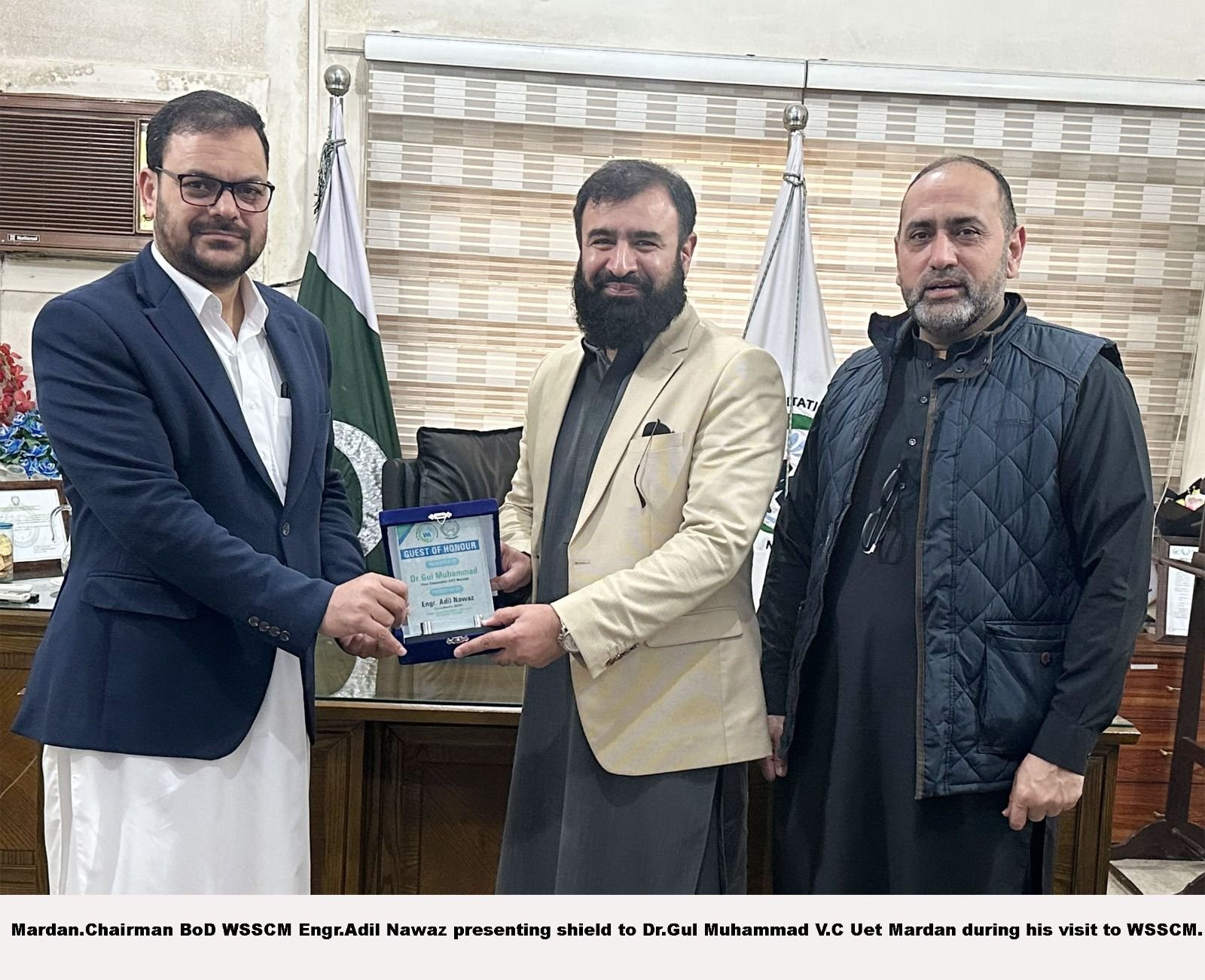
Mardan: The Vice Chancellor of the University of Engineering and Technology Mardan, Professor Dr Gul Muhammad, visited the office of the Water and Sanitation Services Company Mardan on Tuesday, where both institutions agreed to strengthen cooperation in technical support, energy efficiency, and sustainable public services.
During the visit, the vice chancellor was received by Chairman Board of Directors Engr Adil Nawaz and Chief Executive Officer Shahid Khan, who welcomed him and discussed areas of mutual collaboration aimed at improving service delivery in the city.
Speaking on the occasion, Professor Dr Gul Muhammad said UET Mardan is actively promoting coordination among public sector institutions and providing technical assistance in information technology, mechanical, electrical, and civil engineering to enhance efficiency and effectiveness in public services. He said such collaboration is essential to address infrastructure and service challenges through practical and research-based solutions.
The meeting also reviewed plans to jointly work on projects to reduce energy consumption at WSSCM tube wells by shifting operations to modern and sustainable methods. Both sides agreed to place special emphasis on the use of renewable energy, particularly solar power, to cut costs and improve sustainability.
Officials were informed that, in collaboration with various institutions, WSSCM has been equipped with modern tools to ensure the supply of clean and safe drinking water. These devices will allow water quality testing at household level, enabling regular monitoring of water standards.
Chairman Engr Adil Nawaz and CEO Shahid Khan said a comprehensive policy would be developed at the board level to ensure efficient and economical use of energy, with UET Mardan’s research and technical expertise playing a key role. They added that a memorandum of understanding between the two institutions would be signed soon to facilitate the conversion of tube wells to solar energy, reduce energy losses, and introduce sustainable systems.
At the conclusion of the visit, both sides agreed to maintain regular coordination and to initiate joint research projects, student internship programmes, and technical training initiatives in the future.





 Today's E-Paper