
Peace, Power, and the Curious Career of President Trump
By Saeed Minhas
Every generation chooses its heroes carefully. Sometimes those heroes emerge from struggle, sacrifice, and long movements for justice. That is how the twentieth century produced figures like Mahatma Gandhi, Martin Luther King Jr., and Nelson Mandela.
These leaders were shaped by prison, protest, and moral conviction. Their language was restrained. Their power came from persuasion.The twenty-first century has produced a very different type of global actor. Non-violent ways of the 20th century seem to have become old-fashioned, and a new vocabulary, actions, and grammar of “Peace” and “Power” has rendered non-violent theories of iconic figures rudderless.
Instead of quiet moral authority, we now live in an era of media spectacle, strong personalities, and global political theatre. In this new environment, attention itself has become a weapon. Whoever controls the narrative often controls the moment.Into this world stepped Donald J. Trump, a man who entered politics not through social movements but through television and real estate.
For critics, he represents disruption. For supporters, he represents bold leadership. For historians, he represents something else entirely, a symbol of how power operates in the age of spectacle.Some admirers even claim he deserves the Nobel Peace Prize.For many observers, the suggestion feels like satire. Yet the story behind it reveals much about modern geopolitics.
From Property Deals to Global Power
President Trump’s story begins not in parliament or military service but in property development.His father, Fred Trump, built a large real estate business in New York. The young Donald entered that world early and learned a simple lesson about influence. Visibility creates power.
Trump expanded the family business into Manhattan. Towers, casinos, hotels, and golf resorts followed. But even during these years,President Trump understood that brand identity mattered as much as buildings.His name appeared in giant letters across skylines.
This approach eventually moved from business into media. Television programmes like The Apprentice turned him into a global personality. Millions of viewers watched him fire contestants and deliver short lessons about success.
What many observers missed at the time was that Trump was quietly learning the language of mass persuasion. He understood how audiences react to drama, confrontation, and confidence.
When he entered politics in 2015, the political establishment assumed he would fail quickly. Instead, he treated the election campaign like a media show.Every speech became an event. Every controversy became publicity.Within a year, the television personality had become president of the United States.
The Doctrine of Spectacle
Traditional diplomacy relies on patience, secrecy, and slow negotiations. President Trump prefers something different.His method resembles the strategy of a property negotiator: raise the stakes publicly, create pressure through publicity, and then push for a deal.Analysts sometimes describe this style as transactional diplomacy.
By reviewing various verbatim from his first and ongoing second terms, I have tried to synthesize five ideas that recur in President Trump’s foreign policy approach.
- First, personal leadership matters more than institutions.
- Second, serious threats create leverage.
- Third, public messaging shapes negotiations.
- Fourth, economic pressure can replace military occupation.
- Fifth, diplomacy should produce visible wins.
This approach fits naturally within the information age. Modern geopolitics increasingly operates through perception, narratives, and influence campaigns.In academic circles, this environment is often described as Fifth-Generation conflict. In such conflicts, the battle is not only over territory but also over public belief.
President Trump instinctively understands this battlefield.He negotiates through television cameras, social media posts, and dramatic statements that dominate news cycles.In other words, his diplomacy often begins with a headline.
Markets, Power, and the Financial Theatre
Modern politics does not operate only through diplomacy and military power. It also operates through financial markets, where billions of dollars move within seconds in response to political signals.
Few modern politicians have understood this dynamic as instinctively as President Donald Trump.Throughout his political career,President Trump has treated economic announcements, tariffs, and policy statements almost like negotiating tools in a global financial arena. Markets often reacted instantly.
During his presidency, a single tweet about trade negotiations with China could move billions of dollars in global equity markets within minutes. Investors learned to monitor his social media posts as closely as official economic reports.This behaviour reflected Trump’s background as a businessman. In the property world, timing and perception often determine value. President Trump carried that logic into politics.
The most visible financial symbol of this relationship between politics and markets emerged with the public listing of Trump Media & Technology Group, the company behind the social media platform Truth Social.
At its peak after the public merger in 2024, the company briefly reached a valuation exceeding 8 billion dollars despite relatively small revenues. Supporters treated the stock almost as a political symbol rather than a conventional investment.
The company’s share price has since shown strong volatility. Over the past year the stock has fallen from above 20 dollars to around 10 dollars, illustrating how political sentiment and financial speculation can interact in unusual ways.
For many analysts, the stock’s movements reveal something deeper about the political economy of the twenty-first century.Political brands can now function as financial assets.
In President Trump’s case, the boundary between political messaging, media influence, and market speculation has often blurred. Announcements about tariffs, sanctions, or geopolitical tensions frequently influenced investor behaviour.
Markets respond not only to economic fundamentals but also to narratives.President Trump understands this instinctively. A dramatic statement can shift headlines, shape expectations, and sometimes move markets before policy is even implemented.In this sense, financial markets have become (perhaps they have always been) another stage in the global theatre of power.
Peace Through Deals
Supporters of President Trump point to several diplomatic initiatives as evidence that his approach can produce results.The most famous example is the Abraham Accords. These agreements created diplomatic relations between Israel and several Arab states, including the United Arab Emirates and Bahrain. Ironically, for decades, such recognition had been tied to resolving the Palestinian issue. The accords changed that formula. Nevertheless, supporters celebrated the agreements as historic breakthroughs that reshaped Middle Eastern diplomacy. Critics argued that they ignored the central Israeli-Palestinian conflict. Regardless of what anyone thinks, the agreements became the cornerstone of arguments that President Trump deserves international recognition for peace-making.
Later developments added new layers to this narrative. In 2025, Israeli Prime Minister Benjamin Netanyahu nominated President Trump for the Nobel Peace Prize, praising his diplomatic role in the region.
President Trump himself has repeatedly argued that his diplomatic achievements deserve recognition, pointing to efforts to reduce tensions in several regions, including the Balkans and South Asia. In this version of history,President Trump appears as an unconventional negotiator who prefers bold moves over slow diplomacy.Yet the story does not end there.
Wars Without Declarations
The idea of President Trump as a peacemaker becomes complicated when examining moments of military confrontation during his presidency.
One of the most dramatic events occurred in January 2020 when the United States carried out a drone strike near Baghdad airport that killed Iranian commander Qasem Soleimani. The operation had been authorised by Trump and immediately raised fears of a wider regional war. The assassination removed one of the most influential military figures in Iran. American officials described the strike as defensive action against a dangerous adversary. Iranian leaders condemned it as an act of aggression.
The event illustrated a central feature of Trump’s strategy.He is willing to combine diplomacy with sudden displays of military power.Years later, tensions with Iran continued. In 2025, the United States and Israel carried out strikes on Iranian nuclear facilities during a brief conflict, which President Trump later described as a major success.
Supporters argue that such actions demonstrate strength and deterrence. Critics argue they risk escalating regional wars.Either way, they complicate the narrative of President Trump as a pure peacemaker.
Gaza and the Politics of Catastrophe
No issue illustrates the moral complexity of modern geopolitics more than the conflict in Gaza.Trump’s administration strongly supported Israel during his presidency, including recognising Jerusalem as Israel’s capital. The decision was welcomed by Israeli leaders but condemned by Palestinians and many international observers.
Later wars in Gaza produced intense global debate. Some activists accused Israel of committing genocide, accusations that Israel firmly rejects.
Within this environment, Trump’s legacy remains contested.Supporters argue that his regional diplomacy helped reduce tensions between Israel and several Arab states. Critics argue that bypassing the Palestinian issue contributed to deeper instability.
The truth, like most geopolitical realities, lies somewhere inside a complicated landscape of history, ideology, and strategic calculation.For ordinary civilians in the region, the political debates matter less than the human cost of war.
A Global Court of Admirers
Power rarely travels alone. It gathers followers, allies, and enthusiastic admirers.Trump’s political orbit has gradually expanded into a global network of supporters, commentators, lobbyists, and political figures who view proximity to him as valuable.
Among those occasionally appearing within this orbit are figures linked with the political circle of one of the many Pakistani ruling elite; Sharifs (Shahbaz), currently serving as the Prime Minister of the country.
For some observers, this creates moments of political irony. Leaders who once criticised American policies sometimes become vocal supporters when geopolitical interests shift.This phenomenon is not unique to Trump.
Throughout history, powerful leaders attract a court of admirers who praise their vision, celebrate their strength, and seek political advantage through association.
The difference today is that these interactions unfold in public view through social media, interviews, and international conferences.The modern court is global.
Shadows from New York (Epstein Files)
The story of global elites in the early twenty-first century cannot avoid one dark chapter.That chapter involves Jeffrey Epstein, whose network of wealthy and influential acquaintances has been examined extensively by journalists.
Epstein moved in elite social circles that included business leaders, celebrities, and politicians. Photographs and reports indicate that Trump and Epstein attended some of the same social events during the 1990s.
Trump later stated that he had ended his relationship with Epstein long before the financier’s arrest in 2019.No evidence, thus far, has linked Trump to Epstein’s crimes, yet the broader scandal revealed how deeply interconnected wealthy social networks can become.
For investigative journalists, the Epstein story remains a symbol of the hidden relationships that often exist within global power structures.
The Venezuelan Theatre of Power
Modern geopolitics sometimes resembles theatre.The confrontation between the United States and Venezuela offered a dramatic example. The government of Nicolás Maduro frequently accused Washington of attempting to overthrow his government.
These tensions produced episodes that felt almost cinematic, allegations of covert operations, arrests of foreign participants, and competing propaganda narratives.For Washington, the events represented struggles against authoritarian rule.For Caracas they represented evidence of foreign interference.
Observers watching from outside saw something else entirely, a modern geopolitical drama where every action is immediately broadcast to the world.In such conflicts, perception becomes as important as reality.
The Nobel Puzzle
The Nobel Peace Prize has always been surrounded by controversy.Some winners become universally respected figures. Others remain debated for decades.
Trump’s supporters argue that his diplomatic initiatives, especially the Abraham Accords, represent significant contributions to international peace. This argument gained attention when Netanyahu publicly nominated Trump for the prize in recognition of his role in Middle Eastern diplomacy.
At the same time, critics point out the contradictions between diplomatic achievements and military actions such as the strike on Soleimani or attacks on Iranian facilities.
The debate illustrates a broader question about modern diplomacy.Can peace sometimes emerge through displays of power rather than purely through negotiation?The Nobel committee rarely answers such philosophical questions directly. It simply awards the prize.History then debates the decision for decades.
The Satire of Modern Power
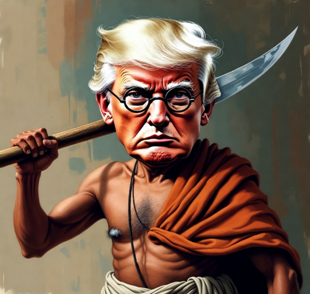
Calling President Donald Trump the Gandhi of the twenty-first century is clearly satire.Gandhi built his influence through restraint, sacrifice, and moral philosophy.Trump built his influence through publicity, disruption, and constant visibility.Yet both figures demonstrate one universal truth about politics.Power belongs to those who shape the narrative.
Gandhi shaped the narrative of colonial resistance.Trump shapes the narrative of modern political spectacle.Whether future historians remember him as a disruptive populist, an unconventional negotiator, or a master of political theatre remains uncertain.
But one thing is clear.In the strange theatre of the twenty-first century, the line between satire and reality often becomes difficult to see.And sometimes the story of global politics begins to read like satire long before journalists have finished writing it.


 Today's E-Paper