
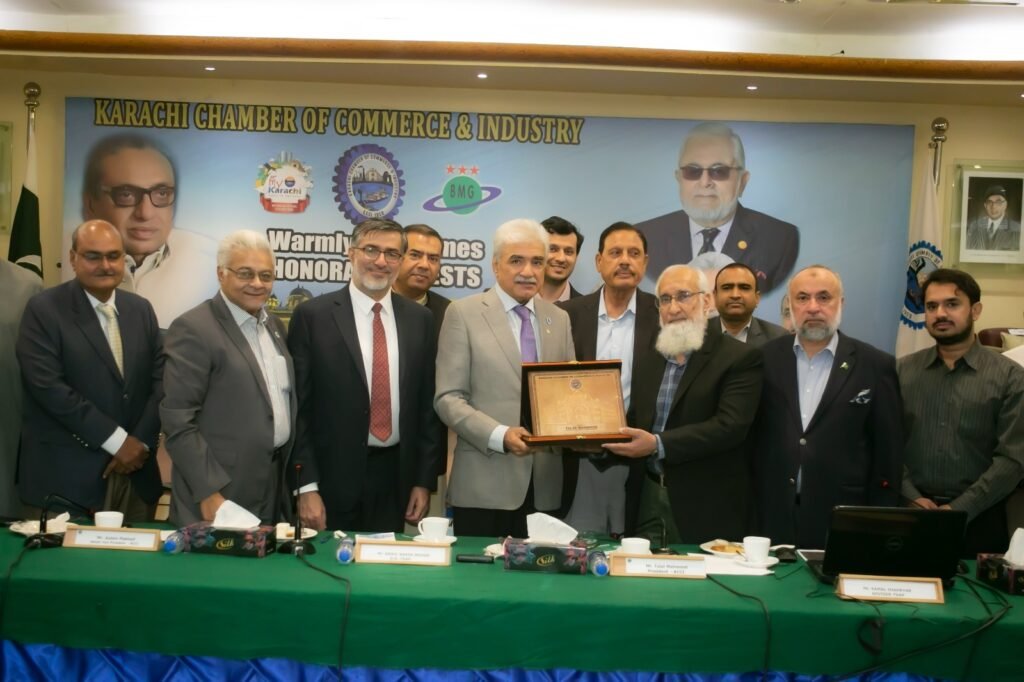
Pakistani exporters can strengthen their competitiveness in international markets by taking advantage of preferential tariff concessions under various trade agreements, Trade Development Authority of Pakistan (TDAP) Consultant Kamal Sheharyar has said.
Speaking during a presentation on the Preferential Trade Access Database (PTAD) portal at the Karachi Chamber of Commerce & Industry (KCCI), he said the platform enables foreign buyers to independently assess customs duty benefits available on products imported from Pakistan.
He explained that PTAD provides free and worldwide access to information about preferential trade arrangements, tariff concessions and market-access opportunities for Pakistani products.
The presentation was attended by KCCI President Talat Mahmood, Senior Vice President Aslam Pakhali, Vice President Arif Jameel Ur Rahman and members of the chamber’s Executive Committee.
The TDAP delegation included Director General Abdul Karim Memon, Deputy Director Tariq Idrees, Assistant Manager Noman Badar Siddiqui and Research Associate and Helpdesk Officer Mahendar Kumar.
The presentation was organised as part of TDAP’s initiative to establish a helpdesk at KCCI to facilitate exporters, importers and other business stakeholders.
PTAD Covers 29 Trade Arrangements Across 95 Countries
Kamal Sheharyar said PTAD covers 29 trade arrangements involving 95 countries, while Pakistan enjoys preferential trade arrangements in 93 countries for export purposes.
The database includes information about:
Free Trade Agreements (FTAs).
Preferential Trade Agreements (PTAs).
Regional and multilateral trade agreements.
Generalized System of Preferences (GSP) schemes.
He noted that Pakistan benefits from 15 GSP schemes covering different countries and product categories.
Each trade arrangement has a dedicated module containing product coverage, Most Favoured Nation (MFN) and preferential tariff rates, Rules of Origin, origin procedures and export-import documentation requirements.
How Preferential Tariffs Benefit Exporters
Explaining the financial advantages, Sheharyar said preferential tariffs allow eligible products to enter international markets at lower customs duty rates than standard MFN tariffs.
He illustrated the benefit with an example: if a shipment worth US$100,000 attracts an MFN tariff of 12% but qualifies for a preferential rate of 3%, the foreign buyer can save US$9,000 in customs duties.
Such savings can make Pakistani products more attractive to international buyers, improve price competitiveness and encourage greater sourcing from Pakistan.
Platform Simplifies Access to Trade Information
Sheharyar explained that businesses previously faced difficulties accessing tariff concessions because relevant information was scattered across lengthy trade agreements, annexures and tariff schedules on different websites.
Identifying the correct Harmonized System (HS) Codes, checking product eligibility and calculating tariff advantages often required considerable time and effort.
PTAD addresses these challenges by consolidating trade-related information into a single, accessible platform.
He also highlighted that the database covers both export and import perspectives. Pakistani exporters can identify international markets offering preferential access, while local importers can explore favourable sourcing arrangements for raw materials and industrial inputs.
This is particularly beneficial for manufacturers importing materials, adding value locally and exporting finished products.
Exporters Urged to Promote PTAD Among International Buyers
Kamal Sheharyar encouraged Pakistani exporters to share the PTAD portal with overseas buyers and incorporate it into their export marketing and business-development strategies.
He also urged importers, chambers of commerce and trade associations to promote awareness and effective use of the platform.
He added that PTAD could support government agencies and trade-negotiating teams by providing consolidated tariff information to evaluate existing arrangements and prepare for future trade negotiations.
He expressed hope that wider utilisation of the database would help Pakistani businesses make informed trade decisions, diversify export destinations, benefit from existing tariff concessions and strengthen Pakistan’s international trade competitiveness.