
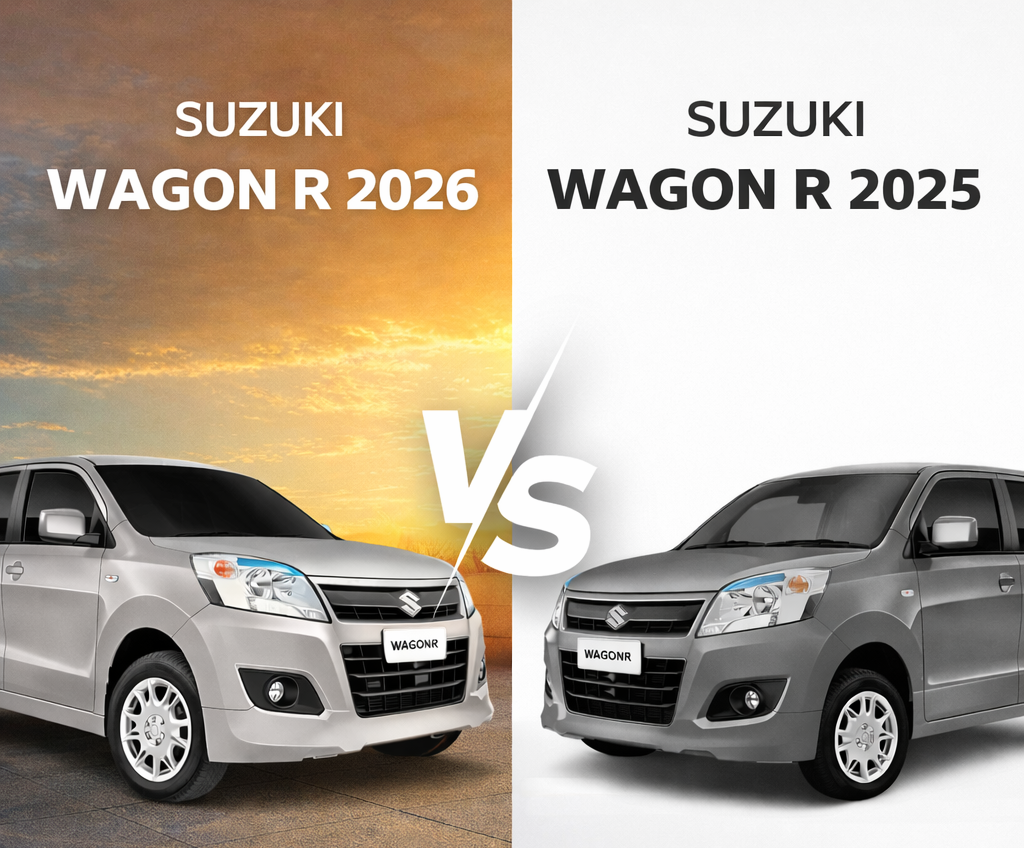
The newly launched Suzuki Wagon R 2026 marks a notable shift from the 2025 model, particularly in terms of seating capacity, fuel efficiency claims, and feature positioning. While the Wagon R 2025 has remained a popular budget-friendly hatchback in India, the 2026 version aims to reposition the model as a more practical family vehicle.
1. Seating capacity and body layout
Wagon R 2025:
The 2025 model is a 5-seater hatchback, designed mainly for small families and urban commuting. Its tall-boy design offers good headroom but limited third-row or extended family usability.Wagon R 2026:
The 2026 version introduces a 7-seater configuration, a major upgrade aimed at larger families. An extended wheelbase and reworked interior layout allow additional seating while retaining a compact footprint for city driving.
Key difference:
The move from 5 seats to 7 seats is the biggest functional change.
2. Engine options and fuel efficiency
Wagon R 2025:
Available with 1.0L and 1.2L petrol engines, along with a CNG option.Petrol mileage: around 24–25 km/l
CNG mileage: around 34 km/kg
Wagon R 2026:
The 2026 model claims up to 37 km/l, likely achievable through hybrid or enhanced fuel-saving technology, alongside petrol and CNG variants.
Key difference:
The 2026 model focuses heavily on maximum fuel efficiency, surpassing the 2025 figures on paper.
Also read: Suzuki Alto 2026 in Pakistan: Higher Price, Same Performance, and Buyers Losing Patience
3. Interior space and comfort
Wagon R 2025:
Practical cabin with good headroom, limited boot space when fully occupied, and basic comfort features.Wagon R 2026:
More flexible interior with foldable rear seats, better luggage management, and improved legroom for passengers. The focus is clearly on family travel and longer journeys.
Key difference:
The 2026 model offers greater versatility and passenger capacity.
4. Technology and features
Wagon R 2025:
Basic touchscreen infotainment (in higher trims)
Limited USB charging points
Manual AC
Minimal connected features
Wagon R 2026:
Updated touchscreen infotainment system
Smartphone connectivity
Multiple USB charging ports
Steering-mounted controls
Rear AC vents
Key difference:
The 2026 version adds more modern, family-friendly tech.
5. Safety features
Wagon R 2025:
Dual airbags
ABS with EBD
Rear parking sensors
Wagon R 2026:
Dual airbags (standard)
ABS with EBD
Reinforced body structure
Optional features like ESC, hill-hold assist, and reverse camera in higher variants
Key difference:
Safety coverage appears broader in the 2026 model, especially in top trims.
6. Price and affordability
Wagon R 2025:
Known for affordability, with lower upfront cost and minimal ownership expenses.Wagon R 2026:
Expected to remain budget-friendly despite upgrades, with EMI options starting around ₹8,000 per month, making it accessible for middle-class families seeking a 7-seater alternative.
Key difference:
The 2026 model offers more car for similar monthly affordability, though overall price may be slightly higher.
Final verdict: Which one makes more sense?
Choose Suzuki Wagon R 2025 if:
You want a simple, proven, 5-seater city car
Your priority is lower purchase price
You mainly drive short urban routes
Choose Suzuki Wagon R 2026 if:
You need a 7-seater for a growing family
Fuel efficiency is a top priority
You want modern features without SUV-level costs