
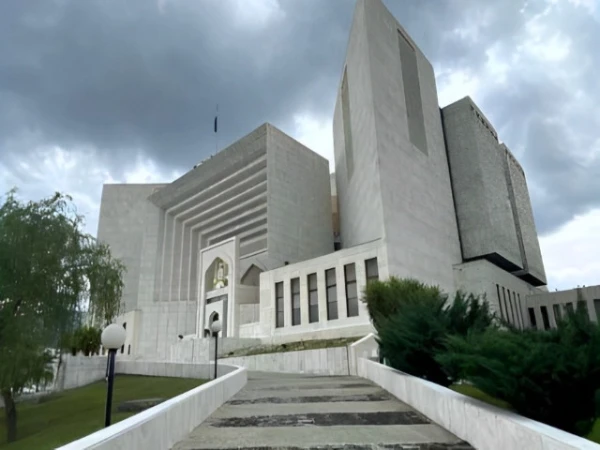
ISLAMABAD, September 28, 2026: The Supreme Court of Pakistan conducted hearings connecting judges, lawyers and litigants across six cities through video-link technology on Monday, using fully digitised case files to allow proceedings without the physical transfer of judicial records between Islamabad and branch registries.
The technology-enabled hearings connected Islamabad, Peshawar, Mingora, Quetta, Karachi and Lahore, allowing benches sitting at the Supreme Court’s Principal Seat and Branch Registries to hear cases while participants joined remotely from their respective locations.
According to a press release issued by the Supreme Court, the arrangements enabled judges to access complete case records digitally, eliminating the need to transport physical paper books between court locations.
In one proceeding, the Chief Justice of Pakistan presided over a bench from the Principal Seat in Islamabad, while Justice Shakeel Ahmad joined from the Peshawar Branch Registry.
Counsel representing one of the parties participated from Mingora through video link, connecting the bench and legal representatives across three different locations during the same hearing.
The arrangement allowed the proceedings to continue without requiring all participants to travel to a single courtroom.
Supreme Court benches hear cases from Quetta, Karachi and Lahore
The digital arrangements also enabled Supreme Court benches sitting in Islamabad to hear cases associated with the Quetta, Karachi and Lahore Branch Registries.
A three-member bench headed by Justice Jamal Khan Mandokhail heard cases from the Quetta Branch Registry, while a two-member bench headed by Justice Muhammad Ali Mazhar took up matters from the Karachi Branch Registry.
Similarly, a two-member bench headed by Justice Ayesha A. Malik heard cases from the Lahore Branch Registry.
Lawyers and litigants participated through video link from their respective locations, while the benches continued their judicial proceedings in Islamabad.
The Supreme Court said the system allowed branch registry cases to be heard without requiring the physical movement of judges, lawyers, litigants or case records between cities.
The arrangement is intended to support continuity of hearings and make more effective use of judicial time.
Digital case files replace physical paper books
A key feature of Monday’s proceedings was the use of fully digitised case files, allowing judges to access relevant judicial records electronically during hearings.
Previously, proceedings involving different court locations could require physical case files and paper books to be retrieved and transported between the Principal Seat and Branch Registries.
With digital records available to the benches, the Court said the need for such transfers could be reduced, saving time and simplifying administrative arrangements.
The combination of electronic case records and institutionalised video-link hearings is also intended to reduce travel requirements and associated expenses for lawyers and litigants.
It allows parties to participate in proceedings closer to their locations while enabling the Court to continue hearing matters involving different branch registries.
E-filing, digital payments and case tracking part of judicial reforms
The Supreme Court’s wider digital reform programme includes several initiatives aimed at modernising judicial administration and improving access to court services.
These include digitisation of case files, barcode-based case tracking, electronic filing, electronic transmission of court orders, digital payment facilities and the introduction of e-Office systems.
The Court is also expanding institutionalised video-link hearings as part of efforts to connect judicial records, administrative processes and public-facing services through digital technology.
According to the Supreme Court, these measures are intended to make case management more accessible and efficient while reducing unnecessary procedural delays and logistical difficulties.
The digital facilities are being progressively integrated into judicial operations to improve access to records and support more consistent hearing arrangements.
The Court said the objective of its technology-driven reforms was to deliver practical benefits to litigants and legal practitioners through easier access to case information, fewer unnecessary journeys and lower associated costs.
The continued expansion of digital services is intended to improve accessibility, efficiency and transparency while maintaining the orderly conduct of judicial proceedings.