
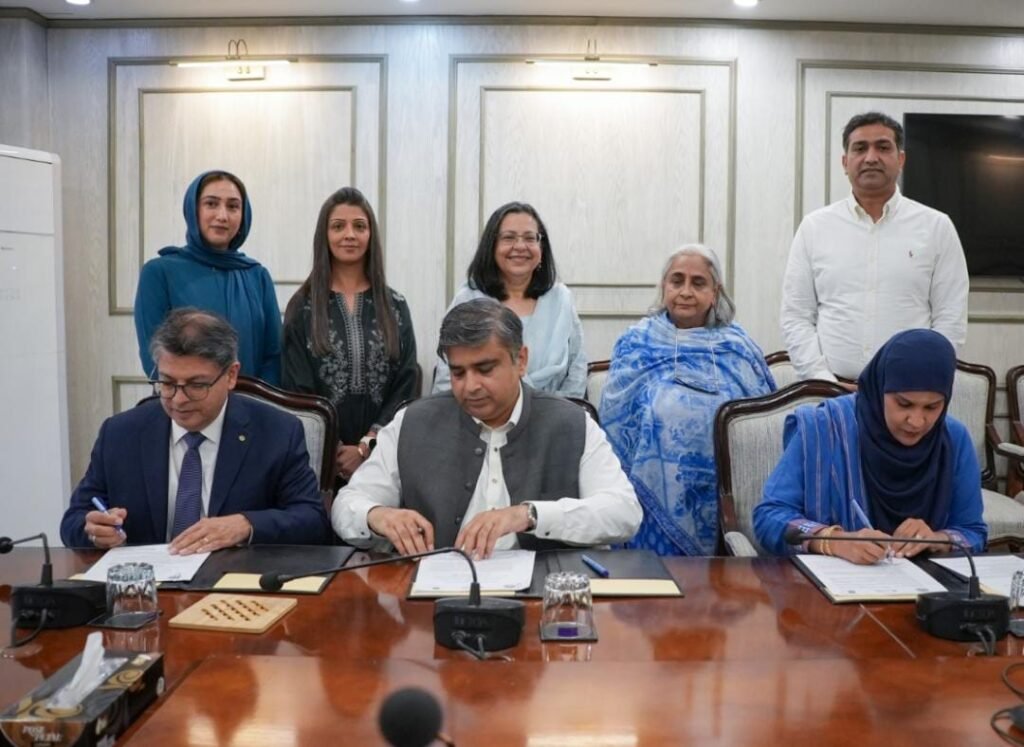
KARACHI: The Health Department of the Government of Sindh, the Lahore University of Management Sciences (LUMS) and Aga Khan University (AKU) have signed a three-year Letter of Collaboration to integrate the National AI Hub for Maternal, Newborn and Child Health into the public healthcare system.
Supported by the Gates Foundation, the partnership aims to bring artificial intelligence tools to frontline healthcare, with a focus on improving maternal, newborn and child health outcomes, particularly at primary healthcare facilities.
The agreement was signed at the office of Sindh Minister for Health and Population Welfare Dr Azra Fazal Pechuho on September 2, 2026. It was signed by Health Secretary Tahir Hussain, LUMS Associate Professor Dr Maryam Mustafa, who is the Hub Director and Principal Investigator, and AKU Medical College Dean Dr Karim Damji.
Dr Anita Zaidi, President of Gender Equality at the Gates Foundation, attended the signing. The foundation is supporting the Hub through a multi-year grant. AKU Associate Professor of Paediatrics and Child Health Dr Zahra Hoodbhoy, who has been working on point-of-care ultrasound AI models, was also present.
Under the collaboration, the three institutions will jointly develop and deploy risk-stratification models, clinical decision-support systems and voice-assisted tools for frontline healthcare providers delivering maternal and child health services.
Focus on Primary Healthcare
Dr Azra Pechuho said the initiative would focus on primary healthcare facilities, with the aim of improving outcomes for mothers and children.
“I would like to see healthier babies, and prematurity rates go down,” she said, adding that the initiative could also help identify congenital conditions and strengthen paramedical services.
The AI Hub builds on a multi-year collaboration involving computer scientists, human-centred design experts and clinical epidemiologists.
Its clinical research component is led by AKU’s Dr Fyezah Jehan, Chair of the Department of Paediatrics and Child Health. Her clinical trial networks, maternal-newborn cohort datasets and field-based epidemiological research are intended to provide real-world clinical evidence for validating predictive algorithms.
Voice AI for Frontline Health Workers
The technology component builds on Dr Maryam Mustafa’s Awaaz-e-Sehat, a voice-enabled electronic record management platform initially supported through a Grand Challenges grant.
Her team’s work in localised speech recognition and natural-language technologies is designed to support healthcare workers in low-literacy environments and enable interaction with AI tools in local languages.
Dr Mustafa said Pakistan faces challenges in adopting AI in healthcare, particularly because of limited formalised data infrastructure needed to scale such technologies.
She said the goal was to embed AI tools within existing health systems so they could eventually reach even remote communities.
How the Partnership Will Work
Sindh Health and Population Welfare Department: Strategic oversight, integration with provincial health facilities, alignment with national health policies and public-sector deployment.
LUMS: Technical partner responsible for model development, algorithm validation, speech technologies and technical safeguards.
Aga Khan University: Clinical, research and implementation partner responsible for clinical safety, real-world evaluation and field implementation across primary healthcare facilities.
The partners said the collaboration will follow national regulatory requirements, data privacy guidelines and ethical safeguards. The initiative is based on the principle that AI tools will assist healthcare professionals rather than replace clinical judgment.