
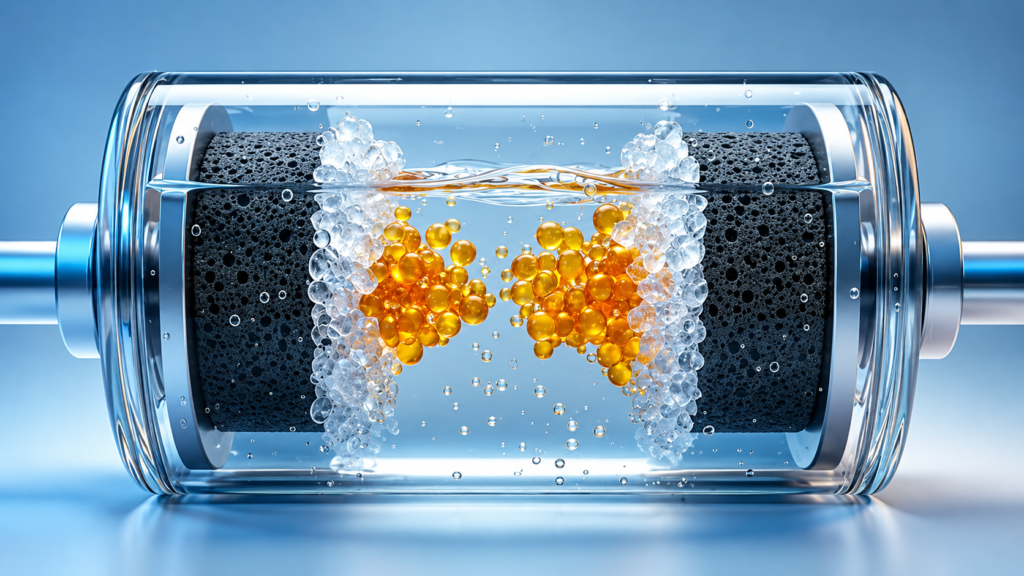
LONDON, November 15, 2026: Scientists have developed a new battery technology that could make renewable energy storage safer, more efficient and potentially more affordable, offering a promising alternative to conventional lithium-ion batteries.
The breakthrough, reported in the scientific journal Nature, involves water-based iodine batteries capable of storing more energy while avoiding some of the safety and environmental concerns associated with existing battery systems.
Large-scale energy storage is essential for expanding the use of solar and wind power, allowing surplus electricity to be stored and supplied when sunlight or wind is unavailable.
Lithium-ion batteries currently dominate energy storage systems, but their use of flammable materials and reliance on mined resources such as cobalt have raised safety and environmental concerns.
Water-based batteries are considered a potentially safer alternative because they use non-flammable, water-based electrolytes. However, their relatively limited energy storage capacity has restricted wider commercial adoption.
Researchers led by University College London (UCL) have now developed a new electrolyte formulation that improves the performance of iodine-based batteries.
The team enabled iodine to transfer four electrons during charging and discharging instead of two, increasing the amount of energy the battery can store.
Previously, achieving this reaction required highly concentrated electrolytes containing corrosive chemicals, making the technology expensive and difficult to scale up.
The researchers addressed this problem by modifying the molecular environment surrounding iodine, preventing unwanted reactions with water while stabilising highly reactive iodine compounds.
The team also demonstrated that the technology could operate reliably in different battery designs, including pouch cells commonly used in portable electronics and smaller coin-shaped cells.
During durability testing, zinc-iodine batteries retained nearly all their energy storage capacity after thousands of charging and discharging cycles.
Researchers believe the approach could also be adapted for aluminium-iodine batteries, opening further possibilities for developing alternative energy storage technologies.
Although additional research and commercial testing will be necessary, the findings could help advance safer, longer-lasting batteries for renewable energy storage.