
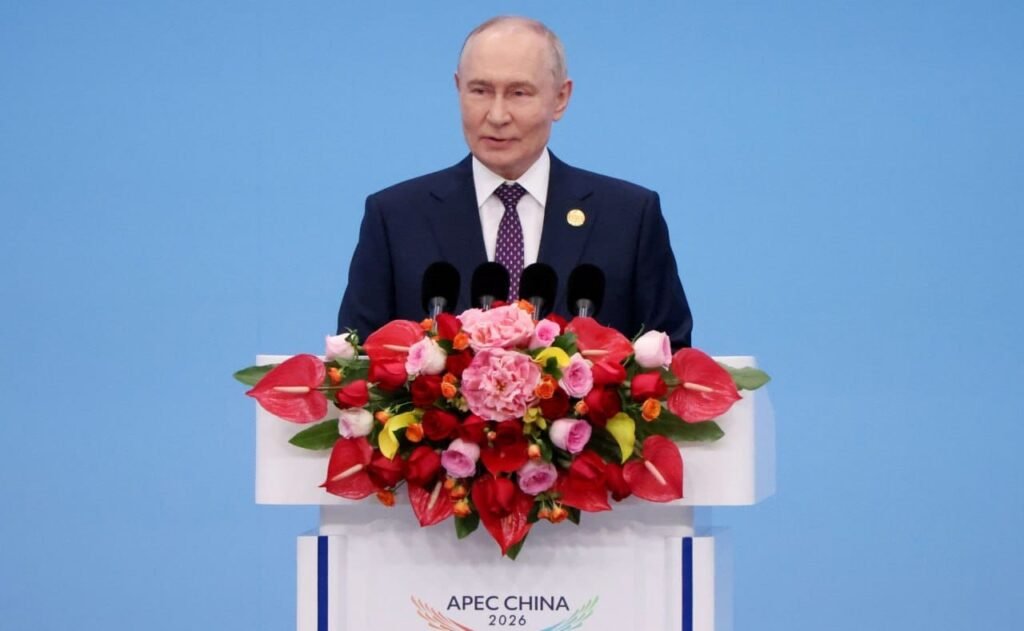
SHENZHEN, November 18, 2026: Russian President Vladimir Putin has expressed support for a proposed trilateral meeting involving Russia, China and the United States on the sidelines of the Asia-Pacific Economic Cooperation (APEC) Summit, describing dialogue among major powers as an opportunity to address political, economic and security differences.
Addressing the APEC CEO Summit in Shenzhen, Putin said the Asia-Pacific region had emerged as the centre of global economic activity and a leading hub for industrial production, technological innovation and international trade.
He argued that the region’s growing economic influence reflected a broader shift towards a more interconnected international order, with countries increasingly developing partnerships based on mutual interests rather than traditional power structures.
Putin said APEC could provide an important platform for discussions among major economies, particularly at a time of increasing geopolitical tensions and economic fragmentation.
He expressed optimism about the proposed meeting involving the leaders of Russia, China and the United States, saying such engagements could help countries address disagreements through compromise and dialogue.
The remarks, supplied as key points from his address, describe the trilateral meeting as scheduled, although its arrangements have not been independently verified.
Putin Criticises Sanctions and Trade Restrictions
The Russian president also criticised the use of economic sanctions, tariffs and export restrictions, arguing that such measures were becoming less effective in an increasingly interconnected global economy.
He maintained that economic pressure could disrupt trade and slow development but could not permanently prevent countries from expanding their economic capabilities.
Referring to Western sanctions imposed on Russia, Putin said Moscow had managed to withstand extensive economic restrictions while maintaining its role in international trade.
He argued that attempts to isolate Russia had failed to achieve their intended objectives.
Putin also criticised the European Union’s decision to reduce its dependence on Russian energy supplies, claiming that the resulting economic pressures had contributed to industrial difficulties, inflation and growing fiscal challenges.
These assessments reflect the Russian president’s position and do not independently establish the economic impact of sanctions or European energy policies.
Asia-Pacific Accounts for Majority of Russia’s Trade
Highlighting Russia’s growing economic engagement with the Asia-Pacific, Putin said the region now accounted for 53 percent of the country’s foreign trade.
He noted that the Asia-Pacific represented more than a quarter of Russia’s external trade in 2014, when Moscow established a long-term objective of increasing that share to 40 percent.
According to Putin, the latest figure demonstrates Russia’s expanding commercial relationships with Asian economies and the growing importance of regional markets.
He called on APEC members to strengthen logistics infrastructure and transport connectivity to accommodate changing global trade patterns.
Putin said Russia could contribute to regional connectivity through its extensive land and maritime transport networks, offering additional transit opportunities for international trade.
He emphasised that stronger transport links could support economic cooperation, improve supply chains and facilitate trade across the region.
The Russian president concluded by stressing the importance of multilateral dialogue, arguing that APEC could help major economies resolve differences and identify common approaches to sustainable development.
Reports from Reuters and China’s Foreign Ministry confirm that the Russia-China-US meeting is scheduled for November 19 in Shenzhen. Putin’s remarks were delivered ahead of the talks, rather than after them.