
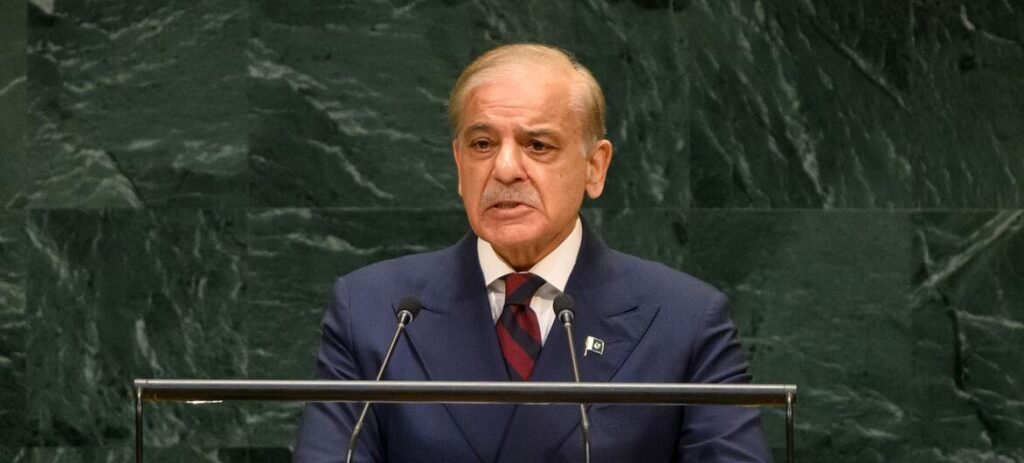
Prime Minister Shehbaz Sharif has warned that any attempt by India to stop, impede or divert Pakistan’s share of the Indus River waters would be treated as an “act of war.”
Addressing the General Debate of the 81st session of the United Nations General Assembly on September 25, Sharif described the Indus River system as vital to Pakistan and the wider region.
He said India’s decision to hold the Indus Waters Treaty in abeyance had “no legal basis whatsoever,” according to his address. Sharif also said that Pakistan’s position had been supported by findings he attributed to UN experts and the Court of Arbitration.
“Water must never be weaponized. Rivers should nourish nations, not divide them,” Sharif said.
Call for Diplomacy
Turning to tensions in the Middle East, Sharif said Pakistan had sought to facilitate dialogue between Washington and Tehran in Islamabad.
With hostilities again escalating, he called for diplomacy to remain central to efforts to reduce tensions. He also said the Strait of Hormuz and Bab el-Mandeb should remain open.
Sharif condemned recent Houthi attacks against Saudi Arabia, including an attempted drone attack targeting Mecca, according to his address.
Kashmir and Gaza
The prime minister also addressed the Kashmir dispute, saying Pakistan had exercised its right to self-defence under Article 51 of the UN Charter during what he described as external aggression from India.
He credited US President Donald Trump’s intervention with helping avert a wider conflict between Pakistan and India.
Sharif called for a solution to the Kashmir dispute and said Kashmiris had been waiting for a UN-sponsored plebiscite for decades.
On Gaza, he highlighted the death of an eight-year-old Palestinian girl, Wafa Akilah, and questioned whether children in Gaza should have the same opportunities and future as children elsewhere.
Sharif also raised concerns over developments in the West Bank and criticised Israeli policies there, while accusing the RSS-driven Hindutva ideology of contributing to religious tensions in India. These were statements made by the Pakistani prime minister in his UN address.
Afghanistan and Regional Security
Sharif also accused militant groups of operating from sanctuaries in Afghanistan and called on Afghan authorities to take what he described as “verifiable, decisive action” against groups he said were destabilising Pakistan.
Concluding his address, Sharif said Pakistan had chosen dialogue and cooperation over confrontation and called for peace and diplomacy to prevail over conflict.
“We have chosen dialogue over confrontation. We have chosen cooperation over coercion. We have chosen peace over war,” he said.