
The University of Lahore (UOL) has achieved a significant milestone in Pakistan’s higher education landscape by successfully organising the country’s first structured, university-wide Three Minute Thesis (3MT) Competition on 18 November 2026. Organised by the Office of Postgraduate Studies and Research (PGSR), the competition brought together 38 PhD graduates who communicated the essence, scholarly significance and potential societal impact of their doctoral research within just three minutes.
The initiative reflects a fundamental educational philosophy: the value of a postgraduate degree should not be judged exclusively by the completion of a thesis or publication of research papers, but also by the researcher’s ability to explain what problem has been addressed, how it was investigated, what was discovered and how the findings can benefit society. Research should not remain confined to academic documents and specialist discussions; its knowledge must be communicated, understood and translated into meaningful applications.
Inspired by the internationally recognised 3MT concept pioneered by The University of Queensland, Australia, UOL has introduced a structured institutional programme with the ambition of establishing an annual university-wide tradition, expanding it to universities across Pakistan within two years and developing international linkages within three years. The inauguration of the M. A. Raoof Champions Trophy and the establishment of the UOL 3MT Council provide important institutional foundations for its continuity and development.
Beyond a competition, this initiative seeks to strengthen postgraduate education, research communication, public engagement, academic ownership and the societal relevance of university research. It aspires to create a movement in which researchers are recognised not merely for generating knowledge but also for making it understandable and useful.
Three Minutes! One Research Journey! A World of Impact!
An MPhil or PhD degree represents years of intellectual commitment, academic discipline and systematic investigation. However, obtaining a postgraduate qualification should not be considered the final achievement of a researcher’s academic journey. It should mark the beginning of a greater responsibility: generating knowledge that addresses important problems, communicating discoveries effectively and contributing to human progress.
A researcher may spend several years investigating a complex scientific or social problem, produce an excellent thesis and publish research in prestigious journals. Nevertheless, the broader value of that work may remain limited if its significance cannot be explained to people outside the researcher’s specialist discipline.
The true worth of research becomes evident when its central problem, methodology, findings, originality and potential applications can be communicated in a language that an ordinary person can understand.
Recognising this important dimension of postgraduate education, The University of Lahore, through its Office of Postgraduate Studies and Research (PGSR), has introduced a structured Three Minute Thesis (3MT) programme. Its successful inaugural competition marks the beginning of an institutional commitment to making effective research communication an integral part of postgraduate education.
Global Context
The Three Minute Thesis (3MT) originated at The University of Queensland, Australia, in 2008. Its purpose was to encourage doctoral researchers to communicate the significance of their research to audiences beyond their specialist academic disciplines.
Since its introduction, 3MT has gained international recognition and has been adopted by universities in different countries. It has demonstrated the importance of research communication as an essential component of postgraduate development and public engagement.
UOL’s initiative draws inspiration from this internationally recognised concept while establishing a structured university-wide programme designed to develop its own institutional identity, sustainability and wider reach.
The Inaugural Event
On 18 November 2026, The University of Lahore successfully organised Pakistan’s first structured, university-wide 3MT Competition, bringing together 38 PhD graduates from different academic disciplines.
The participants were challenged to communicate the central message, scholarly contribution and potential practical implications of their doctoral research through a single PowerPoint slide and a presentation lasting no more than three minutes.
The quality of presentations was exceptionally impressive. Participants demonstrated that even highly specialised and technically complex research can be translated into clear, compelling and accessible messages without compromising its intellectual substance.
The event was more than a competition. It celebrated doctoral scholarship, encouraged intellectual confidence and demonstrated the importance of connecting university research with public understanding and societal needs.
The competition also highlighted an important distinction between possessing research knowledge and being able to communicate its value. The ability to explain years of investigation within three minutes requires a researcher to identify the central contribution of the work, distinguish essential findings from technical detail and present its significance convincingly.
Why 3MT Matters
The 3MT programme addresses an important gap in postgraduate education. Researchers are trained to investigate, analyse and publish, but they also need to learn how to communicate their discoveries beyond academic circles.
Every participant must be able to answer five fundamental questions:
- Research Problem: What issue or knowledge gap does the research address?
- Methodology: How was the problem investigated?
- Findings: What new knowledge or discoveries emerged?
- Significance: Why should society, industry or policymakers care?
- Potential Application: How can the findings contribute to practical benefits?
The challenge is to communicate these dimensions within three minutes in language accessible to a general audience.
The real measure of research communication is not how complicated a researcher can make an explanation, but how clearly the researcher can make a complex idea understandable.
Beyond Degrees
The 3MT is not merely a public-speaking exercise. It represents a broader approach to strengthening the intellectual, professional and societal value of postgraduate qualifications.
It encourages researchers to develop:
- Clarity: Explaining complex research in straightforward language.
- Confidence: Presenting discoveries convincingly before diverse audiences.
- Critical Thinking: Identifying the central contribution of their research.
- Creativity: Making research engaging and memorable.
- Public Engagement: Connecting academic discoveries with societal needs.
- Research Impact: Identifying opportunities to translate findings into practical benefits.
These capabilities strengthen graduate employability, encourage interdisciplinary understanding and prepare postgraduate researchers for responsibilities in academia, industry, entrepreneurship, government and other professional sectors.
An MPhil or PhD degree should represent more than the successful completion of an academic programme. It should reflect the researcher’s ability to investigate, discover, explain and contribute.
UOL’s Pioneering Initiative
The successful inaugural competition reflects UOL’s commitment to advancing a research-intensive academic culture in which knowledge is not merely generated but also effectively communicated, understood and translated into meaningful impact.
Organised by PGSR, the programme has been designed as a structured, university-wide initiative rather than an isolated academic event. Its institutional foundations include participation across faculties, common competition guidelines, transparent evaluation and independent external jury members.
The competition encourages all academic disciplines to participate, recognising that the ability to communicate research is equally important in the sciences, social sciences, management, engineering, health sciences and humanities.
By institutionalising 3MT, UOL seeks to make research communication a continuing component of postgraduate academic development and to encourage researchers to take greater ownership of the public value of their work.
- A. Raoof Champions Trophy

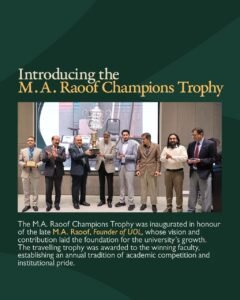
A special highlight of the inaugural event was the inauguration of the M. A. Raoof Champions Trophy, established in honour of the late M. A. Raoof, Founder of The University of Lahore, whose vision and contribution laid the foundation for the University’s growth.
The trophy was presented as a travelling championship award to the winning Faculty, establishing an annual tradition of healthy academic competition, collective achievement and institutional pride.
The Chief Guest, Mr. Uzair Raoof, Deputy Chairman, Board of Governors, UOL, distributed shields and cash prizes among the top five winners in recognition of their outstanding research communication skills.
The championship trophy carries significance beyond the competition itself. It provides a lasting institutional symbol of excellence, participation and the collective commitment of faculties towards strengthening research communication.
UOL 3MT Council
In another important development, the establishment of the UOL 3MT Council was announced to ensure the continuity, governance and sustainability of the programme.
The Council will provide strategic direction, institutional coordination and leadership for the future development of 3MT at UOL.
The founding members and inaugural office-bearers will establish its initial organisational framework, while the annual renewal of its cabinet will encourage wider participation, shared ownership and opportunities for emerging academic leaders.
This arrangement is intended to ensure that 3MT develops as an enduring institutional tradition rather than remaining dependent on a particular individual or administrative tenure.
Expansion Roadmap
The long-term vision is to transform the UOL 3MT programme into a recognised institutional, national and international platform.
Phase I: Institutional Development
- Establish 3MT as an annual university-wide competition.
- Encourage participation from all faculties and academic disciplines.
- Maintain independent external evaluation.
- Recognise outstanding participants, finalists and winners.
- Strengthen the role of the UOL 3MT Council.
- Develop a sustainable institutional culture of research communication.
Phase II: National Expansion-Within Two Years
- Invite Pakistani universities to adopt and participate in the 3MT programme.
- Develop common guidelines and transparent evaluation standards.
- Organise inter-university competitions.
- Establish a national platform for recognising outstanding postgraduate research communication.
- Encourage academic collaboration and the exchange of research ideas.
Phase III: International Linkages-Within Three Years
- Establish partnerships with internationally recognised universities.
- Encourage international participation and collaborative 3MT events.
- Promote cross-country exchange of research discoveries and innovations.
- Explore opportunities for international competitions and academic networks.
- Position UOL as an active contributor to the global research communication movement.
These targets reflect an ambitious but progressive vision: beginning with institutional consolidation, extending the programme nationally and subsequently developing meaningful international partnerships.
Raising the Value of Postgraduate Degrees
The long-term significance of 3MT extends well beyond the competition itself.
- Research Quality
The requirement to communicate research in three minutes encourages researchers to understand the originality, central findings and significance of their work.
- Public Understanding
Society becomes better informed about the research undertaken in universities and the potential benefits of academic discoveries.
- Institutional Reputation
Universities gain greater visibility when their researchers can communicate discoveries and innovations beyond specialist publications.
- Graduate Employability
The ability to explain complex ideas clearly is valuable in professional environments, including industry, government, education and entrepreneurship.
- Research Translation
Researchers are encouraged to think beyond thesis submission and publication towards practical applications, industry engagement and societal benefit.
- Academic Accountability
Researchers become more conscious of their responsibility to demonstrate the relevance of the knowledge generated through institutional resources, academic effort and public investment.
Ultimately, the value of a postgraduate qualification should be reflected not only in the academic achievement of its holder but also in the knowledge, solutions and positive changes that the research can generate.
Building a New Culture
The introduction of 3MT at UOL reflects a shift towards a more outward-looking postgraduate research culture.
Universities have a responsibility not only to generate knowledge but also to make it accessible, understandable and useful. Researchers must learn to communicate with audiences beyond their own disciplines and recognise that the ultimate beneficiaries of research may be communities, industries, policymakers and ordinary citizens.
A three-minute presentation cannot replace a thesis, a scientific paper or a detailed academic discussion. Its purpose is different: to demonstrate whether a researcher can identify and communicate the central value of years of investigation without relying on specialist terminology.
The ability to explain a complex research project in three minutes is not a substitute for research depth; it is evidence of the researcher’s ability to recognise and communicate its essence.
Dean PGSR’s Vision
As Dean of Postgraduate Studies and Research, my vision is to establish 3MT as a sustainable academic tradition at The University of Lahore and progressively extend its reach to universities across Pakistan and the international academic community.
Postgraduate education must produce more than degree holders. It should develop researchers who understand societal challenges, generate meaningful knowledge, communicate their discoveries and contribute towards practical solutions.
I envisage a research culture in which every postgraduate researcher develops the habit of asking five questions:
- What problem am I addressing?
- What new knowledge am I generating?
- Why is my research important?
- Who can benefit from my findings?
- How can I communicate its value to society?
These questions should become an integral part of postgraduate research thinking and academic practice.
My Motto
“Research is not complete until society understands its value.”
Conclusion
The successful inaugural 3MT Competition marks an important beginning in the evolution of postgraduate research communication at The University of Lahore. By bringing together 38 PhD graduates and providing them with a platform to explain their research to a wider audience, UOL has demonstrated its commitment to connecting academic scholarship with public understanding and societal impact.
The inauguration of the M. A. Raoof Champions Trophy, the establishment of the UOL 3MT Council and the ambitious targets for national and international expansion provide a foundation for developing this initiative into a lasting academic tradition.
The real achievement, however, will be measured not by the number of competitions organised but by the generations of researchers who learn to communicate their discoveries, engage with society and translate knowledge into meaningful contributions.
A postgraduate degree should not merely certify what a researcher has studied; it should demonstrate what the researcher has discovered, how clearly it can be explained and how meaningfully it can benefit society.
THREE MINUTES! ONE RESEARCH JOURNEY! A WORLD OF IMPACT!
The University of Lahore-Where Research Finds Its Voice and Knowledge Inspires the World.