
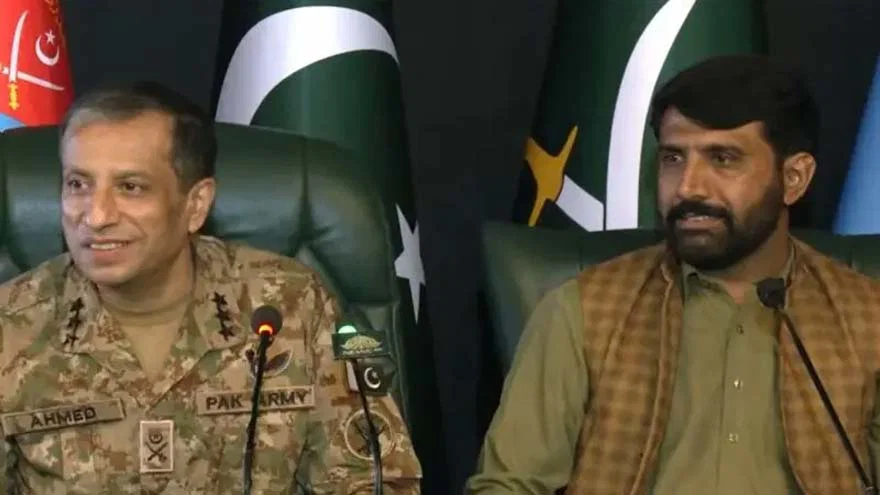
RAWALPINDI: A retired Pakistan Army soldier whom Indian reports claimed had been killed in an operation in Indian Illegally Occupied Jammu and Kashmir (IIOJK) appeared alive before the media on Thursday, as the Pakistan military rejected the Indian account and described the episode as another alleged false-flag operation.
Inter-Services Public Relations (ISPR) Director General Lt Gen Ahmed Sharif Chaudhry presented retired Havaldar Muhammad Asif during a press conference and questioned Indian claims linking him to the banned Lashkar-e-Taiba (LeT).
Indian media had reported that a man killed during an operation was affiliated with LeT and had served in the Pakistan military. Citing unnamed sources, the reports identified the individual as Mohammad Asif.
Lt Gen Chaudhry presented a five-point timeline of the episode, saying it began on September 29.
Referring to a social media post by the Indian Army’s Chinar Corps, he said Indian forces claimed they had launched a joint operation with police and the CRPF in the general area of Korag, Yousmarg, on the basis of intelligence reports.
A subsequent Chinar Corps post on September 30 claimed that the body of a “Lashkar-e-Taiba terrorist” had been recovered.
The DG ISPR said Indian news agency ANI later identified the deceased as Mohammad Asif and alleged that he had been inducted into Pakistan Army’s Special Services Group (SSG).
According to Lt Gen Chaudhry, India’s Ministry of Home Affairs and Press Information Bureau also repeated the claims.
He said Indian authorities later linked the alleged militant to an individual named Asif Ilyas — while Muhammad Asif himself was present at the press conference in Rawalpindi.
‘I am alive,’ Muhammad Asif tells media
Speaking to journalists, retired Havaldar Muhammad Asif said he was a resident of Pindi Gheb in Attock district.
He said friends began calling him after seeing reports on social media that Indian forces had killed him.
“After the fabricated report of my martyrdom, I started receiving phone calls. I was surprised because I was at home, so I wondered how the Indian army could have killed me,” Asif said.
He said he retired from the Special Services Group in 2023 after serving in the Pakistan Army.
“I remain ready to serve my country whenever needed. I strongly condemn India’s baseless and fabricated allegations,” he said.
Asif said he currently worked for a security company and lived in Rawalpindi.
“India has made a false allegation against my country. I am alive, I live in Rawalpindi and I am standing before you,” he said.
Lt Gen Chaudhry said Indian reports had described the deceased as a havaldar in the SSG, adding that the episode brought back memories of the Uri and Pahalgam incidents.
India’s Press Information Bureau had claimed that the “neutralisation” of “Musa alias Asif Fauji” was part of an “ongoing, long-sustained Operation Sheruwali,” which it said had been launched in May.
“After six months of hard work, Musa alias Asif Fauji has been neutralised. Congratulations, applause,” Lt Gen Chaudhry said sarcastically while referring to the Indian claim.
He also read out Indian allegations linking Asif to several attacks, including the Halan attack on August 23, the DKG attack in December 2023, the Kandi attack in May 2023, the Shah Sitar attack in May 2024, the Shiv Khori attack in June 2024, the Gagangeer attack in October 2024, the Boota Pahari attack in October 2024 and the Basira attack in April 2025.
The DG ISPR said the Indian government had also claimed to have “neutralised” three other members of the group.
DG ISPR accuses India of sponsoring terrorism
Lt Gen Chaudhry also accused India of sponsoring terrorist organisations involved in attacks inside Pakistan.
He alleged that Indian support for groups including Mukti Bahini and the Tehreek-e-Taliban Pakistan (TTP) was an open secret and claimed that the evidence was visible internationally.
The DG ISPR further alleged that extremist Hindu leaders, including Narendra Modi, had openly taken pride in what he described as state-sponsored terrorism.
He described India as a centre for spreading terrorism globally and called it the “world’s biggest terrorist state.”
Lt Gen Chaudhry said people in occupied Kashmir continued to highlight what he described as severe human rights abuses in the region.
He accused India of carrying out false-flag operations for decades in an attempt to malign Pakistan and described occupied Kashmir as “the world’s biggest prison.”
The DG ISPR said “today’s India has become an encounter state” and questioned what purpose was served by what he described as a false-flag operation involving retired Havaldar Muhammad Asif.
He said India had projected the reported operation as a major success under “Operation Sheranwali.”
Lt Gen Chaudhry also alleged that terrorism by the Afghan Taliban regime was another manifestation of what he described as India’s anti-Pakistan activities.
Pakistan’s commitment to Haramain security ‘absolute’
On regional defence cooperation, the DG ISPR said Pakistan remained fully committed to implementing the Makkah Joint Defence Agreement.
He said details of cooperation under the Makkah Alliance could not be made public because defence-related information under the arrangement was confidential.
“The commitment of Pakistan towards the security of Haramain Sharifain is absolute,” Lt Gen Chaudhry said.
Army has nothing to do with politics: DG ISPR
Responding to political questions, Lt Gen Chaudhry reiterated that the Pakistan Army had no role in politics.
“Politics is the job of political parties,” he said, adding that he would not comment on political matters.
He said the National Action Plan had been formulated by political leaders and should now be implemented.
The DG ISPR added that dialogue with the provinces was the responsibility of the federal government.