
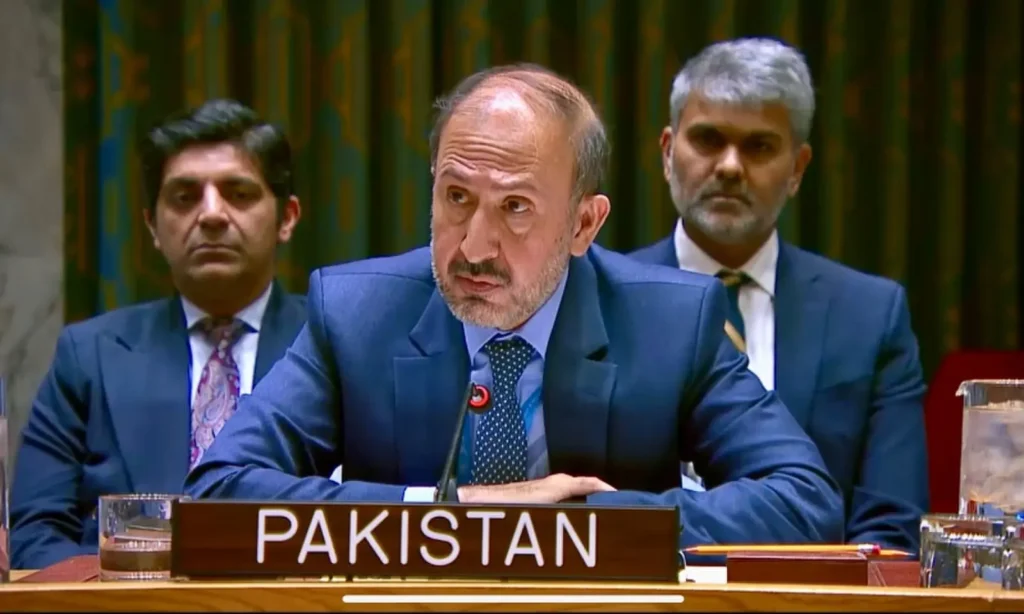
UNITED NATIONS, November 22, 2026: Pakistan has called for comprehensive reforms in the United Nations Security Council’s counterterrorism framework, warning that emerging technologies, evolving militant networks and unresolved conflicts are creating new challenges for international peace and security.
Addressing a Security Council briefing on November 19, Pakistan’s Permanent Representative to the UN, Ambassador Syed Haider Shah, urged the international community to strengthen counterterrorism mechanisms and ensure that sanctions regimes operate fairly, transparently and without political considerations.
The ambassador said Pakistan had suffered more than 90,000 casualties and billions of dollars in economic losses in its fight against terrorism. He added that more than 4,700 Pakistanis had lost their lives over the past three years due to terrorism emanating from Afghanistan.
Shah expressed concern over the presence of militant organizations in Afghanistan, including ISIL-K, Tehreek-e-Taliban Pakistan (TTP), Balochistan Liberation Army (BLA), the Majeed Brigade and the East Turkestan Islamic Movement (ETIM).
He alleged that these organizations were operating under the patronage of their hosts and receiving backing from Pakistan’s principal regional adversary.
Highlighting shortcomings in the UN’s existing counterterrorism architecture, the Pakistani envoy said the Security Council’s 1267 sanctions regime was inadequately equipped to address contemporary terrorism in all its dimensions.
He urged the Council to broaden its approach to terrorist designations without discrimination based on religion, nationality or ethnicity.
The ambassador also called for mechanisms to address violent far-right extremism, ultra-nationalism, xenophobia and Islamophobia, warning that such movements had been responsible for attacks targeting minorities and vulnerable communities.
He stressed that decisions concerning terrorist listings and delistings should be objective, impartial and free from political influence. He also advocated strengthening the Office of the Ombudsperson through greater autonomy and adequate financial and human resources.
Turning to emerging technological threats, Shah warned that terrorist organizations were increasingly exploiting the internet, dark web, cryptocurrencies and digital wallets for recruitment, propaganda and financing.
He called for stronger regulation of social media platforms, artificial intelligence and digital payment systems to prevent their misuse for radicalization, hate speech, disinformation and exploitation of vulnerable young people.
Referring to the UN Counter-Terrorism Executive Directorate (CTED), the ambassador emphasized the importance of international cooperation and wider UN membership support in developing effective counterterrorism standards.
He urged CTED to prioritize countries most affected by terrorism and make greater use of technological solutions for country assessments, training and engagement with member states.
On nuclear security and non-proliferation, Shah reaffirmed Pakistan’s support for preventing weapons of mass destruction from reaching non-state actors.
He highlighted Pakistan’s participation in implementing UN Security Council Resolution 1540 and its contributions to international cooperation, technical assistance and awareness initiatives.
The ambassador maintained that non-proliferation efforts must remain consistent with the UN Charter and international treaty obligations while respecting the right of states to use nuclear and other dual-use technologies for peaceful purposes.
Concluding his remarks, Shah called for closer coordination among the Security Council’s subsidiary bodies and their expert groups, emphasizing timely appointments of committee chairs and effective cooperation among member states.
He said the changing nature of terrorism and its growing links with emerging technologies required a coordinated international response to safeguard regional and global security.