
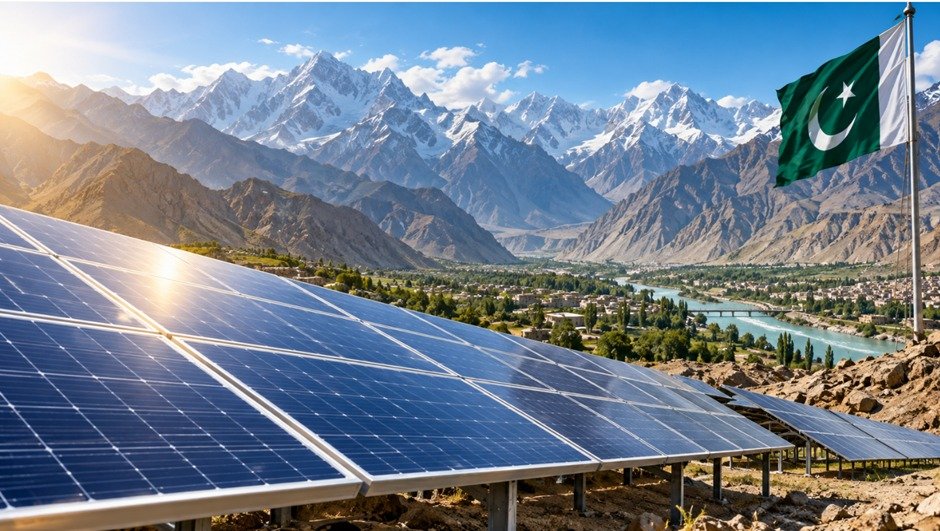
ISLAMABAD: Pakistan has advanced a Rs32.424 billion proposal to develop 100 MWp of distributed solar photovoltaic capacity in Gilgit-Baltistan, as the government looks to strengthen the region’s power infrastructure and expand renewable energy investment.
According to the Ministry of Planning, Development and Special Initiatives’ Monthly Development Update for September 2026, the project was recommended by the Central Development Working Party to the Executive Committee of the National Economic Council on August 28.
The proposal, titled “Development of 100 MWp Distributed Solar Photovoltaic Plants in Gilgit-Baltistan,” is sponsored by the Government of Gilgit-Baltistan and has been listed as a position paper, or PP-I, with the status “Recommended to ECNEC.”
The official report does not provide a site-wise breakdown of the proposed solar capacity or identify the number and locations of individual installations.
Solar Project Tied to Wider Energy Reforms
The proposed investment comes as the federal government places greater emphasis on energy reform, renewable power and infrastructure development in Gilgit-Baltistan.
A high-level review held on August 5 under the Prime Minister’s Review Committee examined the region’s fiscal, governance, energy and development priorities.
The discussions included an NFC-based resource-sharing framework, power-sector reforms, hydropower development, climate resilience and digital connectivity.
Officials also identified improved fiscal sustainability, faster implementation of ongoing projects and greater private-sector investment in hydropower and renewable energy among the region’s key development priorities.
The Planning Ministry said the review reaffirmed the federal government’s commitment to sustainable, resilient and inclusive development in Gilgit-Baltistan.
Medical College Project Also Approved
Gilgit-Baltistan also featured prominently in other development decisions taken by the CDWP during August.
The forum approved a revised project for the establishment of a Medical and Nursing College in Gilgit at a cost of Rs4.924 billion.
The project is aimed at expanding access to medical and nursing education and developing trained healthcare professionals to meet the region’s growing needs.
Across two CDWP meetings held in August, the forum considered 19 agenda items, including 14 projects, four position papers and one policy paper.
Seven projects worth Rs25.4 billion and two position papers were approved, while five projects worth Rs283.9 billion and one position paper were recommended to ECNEC.
The 100 MWp solar initiative was the position paper recommended to ECNEC and is separate from the five projects carrying the combined Rs283.9 billion cost.
Project Still Awaiting Final ECNEC Approval
The solar proposal has not yet received final ECNEC approval and remains under consideration at the federal development-planning level.
The project is also being assessed under a broader framework that places greater emphasis on climate resilience, economic viability, technical readiness, social impact and long-term sustainability.
The Planning Ministry has finalized the Public Investment Procedure and Parameters, a scorecard-based mechanism for selecting and prioritizing Public Sector Development Programme projects.
Under the framework, ministries are required to rank projects against prescribed criteria before they are compared across sectors by the Planning Commission.
The federal Public Sector Development Programme for FY2026-27 has been set at Rs1 trillion, including Rs255 billion in foreign-loan rupee cover, with priority being given to high-impact and fast