
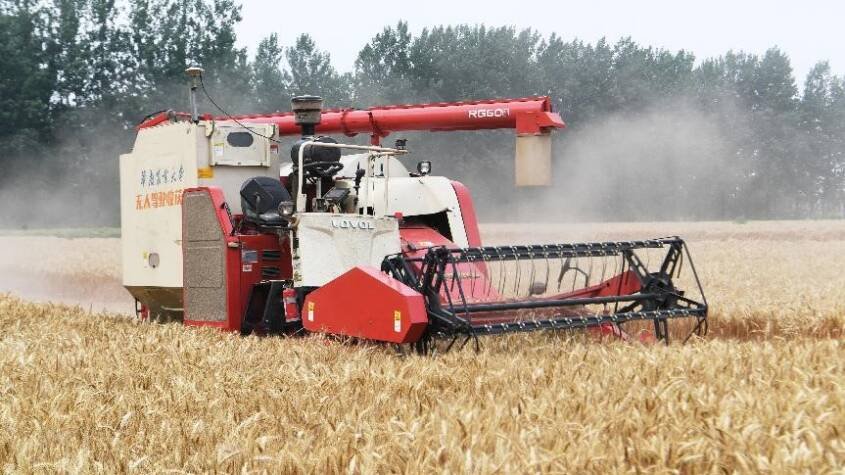
ISLAMABAD, Aug 08 (ABC): Pakistan has received 258 advanced agricultural machines and irrigation systems from China under the China-Pakistan Economic Corridor (CPEC) agricultural cooperation to modernise farming practices, improve productivity and promote climate-resilient agriculture across the country.
According to official documents available with Wealth Pakistan, the machinery was received and assembled by the Agricultural Engineering Institute of the Pakistan Agricultural Research Council (PARC) at the National Agricultural Research Centre (NARC), Islamabad.
The equipment are subsequently inaugurated and distributed among PARC and provincial governments for technology demonstration and wider adoption.
The package comprises nine categories of agricultural machinery and equipment, including 40 tractors, 20 rotary tillers, 30 rotary tillage fertilizer drills, 40 crawler-type rice-wheat combine harvesters, eight corn harvesters, 40 inter-tillage weeders, 40 trimmers, 20 hose-reel irrigation systems and 20 photovoltaic water-pumping systems.
Of the 258 units, 75 are allocated to Punjab, 45 to Sindh, 38 to Khyber Pakhtunkhwa, 36 to Balochistan and 64 to PARC.
The machinery support forms part of the Prime Minister’s Agriculture Modernization Initiative, a flagship government programme aimed at transforming Pakistan’s agriculture into a technology-driven, climate-resilient and export-oriented sector.
The initiative seeks to raise agricultural productivity, strengthen food security, promote value addition and enhance the competitiveness of Pakistan’s agri-food system through modern machinery, improved seeds, biotechnology, precision agriculture and climate-smart technologies.
It is being supported by the recently approved National Agricultural Biotechnology Policy 2026 and National Seed Policy 2026, which provide a framework for developing and commercialising improved crop varieties, expanding biotechnology and genome-based research, strengthening the national seed system and increasing farmers’ access to high-yielding and climate-resilient varieties.
A key element of the programme is strategic cooperation between PARC and the Chinese Academy of Agricultural Sciences (CAAS).
The federal government accorded in-principle approval in March 2026 to restructure PARC along the lines of CAAS and constituted a dedicated working group to oversee the transformation.
Under the restructuring plan, five Centres of Excellence are envisaged at NARC, Islamabad, focusing on genome-based research in field and horticultural crops; genetic improvement and health management of livestock; climate-smart solutions for land, water and energy; artificial intelligence and technology in agri-food systems; and food processing, value addition and product development.
The plan also includes a Centre of Excellence for Advanced Agricultural Mechanization and Digital Agriculture at PARC in collaboration with CAAS.
The centre is expected to serve as a national hub for research, development, adaptation, testing, demonstration and commercialisation of precision agriculture, artificial intelligence, robotics, Internet of Things (IoT), drones and climate-smart agricultural machinery.
The Ministry is also pursuing a broader agricultural mechanisation agenda, including the formulation of a National Agricultural Mechanization Policy, strengthening indigenous agricultural machinery research, establishing a national machinery testing, standardisation and certification system, promoting local manufacturing of advanced farm machinery and expanding Custom Hiring Centres through public-private partnerships.
The agenda also covers post-harvest mechanisation and advanced training for agricultural engineers to build national capacity in modern farming technologies.
Another major component is the Prime Minister’s flagship programme to train 1,000 Pakistani agricultural graduates in China. So far, 885 graduates have completed specialised training, while the remaining 115 trainees are scheduled to depart shortly, completing the government’s target.
The training covers nine priority areas, including aquaculture, crop breeding and genomics, farm mechanisation, fruit and vegetable processing, high-efficiency irrigation, drones, artificial intelligence and IoT, livestock breeding and genomics, livestock disease surveillance, and seed production and processing technologies.
The trained graduates are expected to serve as master trainers and transfer modern knowledge and technologies to farmers, extension services, researchers and educational institutions across Pakistan.
The programme is aimed at accelerating the adoption of hybrid seeds, precision agriculture, mechanisation, water-efficient technologies and value-added processing while improving agricultural productivity, resilience and competitiveness.