
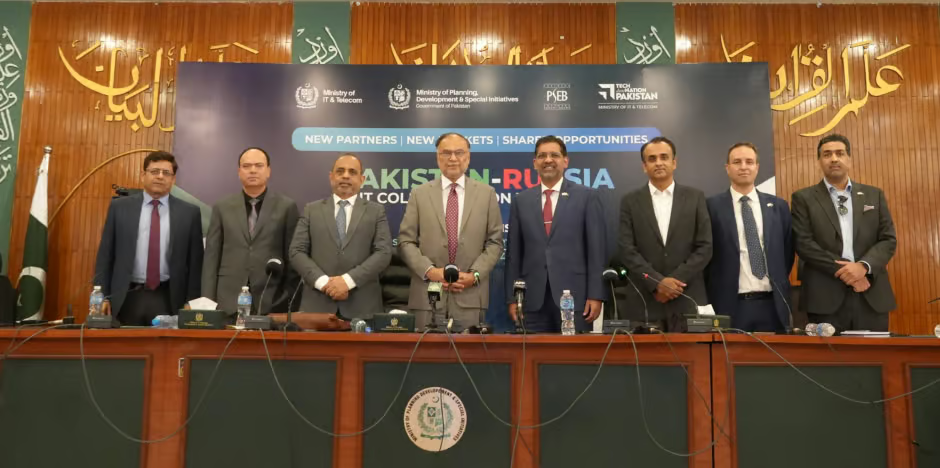
ISLAMABAD, November 5, 2026: Planning Minister Ahsan Iqbal said Pakistan aims to develop one million artificial intelligence (AI) professionals by 2030 while expanding technology cooperation with Russia through joint ventures, commercial partnerships and digital innovation projects.
Addressing the Pakistan-Russia IT Collaboration: Industry Engagement Framework on Thursday, the minister called for greater cooperation between technology companies of the two countries, with a focus on converting business discussions into commercial agreements, investment opportunities and practical projects.
He said Pakistan and Russia could collaborate in artificial intelligence, cloud computing, cybersecurity, industrial automation, enterprise software, digital agriculture and secure trade systems.
Iqbal highlighted recent business-to-business meetings organised by the Pakistan Software Export Board (PSEB) in collaboration with the Pakistan Software Houses Association (P@SHA), during which five Russian companies held 16 meetings with 11 Pakistani firms.
He said future engagements should provide businesses with a clearer pathway from initial discussions to commercial contracts and joint projects.
The minister described technology as a central component of Pakistan’s economic transformation strategy, noting that e-Pakistan was one of the five pillars of the National Economic Transformation Plan, which aims to transform the country into a trillion-dollar economy by 2035.
He stressed that Pakistan needed to move beyond traditional IT services exports and focus on developing software products, digital platforms and technology solutions for international markets.
Highlighting the country’s workforce potential, Iqbal said Pakistan produces more than 75,000 graduates annually, while the National AI Policy sets a target of developing one million AI professionals by 2030.
He added that seven new AI centres would connect academic research, skills development, startups and industry to strengthen the country’s artificial intelligence ecosystem.
The minister also cited Pakistan’s experience in digital public infrastructure, particularly the National Database and Registration Authority’s (NADRA) digital identity system and the RAAST instant payment platform.
According to Iqbal, RAAST processed 646 million transactions in a single quarter, demonstrating the growing scale of digital financial services.
He said Russia’s scientific and engineering expertise, particularly in enterprise software, cloud computing and cybersecurity, complemented Pakistan’s engineering workforce and experience in delivering technology services internationally.
Both countries could jointly develop and deploy digital solutions in their domestic markets and third countries, he added.
Iqbal identified artificial intelligence and digital governance as promising areas of cooperation, noting that both countries had experience operating large-scale digital systems.
He emphasised that partnerships should address practical challenges and deliver measurable results, including higher industrial productivity, improved data management and more accessible public services.
The minister said Pakistan-Russia technology cooperation should remain company-led, commercially driven and transparent, while complying with the laws and international obligations of both countries.
Acknowledging difficulties involving payment and settlement mechanisms, he said relevant institutions were working to address the challenges.
He urged participating companies to identify specific business opportunities, establish partnerships and agree on follow-up actions rather than limiting cooperation to announcements.
Iqbal said PSEB and the University of World Civilizations, Moscow, were prepared to facilitate further engagement between Pakistani and Russian technology organisations.
The minister also highlighted language barriers as an obstacle to expanding scientific and academic cooperation.
Recalling discussions during a previous visit to Moscow, he said Pakistani students and researchers had faced difficulties accessing certain Russian scholarships because of limited Russian-language proficiency.
He said the government was working with Allama Iqbal Open University and the Higher Education Commission to promote Russian-language learning among students, academics and researchers.
Russian-language instruction was also being incorporated into additional language programmes to support cooperation between universities, research institutions and businesses.
Concluding his remarks, Iqbal said technology should become an increasingly important component of Pakistan-Russia relations.
“Energy has powered our partnership for years. Now, let’s let technology power our future,” he said.