
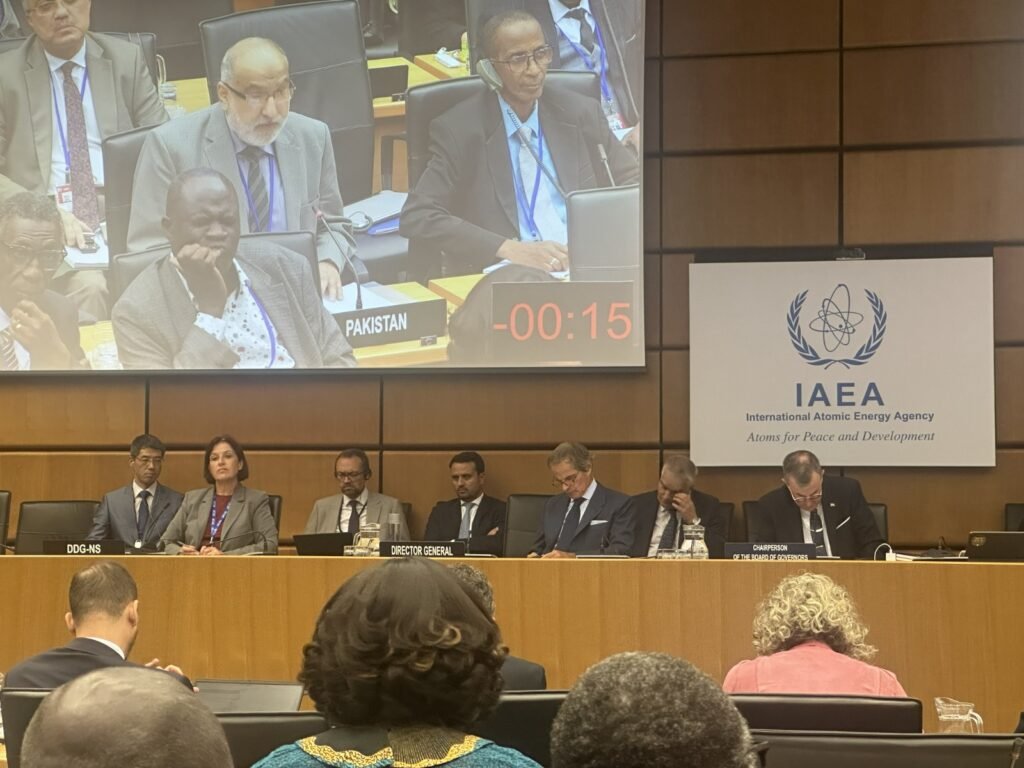
VIENNA/ISLAMABAD, September 8, 2026: Pakistan has reaffirmed its commitment to international standards of nuclear and radiation safety and nuclear security at the ongoing meeting of the International Atomic Energy Agency (IAEA) Board of Governors in Vienna.
Pakistan Atomic Energy Commission (PAEC) Chairman Dr Raja Ali Raza Anwar, while delivering Pakistan’s National Statement, said responsibility for nuclear safety and security within a state rests exclusively with the concerned member state.
He stressed that this fundamental principle should remain central to the IAEA’s planning and activities relating to nuclear safety and security.
Dr Anwar said Pakistan remained firmly committed to maintaining international standards of nuclear safety and security, describing them as essential components of the country’s peaceful nuclear programme.
He highlighted Pakistan’s five decades of safe and secure operation of nuclear installations, saying the country’s record reflected the strength of its domestic nuclear safety and security regime.
The PAEC chairman also appreciated progress in nuclear safety and security worldwide with IAEA assistance, particularly the agency’s role in supporting member states through capacity-building programmes.
He noted continued progress in adherence to and participation in the Convention on Nuclear Safety (CNS).
Dr Anwar highlighted Pakistan’s contribution to strengthening global nuclear safety, noting that Pakistan served as president of the 10th Review Meeting of the Convention on Nuclear Safety held in April 2026.
He expressed confidence that recommendations from the review meeting would contribute to further strengthening nuclear safety globally.
Pakistan also reaffirmed its continued cooperation with the IAEA in nuclear safety and security. Dr Anwar said Pakistani experts participated in an IAEA-coordinated emergency exercise in the Philippines and contributed to an International Physical Protection Advisory Service (IPPAS) mission to China during 2026.
Highlighting Pakistan’s role in regional capacity building, he said the National Institute of Safety and Security (NISAS), an IAEA Collaborating Centre, continued to support regional member states by hosting IAEA-sponsored activities.
He also highlighted the role of the Pakistan Centre of Excellence for Nuclear Security (PCENS), which, under a Practical Arrangement with the IAEA, has developed into a regional hub for capacity building among member states in the field of nuclear security.