
By Sanobar Nadir
There is a different kind of silence at sea.
From the shore, the Arabian Sea may appear endless and peaceful, stretching quietly beneath the morning sun. But for the men and women entrusted with guarding Pakistan’s maritime frontiers, that same sea represents a responsibility that never sleeps. Somewhere beyond the horizon are the routes through which the country’s trade moves, the waters that connect Pakistan to the world, and the approaches from which an enemy could attempt to threaten the nation.
This is where the Pakistan Navy stands.
When the war began in September 1965, the Indian Navy possessed a considerably larger fleet. Pakistan’s naval force was smaller, but its sailors were not prepared to allow that numerical difference to determine the outcome. Their responsibility was clear: protect the coast, safeguard the homeland and prevent the enemy from gaining an advantage at sea.
The Pakistan Army held firm against the aggression on land, and the Pakistan Air Force ruled the skies with a skill that has since become the stuff of military legend. But the story of September 1965 wouldn’t be complete without acknowledging the role of the men in white who guarded the nation’s waters.
Pakistan Navy, known as a four-dimensional force, proved its mettle and lived up to its identity as it brought its wrath upon the enemy from all four directions.
It is often said that the war was decided on 6th September, but the truth is that the fighting did not end with that date. The seas remained an active front, and it was the Pakistan Navy that closed the door on any hope the enemy had of striking Pakistan from the water. Despite being outnumbered by a considerably larger Indian Navy, Pakistan’s naval fleet met every challenge with courage and skill, successfully thwarting the enemy’s aggressive designs and proving that victory is never simply a matter of numbers.
And then came the night of 7th September. As the war continued on land and in the air, a fleet of Pakistan Navy warships moved toward the Indian coastal town of Dwarka. In the early hours of 8th September, Pakistani warships carried out Operation Somnath, striking shore installations at Dwarka. The operation demonstrated that Pakistan’s smaller naval force was not prepared to remain confined to defensive waters. It could take the fight to the enemy’s coast when the moment demanded it.
For Pakistan Navy, Operation Somnath became more than a wartime engagement. It became a symbol of professional courage, planning and confidence under pressure. The operation remains one of the proud chapters of the Navy’s history and is remembered every year on Navy Day as a reminder of what a determined force can achieve despite numerical disadvantage.
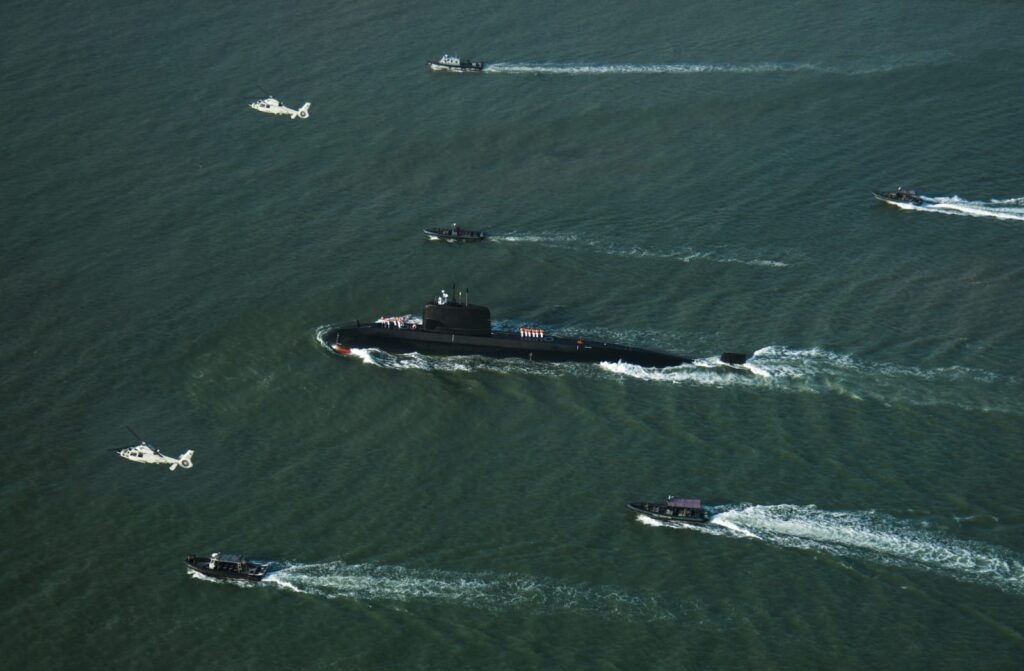
While Pakistan Navy was standing between the enemy and the homeland, central to this defence was the Pakistan Navy’s submarine, PNS Ghazi. PNS Ghazi’s patrol imposed a powerful deterrent on the opposing fleet. Its presence in the Arabian Sea kept the Indian Navy cautious and helped Pakistan maintain the initiative along its maritime frontier despite possessing a much smaller fleet. For the sailors aboard Ghazi, the mission was not simply about patrolling the waters. It was about making the enemy understand that any attempt to challenge Pakistan at sea would be met with a response.
The legacy of 1965 did not end there. When war returned in 1971, the Pakistan Navy once again paid a heavy price for the defence of the nation. PNS Ghazi, the very submarine that had humbled the Indian fleet six years earlier, was lost near Visakhapatnam while on a mission in enemy waters, and her crew were counted among the shuhada of that war. Yet even in the darkest days of 1971, the Navy’s fighting spirit did not waver. PNS Hangor achieved what no submarine in the region had done since the Second World War, sinking the Indian frigate INS Khukri on the night of 9th December 1971, a moment that remains one of the most proudest chapters in the Pakistan Navy’s history. These sacrifices, spread across two wars, form the backbone of the tribute the nation pays every 6th September.
The lions of the Pakistan Navy gave their lives and fought against impossible odds so that the coastline of Pakistan would remain safe and secure. Their courage did not fade with the passing decades.
Their valor… their courage found a modern echo in Marka-e-Haq, when tensions with India escalated once again in 2025. As the enemy poured resources into expanding its naval power, adding large warships, advanced submarines, long-range surveillance aircraft, and armed drones to its arsenal, the Pakistan Navy answered with the same resolve its forebears had shown in 1965.
Beyond its role in conflict, the Pakistan Navy’s defence of the nation extends into peacetime as well, particularly along the coastline, where the threats are quieter but no less serious. The Navy has taken on a central role in coastal security, conducting anti-narcotics operations to choke off the maritime routes used to smuggle drugs into and out of the region, and anti-human trafficking operations to intercept vessels attempting to exploit Pakistan’s waters for the illegal movement of people. These missions rarely make headlines, but they reflect the same vigilance that defined Operation Dwarka and Marka-e-Haq.
Every officer who joins the Pakistan Navy today inherits the legacy of PNS Ghazi, PNS Hangor, and the squadron that struck Dwarka, a legacy built on the understanding that the sea, like the land and the sky, must never be left undefended. The shuhada of 1965 did not fight so that their names would be remembered once a year; they fought so that Pakistan’s sovereignty at sea would never again be tested and found wanting.
They might not share the same blood, but in their blood runs the same conviction, passion and courage to defend Pakistan against every enemy.
“Hasbuna Allahu wa Ni’mal Wakeel” remains at the core of every generation of the men in white who stand watch over Pakistan’s seas.
As the nation marks another Defence Day, the Pakistan Navy’s role serves as a reminder that the war for Pakistan’s dignity was fought as much in the depths of the Arabian Sea as it was on the plains of Sialkot or in the skies over Sargodha. From the shores of Dwarka to the alertness of Marka-e-Haq, from the sacrifice of PNS Ghazi to the daily patrols against narcotics and human trafficking, the Pakistan Navy has carried forward the same vow made by its shuhada and ghazis: that Pakistan’s honor and its waters will never be compromised.