
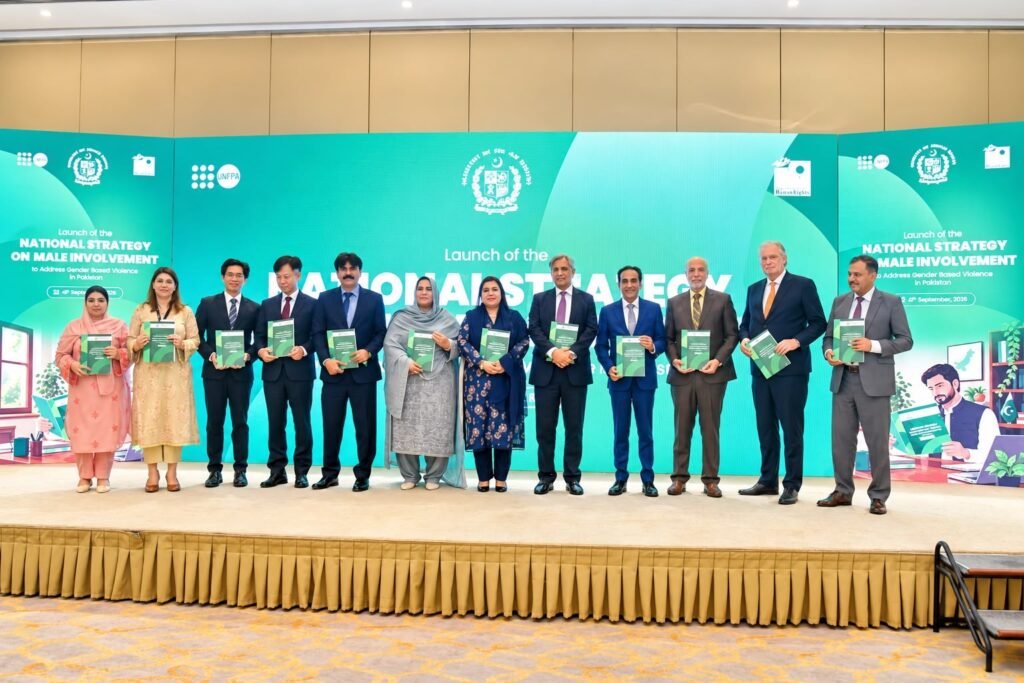
ISLAMABAD — The Ministry of Human Rights has launched a national strategy aimed at involving men and boys in preventing gender-based violence (GBV), seeking to challenge harmful social norms and strengthen efforts to protect women and girls from violence across Pakistan.
The National Strategy on Male Involvement to Prevent Gender-Based Violence was launched with technical support from the United Nations Population Fund (UNFPA) at an event in Islamabad attended by government officials, development partners, civil society representatives and male advocates from across the country.
Federal Minister for Human Rights Azam Nazeer Tarar presided over the launch alongside Federal Secretary for Human Rights Abdul Khalique Shaikh and UNFPA Representative in Pakistan Dr Luay Shabaneh. Representatives of the Embassy of the Netherlands were also present.
The strategy seeks to engage men not merely as beneficiaries or observers of gender-based violence prevention efforts, but as active partners in changing attitudes and behaviours that contribute to violence against women and girls.
Dr Muhammad Arif, Director at the Ministry of Human Rights, briefed participants on the development of the strategy, saying it was formulated following consultations, evidence reviews and engagement with multiple sectors.
28% of Ever-Married Women Report Physical Violence
The initiative comes against the backdrop of significant levels of violence reported by women in Pakistan.
According to the Pakistan Demographic and Health Survey 2017-18 figures cited at the launch, 28% of ever-married women aged 15 to 49 had experienced physical violence since the age of 15.
The survey also found that 34% had experienced physical, emotional or sexual violence by a husband or spouse, while 56% of women who reported experiencing violence had neither sought help nor told anyone.
Officials also noted that transgender persons can be victims of gender-based violence.
The new framework seeks to address such challenges by engaging men in their roles as fathers, husbands, teachers, faith leaders and community members and encouraging what officials described as “positive masculinity.”
It also focuses on changing harmful social norms and improving trauma-informed services for survivors.
Tarar Calls for Strategy to Deliver ‘Real Change’
Speaking at the launch, Human Rights Minister Azam Nazeer Tarar said freedom from violence and fear was at the heart of the country’s human rights responsibilities.
“This Strategy reflects wide consultation across government, civil society and communities, and it is a call to action for every sector of government, education, health, security and families to build a culture of respect and accountability,” Tarar said.
He pledged the ministry’s support for implementing the framework, saying it should translate into “real change, not just a document on a shelf.”
UNFPA Representative Dr Luay Shabaneh stressed the importance of conversations among men in changing attitudes towards violence and gender equality.
“Ending violence against women begins with the conversations men have with other men,” he said, adding that the initiative sought to bring men and boys into the effort as allies rather than bystanders.
Strategy Targets Schools, Workplaces and Public Institutions
Under the framework, federal and provincial human rights authorities have been encouraged to incorporate its recommendations into existing mechanisms for coordinating responses to gender-based violence.
Development partners have been asked to align their programmes and resources with the national framework rather than pursuing separate initiatives.
Civil society organisations and community leaders have also been urged to take its principles into schools, colleges and workplaces, expanding engagement with men and boys beyond government institutions.
Officials called for coordinated implementation across the health, education, justice and security sectors.
The strategy is aligned with Pakistan’s commitments under the Convention on the Elimination of All Forms of Discrimination against Women (CEDAW), the Beijing Platform for Action and Sustainable Development Goal 5 on gender equality.
It was developed with technical support from UNFPA and funding from the Embassy of the Netherlands.
The launch also included testimonials from male advocates and a panel discussion titled “Engaging Men and Boys as Allies in Ending GBV,” involving civil society representatives and youth leaders.