
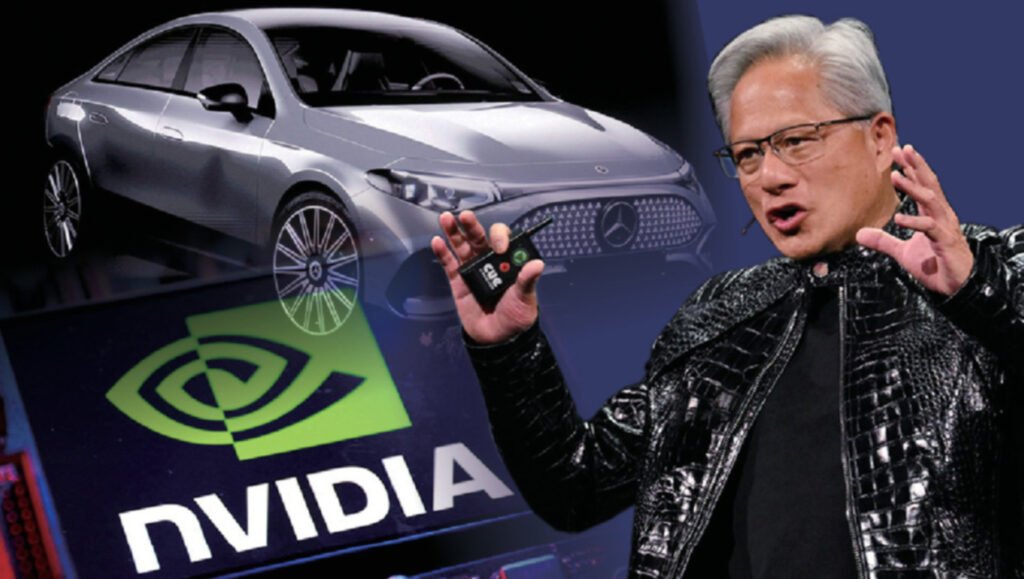
ISLAMABAD, November 10, 2026: NVIDIA, widely known for developing artificial intelligence chips and graphics processors, is expanding its role in the global automotive industry by supplying advanced computing systems that help vehicles navigate traffic, detect hazards and support automated driving.
The US technology company, led by Jensen Huang, is working with major automakers, including Mercedes-Benz, Volvo, BYD, Geely, Nissan, Hyundai and Kia, to develop AI-powered driving assistance and autonomous vehicle technologies.
Unlike conventional automotive components, NVIDIA’s systems process information collected by cameras, radar and other sensors, allowing vehicle software to interpret road conditions and assist with steering, braking and acceleration.
How NVIDIA technology works inside cars
NVIDIA’s automotive technology combines specialised processors, artificial intelligence software and simulation platforms designed to support advanced driver assistance systems.
Its DRIVE AGX platform provides onboard computing power, while DriveOS supports the software running on automotive computers.
Other technologies, including NVIDIA Hyperion, DGX, Alpamayo, Omniverse and Cosmos, help manufacturers develop, train and test increasingly sophisticated automated-driving systems.
However, not every automaker using NVIDIA technology incorporates all these platforms.
Mercedes-Benz introduces NVIDIA-backed driving assistance
One of NVIDIA’s major production applications is the Mercedes-Benz CLA, which uses NVIDIA-backed technology in its MB.DRIVE ASSIST PRO system.
According to Mercedes-Benz technical information, the system relies on 27 sensors, including 10 cameras, five radar sensors and 12 ultrasonic sensors, to monitor surrounding traffic and support driving functions.
The technology can assist with navigation-linked driving tasks in selected urban environments, including steering, acceleration and braking.
However, the system remains classified as Level 2 automation, meaning drivers must continuously supervise the vehicle and remain responsible for driving.
Mercedes-Benz introduced the system in China in late 2025 and plans to make it available for ordering in Germany during the first half of 2027.
Although the Mercedes-Benz CLA has also arrived in Pakistan, the availability of its international MB.DRIVE ASSIST PRO package in locally offered vehicles has not been established.
BYD, Volvo and Nissan develop advanced systems
NVIDIA is also collaborating with several other automotive manufacturers on future automated-driving programmes.
Volvo has incorporated NVIDIA computing hardware into production vehicles, while BYD, Geely and Nissan are developing advanced autonomous-driving technologies using NVIDIA’s Hyperion platform.
Hyundai and Kia are also working with the company on future driver assistance and automated-driving applications.
Some of these programmes target Level 4 automation, under which vehicles could operate without human intervention within specifically defined conditions.
However, participation in such development programmes does not mean manufacturers currently offer fully autonomous vehicles to consumers.
Can NVIDIA-powered cars drive themselves?
Automotive automation ranges from Level 0, where drivers perform all driving tasks, to Level 5, which represents full automation under all driver-manageable conditions.
Level 2 systems, including Mercedes-Benz’s MB.DRIVE ASSIST PRO, can assist with steering and speed control but require continuous driver attention.
Level 4 systems are designed to operate independently within approved environments, subject to technical capabilities and regulatory requirements.
NVIDIA also uses AI simulation platforms to help engineers test how automated-driving systems respond to unexpected situations, including sudden lane changes, pedestrians and adverse weather conditions.
These simulations support vehicle development but do not replace real-world testing and safety validation.
NVIDIA and Uber plan autonomous vehicle deployments
NVIDIA and Uber have announced plans to introduce autonomous vehicle services in selected US markets beginning in 2027, with broader expansion targeted for 2028.
The proposed deployments remain subject to vehicle development, safety testing and regulatory approval.
As automakers increasingly integrate artificial intelligence into their vehicles, NVIDIA’s role is extending beyond semiconductor manufacturing into the computing infrastructure supporting future mobility.
Nevertheless, the presence of NVIDIA technology does not automatically make a vehicle fully autonomous or establish its safety performance. Those capabilities depend on the complete vehicle system, its validation and the conditions under which it operates.