
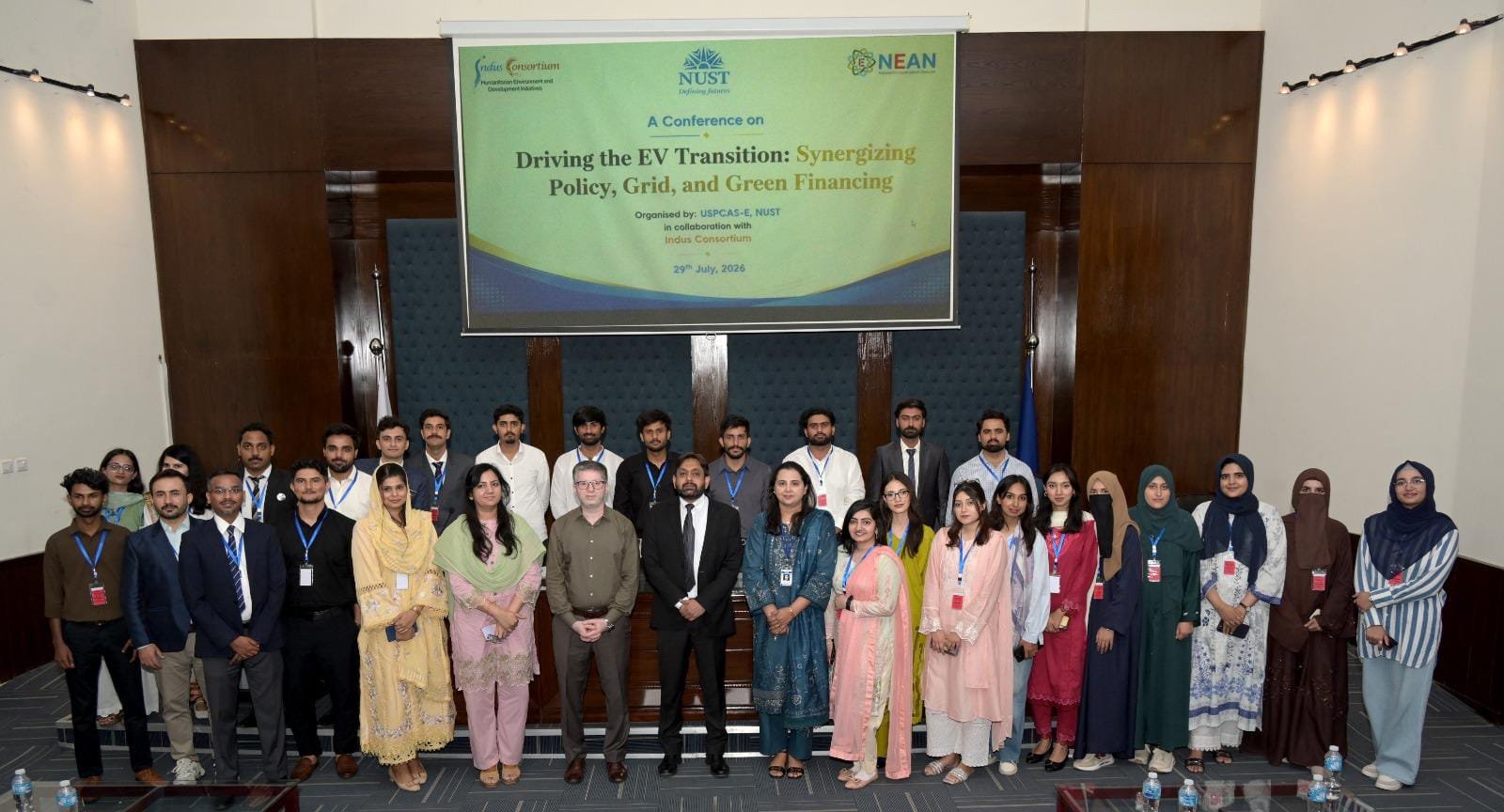
ISLAMABAD, August 2, 2026: Policymakers, manufacturers, researchers and financial sector representatives have called for stronger coordination on policy, infrastructure and financing to accelerate Pakistan’s transition to electric vehicles.
The recommendations emerged at a national conference titled “Driving the EV Transition: Synergising Policy, Grid, and Green Financing,” held at the National University of Sciences and Technology’s main campus in Islamabad.
The event was organised by the US-Pakistan Center for Advanced Studies in Energy at NUST in collaboration with the Indus Consortium. It brought together representatives from government institutions, the automobile industry, academia, financial organisations and civil society.
Participants included officials and experts from the Planning Commission, State Bank of Pakistan, National Energy Efficiency and Conservation Authority, Atlas Honda, ezBike, YES Electromotive, Sustainable Development Policy Institute, Federation of Pakistan Chambers of Commerce and Industry, Pakistan Association of Automotive Parts and Accessories Manufacturers, LUMS, University of Lahore and UET Peshawar.
Locally Developed EV Technology Showcased
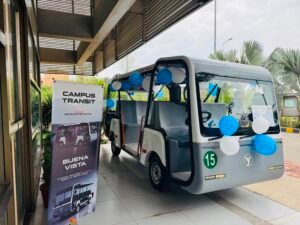
Electric vehicle manufacturers and academic institutions displayed locally designed products and research-based prototypes during an exhibition held alongside the conference.
The technologies on display included electric cars, high-efficiency motorcycles, fast-charging stations, battery-swapping equipment, battery management systems, drive motors, vehicle conversion kits and locally developed EV components.
The exhibition highlighted Pakistan’s growing technical capacity in electric mobility while also drawing attention to the infrastructure, investment and policy support required to move from research and small-scale production to wider commercial adoption.
In his opening remarks, USPCAS-E NUST Principal Dr Adeel Waqas said electric mobility could play an important role in strengthening energy security, reducing carbon emissions and supporting sustainable economic growth.
Industry and Infrastructure Challenges Discussed
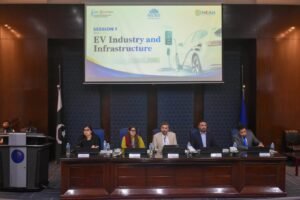
The first panel discussion focused on domestic manufacturing capacity and the development of charging and supporting infrastructure.
Moderated by Rabia Babar, the session included Dr Aazir Anwar Khan of the University of Lahore, Sadullah Ejaz of Atlas Honda, Shuja-ul-Haq Siddiqui of PAAPAM and Mehrosh Fatima of NEECA.
Participants discussed the need to expand local manufacturing, strengthen the auto-parts supply chain and develop reliable charging infrastructure to support the wider adoption of electric vehicles.
Financing Seen as Key to EV Adoption
A second session examined the financial and economic factors shaping Pakistan’s electric vehicle market.
The panel, moderated by Shahid Jilani of the Indus Consortium, included Dr Khalid Waleed of SDPI, Shaheen Akhtar of the State Bank of Pakistan, Dr Huzaifa Rauf of LUMS and Syed Yasir Husain of CAC.
The discussion focused on green financing, investment requirements, consumer affordability and the broader economic impact of shifting from conventional vehicles to electric mobility.
Speakers highlighted the need for financing mechanisms that can support manufacturers, charging-network operators and consumers while reducing the initial cost of EV adoption.
Experts Call for Clear and Consistent EV Policy
The final panel examined the regulatory and institutional measures needed to advance Pakistan’s electric mobility transition.
Moderated by Engr Ubaid Ur Rehman Zia of SDPI, the session featured Hassan Mian of YES Electromotive, Dr Attique Ur Rehman of the Ministry of Planning, Development and Special Initiatives, Bilawal Suhag of FPCCI and Dr Kaleem Ullah of UET Peshawar.
The panellists discussed policy consistency, institutional coordination, local production, infrastructure planning and the role of government in creating a predictable environment for long-term investment.
Concluding the conference, Dr Majid Ali said Pakistan’s EV transition would require closer coordination among policymakers, industry, universities and financial institutions.
He also stressed the importance of sustainable financing and infrastructure development to support the expansion of electric mobility across the country.
Also Read: NUST Showcases Pakistan’s Innovation Ecosystem to National Workshop Balochistan Delegation