
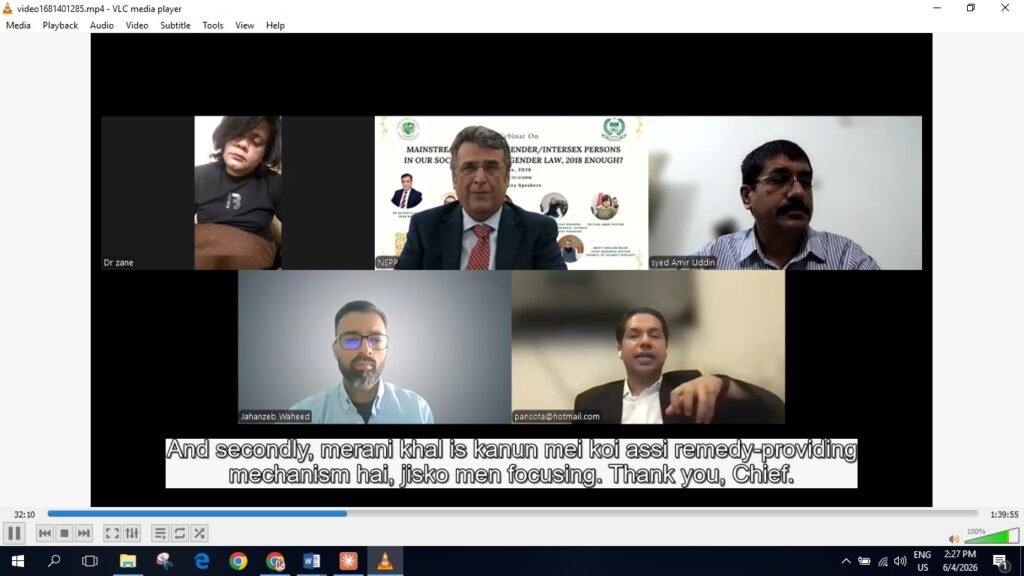
LAHORE: The National Institute of Public Policy (NIPP), a constituent unit of the National School of Public Policy (NSPP), hosted a webinar to discuss the inclusion of transgender and intersex persons in Pakistan and assess the effectiveness of the Transgender Persons (Protection of Rights) Act, 2018.
The webinar, titled “Mainstreaming Transgender/Intersex Persons in Our Society: Is the Transgender Persons (Protection of Rights) Act, 2018 Enough?”, brought together legal experts, policymakers, religious scholars, healthcare professionals, social activists and community representatives to examine the legal, social and policy dimensions of protecting the rights of transgender and intersex persons.
The event began with a welcome address by Ms. Bushra Bashir, Senior Research Analyst at NIPP, followed by opening remarks from the Dean of NIPP. Participants discussed challenges related to implementation of existing laws, social inclusion, access to healthcare and education, and broader policy reforms.
Advocate Muhammad Ahmed Pansota of the Supreme Court of Pakistan presented an overview of the Transgender Persons (Protection of Rights) Act, 2018, highlighting its key provisions, implementation challenges and areas that may require further legislative review.
Dr. Zain shared insights from his work on intersex health issues, emphasizing the importance of public awareness, improved healthcare access and greater sensitivity toward intersex individuals.
Mahnoor Chaudhry, Program Director of the Khawaja Sira Society, discussed efforts aimed at improving social inclusion, healthcare services and equal opportunities for the intersex community. A representative of Satrangi Organization highlighted challenges faced by transgender persons and outlined initiatives focused on education, empowerment and access to opportunities, including the establishment of a transgender school in South Punjab.
The webinar also featured presentations by Mufti Ghulam Majid, Research Officer at the Council of Islamic Ideology (CII), and Ghulam Dastagir Shaheen, Director General Research at the CII. They discussed the rights of intersex persons from the perspective of Islamic teachings and jurisprudence.
In his concluding remarks, the Dean of NIPP stressed the importance of evidence-based policymaking, inclusive governance and continued dialogue among stakeholders. He noted that meaningful inclusion requires a comprehensive approach that addresses legal protections, social acceptance, education, healthcare access and the protection of fundamental rights.
According to organizers, the webinar reflected NIPP and NSPP’s ongoing efforts to encourage informed discussion on public policy issues and promote inclusive governance in Pakistan.
Also Read: NIPP leads impactful discussion on Hussain Naqi’s autobiography