
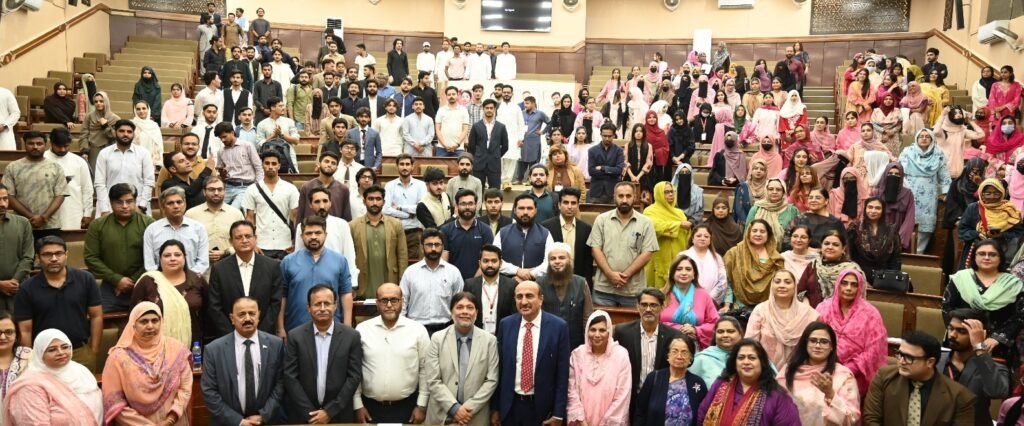
KARACHI: University of Karachi Vice Chancellor Professor Dr Wasim Qazi has emphasized the need to preserve historical truth, strengthen critical thinking and promote research, warning that artificial intelligence, fake news and algorithms have made the protection of factual information increasingly challenging.
He said history should not be viewed merely as a record of past events but also as a means of shaping the future. In this context, fact-checking, critical thinking and responsible conduct are essential to preserving truth and ensuring informed public discourse.
Speaking at a special lecture organized by the Pakistan Study Centre to mark the 150th birth anniversary of Quaid-e-Azam Muhammad Ali Jinnah, titled “Quaid-e-Azam’s Concept of Pakistan: National Unity, Democratic Values, and State Stability,” Professor Qazi stressed the importance of documenting the university’s institutional and academic journey.
He noted that the history of the University of Karachi was last formally written by Dr Riaz-ul-Islam in 1975, adding that no formal work had been undertaken since then. He said a new historical account was necessary to preserve the institution’s academic achievements, research contributions and evolution.
Universities Must Promote Research and Critical Thinking
The vice chancellor said universities should not limit their role to awarding degrees but must also nurture research, creativity and critical faculties among students.
He stressed that curricula should reflect contemporary needs and that education must be linked with social responsibility, the rule of law and public welfare.
Professor Qazi highlighted significant research opportunities at the Pakistan Study Centre and the Area Study Centre for Europe, particularly in areas such as Pakistani identity, national character, diplomacy and international relations.
He called for making these centres more active and effective to encourage quality research, scholarly writing and academic dialogue.
He further emphasized the need to learn from historical experiences and take practical measures to protect national identity, strengthen unity and promote collective progress.
Referring to the national anthem, he said its words and meaning offered important insights into the concept and fundamental objectives of the state. Citing the phrase “Pak sarzameen shad baad,” he questioned what practical requirements must be fulfilled to achieve the vision of a prosperous and flourishing Pakistan.
Mazhar Abbas Questions the State of Research and Education
Senior journalist Mazhar Abbas expressed concern over what he described as a continuing decline in research in Pakistan and the near disappearance of critical thinking in universities.
Discussing Quaid-e-Azam Muhammad Ali Jinnah’s vision of Pakistan, Abbas said differences of opinion had existed since independence and that the debate over the founder’s original concept of the country remained unresolved.
He argued that the views of a prominent personality’s opponents could provide important insight into their character and legacy. Referring to Jinnah’s August 11 speech, he said many people considered it central to understanding his vision of Pakistan.
Abbas questioned whether the country’s present direction reflected that original vision. He remarked that Pakistan was intended to be established as a state but had, in his view, increasingly been treated as real estate.
He also questioned whether the country’s true history and Jinnah’s original vision could be presented openly within the existing system, arguing that an honest examination of these ideas would raise questions about Pakistan’s political and governance arrangements.
Rule of Law and Judicial Independence
Abbas said Jinnah had envisioned a democratic state without martial law, where the state would be responsible for protecting the rights of every citizen.
He highlighted Jinnah’s emphasis on the rights and protection of minorities and expressed concern over the country’s judicial system, arguing that the doctrine of necessity had repeatedly been used to justify unconstitutional takeovers.
According to Abbas, the absence of justice and the weakening of the rule of law were among the major causes of Pakistan’s continuing challenges. He said that, in his assessment, the country had increasingly experienced the exercise of authority according to the wishes of rulers rather than consistent application of the law.
He maintained that Pakistan was envisioned as a democratic and transparent state but argued that political practices had developed serious shortcomings over time.
Accountability and Corruption
The senior journalist also raised concerns about corruption, saying it existed at multiple levels and that institutions responsible for accountability should themselves be subject to scrutiny.
He argued that accountability mechanisms must be credible and impartial, adding that individuals and institutions entrusted with holding others accountable should not be beyond examination.
The discussion highlighted the importance of historical inquiry, independent research, critical thinking and public accountability in understanding Pakistan’s founding ideals and addressing contemporary challenges.