

By: Sheikh Abdul Rashid
In his monumental work A Study of History, British thinker and historian Arnold Toynbee offered a philosophical analysis of the rise and fall of civilizations, presenting a golden rule: the survival and evolution of nations depend entirely on the principle of challenge and response posed by nature or history to a society. When a society sinks deep into the quagmire of geographical, material, or historical hardships, the verdict of its decline or ascent is determined not by the abundance of its material resources, but by its intellectual and inner strength. According to Toynbee, the forces that alter the course of history are always a handful of visionary minds who shatter the chest of the most adverse circumstances to release fresh springs of creation and Ijtihad. Looking at Pakistan’s current higher education landscape through this lens, a bitter reality stands exposed: for decades, our public universities have remained captive to an obsolete, bureaucratic, and colonial structure designed less to nurture creative minds than to mass-produce paper degrees. Yet, across this static canvas of history, whenever an illuminated point emerges that raises the banner of knowledge despite a scarcity of material resources and harsh mountainous atmospheres, it ceases to be merely the story of an educational institution and transforms into a living intellectual miracle. Nestled amidst the high, mist-shrouded pine trees of Murree, Kohsar University and its helm—steered by the internationally recognized researcher and Vice Chancellor, Professor Dr. Rafia Mumtaz—stand as a vibrant and potent manifestation of this very challenge and response.
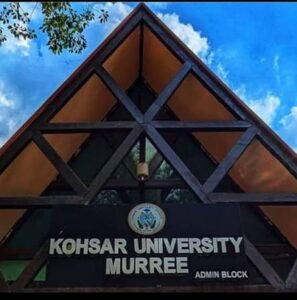
A study of Murree’s geographical history reveals that during the British Raj, these regions were strictly designated as hill stations—residence sanctuaries where colonial masters sought refuge during the blazing summer months. Over time, however, this geography was hurled into the furnace of an eco-colonialism driven by modern capitalist systems and reckless tourism, where glacial melting at alarming rates, widespread deforestation, and the ecological equilibrium of the mountains pushed the region to the brink of catastrophe. The tragedy of Kohsar University was that it was founded precisely within this delicate, arduous, and crisis-laden environmental zone, where a shortage of financial capital and punishing weather erected barriers at every turn. Yet history redirected its course because the institution’s leadership was entrusted to an intellectual framework unfettered by traditional university enclosures. From the advanced scientific and technological environment of NUST to a PhD and postdoctoral research tenure at Britain’s premier University of Surrey, this long journey guarantees that Dr. Rafia Mumtaz’s administrative vision possesses the absolute capacity to fracture the locked boundaries of stagnant bureaucracy. When a scientist equipped with a profound grasp of Artificial Intelligence (AI), cloud computing, data analytics, and modern digital economy assumes the leadership of a nascent mountain university, geographical constraints are effortlessly converted into its greatest strengths.

The most profound structural tragedy of our educational system has been the absolute disconnect of its curricula and research priorities from ground realities, local economies, and the genuine demands of the market. The colonial apparatus never bothered to link universities to contemporary global discourses or pressing societal issues. Kohsar University initiated a quiet, resolute, and decisive battle against this artificial legacy. Here, core disciplines such as tourism, hospitality, forestry, and environmental sciences were never restricted to conventional textbook pages; instead, they were engineered into the very axis of national policymaking, active fieldwork, and scientific models of sustainable development. It remains an open truth that this fledgling public university has battled severe financial strains and fund shortages since its inception, causing temporary delays in expanding advanced technical infrastructure. Yet this lag never served as a roadblock to unyielding resolve. In April 2026, leveraging its minimal financial leeway and routine development allocations, the university procured state-of-the-art computer systems to further upgrade its laboratories, demonstrating how adversity is met head-on.
The question is not merely when or how technological hardware was acquired, but rather what outcomes this institution yielded despite its constrained resources. Reviewing the academic stretch culminating in late May 2026 and recent academic sessions reveals a shining reality: Kohsar University’s computer science students secured the runner-up position during the 2023 and 2025 PINTECH Expo competitions, competing fiercely against more than seventy-5 renowned and conservative universities across Punjab. This achievement was no ordinary milestone; it stands as undeniable proof that resource scarcity can never suffocate true creative capability. Along this intellectual voyage, students clinched prominent triumphs in competitive Prime Minister’s Youth Initiative programs, engaged heavily in world-class online skill-based training pathways offered by Stanford University, and established their mettle across provincial academic arenas. These collective accomplishments bear witness to the fact that Kohsar University’s digital infrastructure and accompanying high-tech computer labs now signal a digital revolution atop the heights of Murree.
Murree and its surrounding landscapes presently occupy an extraordinarily perilous and critical juncture regarding climate change. Faced with rapid glacial retreat, unregulated tourist pressure, and catastrophic forest depletion, Kohsar University enacted an immediate, proactive intellectual response by activating its research gateways, empowering students and researchers to forsake the desperate search for traditional employment in favor of formulating practical scientific projects aimed at structuring the local economy along sustainable, eco-friendly, and digital lines. French philosopher Albert Camus once aptly noted, “To live without art or creation is equivalent to death, and the act of creation amidst adverse conditions constitutes humanity’s greatest rebellion.” This entire academic journey of Kohsar University embodies precisely this intellectual rebellion, waged intelligently through the weaponry of knowledge against a stagnant system and financial deprivation. When a university student utilizes a research thesis not merely to satisfy publication quotas in formal journals, but to ameliorate local ecological preservation and tourist economics, knowledge steps out of confined library chambers to illuminate society’s public pathways.
Despite this luminous and radiant panorama, an unvarnished analysis of structural flaws, the absence of financial self-sufficiency, and the entanglements of bureaucratic red tape within Pakistan’s university networks reveals that monumental challenges persist. Yet the ultimate zenith of a prudent, dynamic, and capable Vice Chancellor lies precisely in steering an institution toward administrative autonomy and fiscal stabilization despite minimal operational means. Dr. Rafia Mumtaz’s premier achievement rests in establishing an alternative, flexible, and modern administrative model from within this colonized and stagnant apparatus, transforming Kohsar University into a reference framework and case study for all remaining Pakistani universities. She has proven conclusively that true leadership avoids whining over grievances, choosing instead to carve bright paths to success from within the belly of unfavorable conditions.
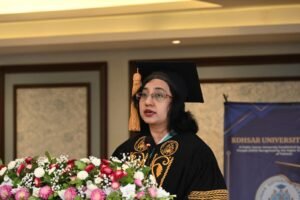
As the Government of Punjab and policymaking bodies officially position knowledge economies, digital governance, and youth empowerment at the forefront of development priorities, Kohsar University emerges as a luminous and practical embodiment of this state vision. To achieve this lofty objective, universities must transcend their reliance on routine government grants, transitioning toward a self-sustaining economic architecture fueled by tourist research, hospitality incubation, and industrial partnerships. An earnest appeal is directed to the Chief Minister of Punjab to announce a special, comprehensive development package for Kohsar University under the brilliant leadership of its new Vice Chancellor. The immediate construction of novel academic blocks, the establishment of advanced teaching and research laboratories, professional faculty enrichment, and the provision of standard student amenities will decisively set the course for this young institution’s upcoming decade. Sound governance demands that high-performing entities receive reinforced financial and administrative backing. If the Punjab government invests trust and resources timely into this fledgling enterprise, this very university will blossom in the coming years into a premier global hub of technology, modern research, and dynamic youth leadership across northern Pakistan. History testifies that timely patronage of a single institution frequently alters not merely the destiny of a university, but redirects the future trajectory of an entire region—and Kohsar University awaits this profound trust and timely state decision today.