
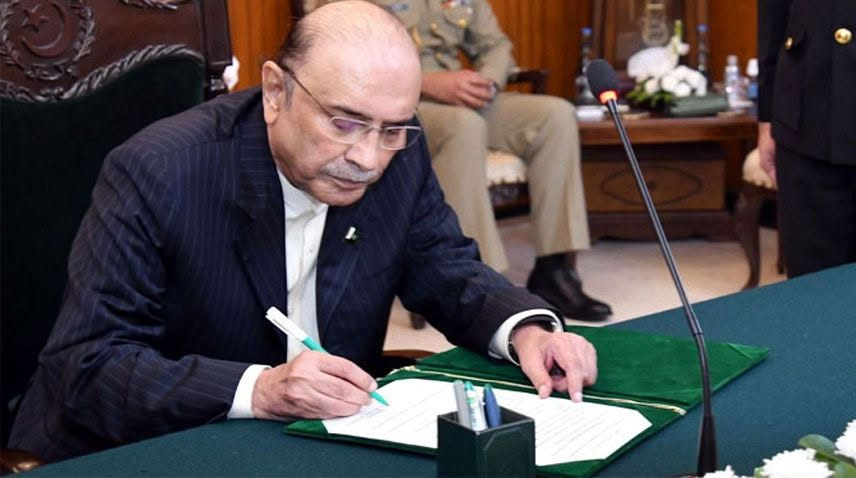
ISLAMABAD, October 11, 2026: President Asif Ali Zardari has approved the imposition of an emergency and governor’s rule in Khyber Pakhtunkhwa, invoking Articles 232 and 234 of the Constitution after the federal government cited a worsening security situation and rising terrorist attacks in the province.
The presidential proclamation took effect immediately on Sunday after Prime Minister Shehbaz Sharif sent constitutional advice to the president following approval by the federal cabinet.
According to the President’s Office, the emergency was imposed amid what it described as an extraordinary increase in terrorist violence, serious threats to public life and property and mounting attacks on government installations, infrastructure and law-enforcement agencies.
The federal government has argued that the provincial administration was unable to effectively address terrorism and deteriorating law and order, providing the basis for extraordinary constitutional intervention.
President Invokes Articles 232 and 234
President Zardari approved the measures under Articles 232 and 234 of the Constitution of Pakistan.
Article 232 provides for the declaration of an emergency when the security of Pakistan or any part of the country is threatened by war, external aggression or internal disturbance that a provincial government is unable to control.
Article 234 separately deals with a breakdown of constitutional machinery in a province and allows the president, under specified constitutional conditions, to assume or direct the governor to assume certain functions and powers of the provincial government.
Although the terms “emergency” and “governor’s rule” are often used together politically, they arise from distinct constitutional provisions and carry different legal consequences.
Provincial Executive to Cease Holding Office
Under the proclamation reported by Pakistani media, the federal government may direct the Khyber Pakhtunkhwa governor to assume all or specified functions of the provincial administration.
Authorities and institutions in the province, other than the provincial assembly where constitutionally protected, may also have their powers exercised under the arrangement provided in Article 234.
The proclamation further provides for the chief minister, provincial ministers, advisers, special assistants and advocate general to cease holding their respective offices with immediate effect, according to reports citing the presidential announcement.
The exact scope of the governor’s powers and the future functioning of the provincial assembly will depend on the wording of the presidential proclamation and the subsequent constitutional process.
Cabinet Approved Emergency Earlier on Sunday
The federal cabinet earlier approved the proposal to impose emergency measures in Khyber Pakhtunkhwa during a special meeting chaired by Prime Minister Shehbaz Sharif.
The prime minister subsequently advised President Zardari to invoke the relevant constitutional provisions.
The move followed days of discussions among senior government leaders over the deteriorating security situation in the province and growing tensions between the Centre and the PTI-led Khyber Pakhtunkhwa government.
Prime Minister Shehbaz Sharif and President Zardari had met a day earlier to discuss the country’s security and political situation as the federal government considered its constitutional options.
Terrorism Cited as Key Reason for Emergency
The presidency cited the sharp rise in terrorism and attacks on law-enforcement personnel and government infrastructure as central reasons for imposing the emergency.
The federal government has maintained that the worsening security environment has reached a level requiring direct constitutional intervention.
The decision comes as Khyber Pakhtunkhwa faces sustained militant violence, particularly in southern and merged districts, where police and security forces have repeatedly come under attack.
Government assessments presented during federal deliberations have also highlighted concerns over police manpower, counterterrorism capacity, equipment shortages and the increasing use of drones and improvised explosive devices by militants.
PTI Had Warned Against Governor’s Rule
The decision is also likely to deepen the political confrontation between the federal government and Pakistan Tehreek-e-Insaf, which governs Khyber Pakhtunkhwa.
Before the proclamation, KP Chief Minister Sohail Afridi had publicly rejected the prospect of governor’s rule or emergency measures, describing such a move as unconstitutional and warning that PTI would resist it.
The PTI leadership has maintained that the provincial government holds a democratic mandate and has opposed attempts to place the province under greater federal control.
The federal government, meanwhile, has argued that the exceptional security situation requires constitutional action.
Major Constitutional and Political Test Ahead
The imposition of emergency and governor’s rule marks one of the most significant interventions by the federal government in Khyber Pakhtunkhwa’s provincial administration in recent years.
The move is expected to trigger intense political and legal debate over the constitutional grounds for the decision, the powers transferred to the governor and the status of the provincial government and assembly.
Attention will also turn to Parliament, as emergency provisions under the Constitution are subject to specified parliamentary procedures and time limits.
With the presidential proclamation now in force, the coming days are expected to determine how the new administrative arrangement will operate and whether the decision faces a constitutional challenge from the PTI or other political stakeholders.