
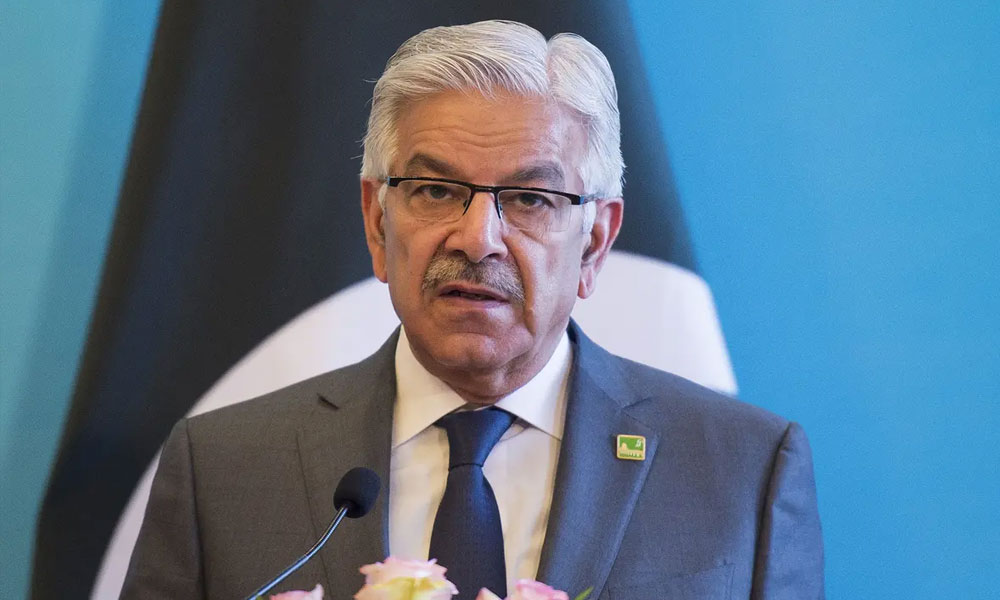
ISLAMABAD: Defence Minister Khawaja Muhammad Asif said on Monday that those questioning the army’s presence along the border should first account for what he described as 13 years of governance and security failures in Khyber Pakhtunkhwa, arguing that the province’s core problem was terrorism rather than politics.
In a detailed post on social media platform X, Asif said PTI’s approach had remained fundamentally at odds with the state’s counterterrorism policy. He alleged that former prime minister Imran Khan had long maintained a soft stance towards the banned Tehreek-e-Taliban Pakistan and had pushed the security establishment towards what he called ill-advised negotiations with militants.
He said the consequences of that approach were now being borne by Khyber Pakhtunkhwa and the rest of the country.
“The policy of the Pakistan Army and the state is clear: terrorists will be eliminated completely,” Asif said, adding that PTI was still advocating engagement and negotiations with extremist groups.
Responding to PTI’s argument that militants should not be able to enter the country if the army was deployed at the border, Asif asked who was fighting on the front lines and making daily sacrifices against terrorists if the military was doing nothing.
He also rejected criticism describing counterterrorism operations as a “dollar war,” asking how many billions of dollars the United States had provided to Pakistan in recent years.
The defence minister further argued that when militants were using drones to attack Kohat, Peshawar and security posts, the armed forces had every right to use modern technology in self-defence.
Asif cited what he described as alarming security figures for Khyber Pakhtunkhwa, saying 6,200 terrorism incidents had taken place in the province over the past two years, resulting in 1,200 deaths. He also claimed that Afghan nationals had carried out 37 suicide attacks, while 14 suicide bombings had taken place so far this year, most of them involving Afghan nationals.
He also criticised the state of the Khyber Pakhtunkhwa Police and Counter Terrorism Department.
According to Asif, the provincial police force has a sanctioned strength of 125,000, but around 13,000 personnel are deployed on VIP security duties while 17,000 posts remain vacant.
He said the CTD was largely ineffective in the merged districts, claiming that of its total strength of 3,300, only 25 personnel were permanent while the rest were working on contract. He added that the department had only 17 bulletproof vehicles.
Asif also alleged that the police had sought Rs42 billion for reconstruction and strengthening of security posts, but the provincial government released only Rs1.2 billion.
He further alleged that the full Rs42 billion was shown as spent on paper despite the much lower actual release, accusing the provincial administration of misusing the funds while police personnel continued to lose their lives because of inadequate resources.
The minister said more than 3,000 terrorism cases remained pending and claimed that no convictions had been secured.
Rejecting PTI’s allegations that Khyber Pakhtunkhwa had been denied federal funds, Asif released financial figures that he said showed the province received Rs8.504 trillion from the federal government between 2010 and 2025.
According to the figures cited by the defence minister, Khyber Pakhtunkhwa received Rs5.867 trillion under the 7th National Finance Commission Award, Rs705 billion from the one per cent share of the divisible pool allocated for the war against terrorism, Rs704 billion for the merged districts, Rs482.78 billion in direct transfers including royalties and gas development surcharge, Rs481.43 billion in Benazir Income Support Programme spending, Rs117.16 billion for internally displaced persons and Rs46.44 billion in the latest NFC instalment.
Asif said the issue was not a shortage of funds but corruption and weak governance that had prevented resources from producing results.
He also questioned whether PTI leaders had ever visited frontline positions or military posts, met families of fallen personnel, established functioning police stations and courts in the merged districts, or convened sufficient apex committee meetings on terrorism.
The defence minister said the state’s basic strategy remained “hold, build and transfer,” under which the military cleared and secured areas at the cost of lives, while the provincial government and civil administration were responsible for taking over governance and building institutions.
He accused the PTI-led provincial government of failing to fulfil that responsibility.