
Monitoring Report
LONDON: British-Pakistani entrepreneur and educationist Bilal Sheikh has paid tribute to Pakistan’s founder Quaid-e-Azam Muhammad Ali Jinnah, saying his vision, political struggle and leadership gave the Muslims of the subcontinent a separate homeland that is today home to around 250 million people.
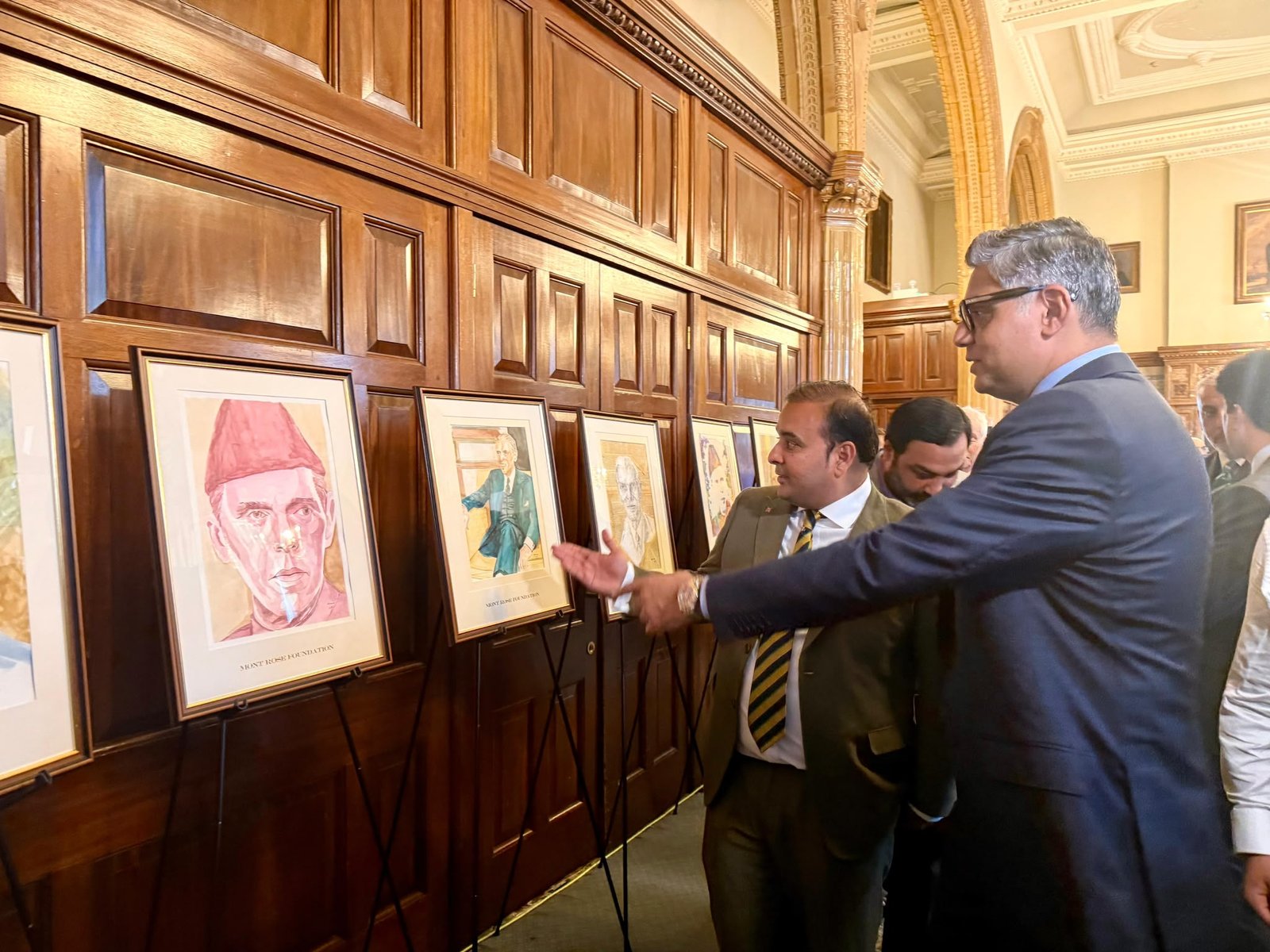
He was speaking at the art exhibition by Mont Rose Foundation, titled “Quaid-e-Azam Muhammad Ali Jinnah: A Legacy Beyond Time,” to celebrate the enduring legacy of Pakistan’s founding father at the prestigious National Liberal Club on Whitehall Place in central London.
The event featured Pakistan’s newly appointed High Commissioner to the United Kingdom, Tipu Usman, along with artist Amera Rashid and several prominent members of the British-Pakistani community, educationists, entrepreneurs and other dignitaries.
In his key-note remarks, the High Commissioner stated that Jinnah firmly believed in the rule of law, reasoned argument, dialogue and political negotiation despite differences with opponents. Tipu Usman said that Jinnah’s legacy was not only about remembering the struggle that led to the creation of Pakistan but it was equally about understanding the principles and values that guided that struggle. The High Commissioner appreciated the efforts of Mr. Bilal Sheikh, CEO of Mont Rose Foundation for organizing the exhibition and also for commissioning a portrait of Quaid-e-Azam that is permanently placed in the National Liberal Club.
Sheikh, the founder of Mont Rose College in London which now teaches thousands of adult students each year, said the creation of Pakistan was the result of Jinnah’s extraordinary constitutional struggle, political determination and commitment to securing a future in which the Muslims of British India could determine their own political, economic and social destiny.
Bilal Sheikh said that more than seven decades after Pakistan came into existence, Jinnah’s message remained relevant not only for Pakistan but also for millions of Pakistanis living around the world, especially so that Pakistan has gained international prominence at the global stage.
“Pakistan’s recent role for the international peace and harmony and for the prevention of war in the Middle East is inspired by what Jinnah taught us. Pakistan’s resounding victory last year in May against a much bigger rival India proved why Quaid-e-Azam Muhammad Ali Jinnah created a new country and why it today asserts as a proud, strong and resilient nation. Jinnah did not simply campaign for a piece of territory. He fought for the political rights, dignity and future of millions of people. The Pakistan of nearly 250 million people that we see today exists because Jinnah had the courage and foresight to pursue a political objective that many once considered impossible,” Sheikh said.
“British Pakistanis are part of the success story of modern Britain. We are present in education, medicine, law, business, public service, technology and many other professions. Serving Britain successfully while contributing to Pakistan’s development is entirely consistent with the values of responsibility, education and progress that Quaid-e-Azam championed,” Sheikh said.
Bilal Sheikh, a British-Pakistani education entrepreneur and CEO of East London-based Mont Rose College, has campaigned for several years for greater recognition of Pakistan’s founder Jinnah in Britain. In 2022, Sheikh commissioned Jinnah’s portrait for London’s National Liberal Club, where Jinnah had been a member more than a century earlier. Sheikh has also advocated for a statue of Jinnah in Parliament Square, arguing that the statesman’s historical links with Britain and his political legacy deserve greater public recognition.
Also Read: Ambassador Albert P. Khorev’s Congratulatory Message on Independence Day of Pakistan