
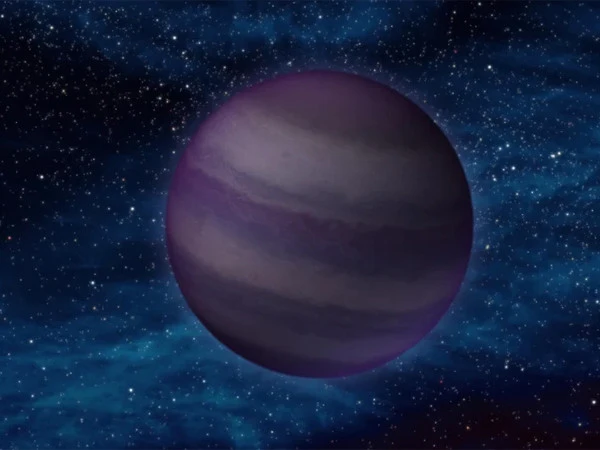
Islamabad: Astronomers have made the first direct confirmation of changing water-cloud thickness on a cold, Jupiter-sized celestial object located about 7.5 light-years from Earth.
A research team led by University of Arizona astronomer Brittany Miles used the James Webb Space Telescope to observe the brown dwarf WISE 0855 continuously for about 11 hours, allowing scientists to track changes in its atmosphere as the object rotated.
WISE 0855 is among the coldest brown dwarfs ever discovered, with an estimated temperature of about 265 kelvin.
Brown dwarfs are objects more massive than planets but not massive enough to sustain the nuclear fusion processes that power stars.
Water Clouds Change as WISE 0855 Rotates
The observations showed that water clouds in the atmosphere of WISE 0855 become thicker and thinner as the brown dwarf rotates.
Researchers also found evidence that chemical gases from deeper atmospheric layers are being transported upward through thermal processes.
The findings provide a more detailed picture of how weather and atmospheric circulation can operate on extremely cold worlds beyond the Solar System.
Webb Tracked the Object Every 15 Minutes
Scientists recorded the spectrum of light coming from WISE 0855 at roughly 15-minute intervals throughout the 11-hour observation period.
That allowed the team to examine how the object’s atmospheric conditions changed over time rather than relying on a single snapshot.
By tracking variations in the spectrum, researchers were able to identify changes associated with the movement and thickness of water clouds as well as gases rising from deeper layers.
The research was published in The Astrophysical Journal.
Discovery Could Help Explain Weather on Distant Worlds
Astronomers say the findings mark an important step in understanding weather systems and atmospheric dynamics on celestial objects outside the Solar System.
Because WISE 0855 is exceptionally cold, its atmosphere provides scientists with a rare opportunity to study processes involving water clouds under conditions that differ sharply from those on hotter brown dwarfs and stars.
The observations could also help researchers improve models used to study the atmospheres of giant exoplanets and other cold worlds.