
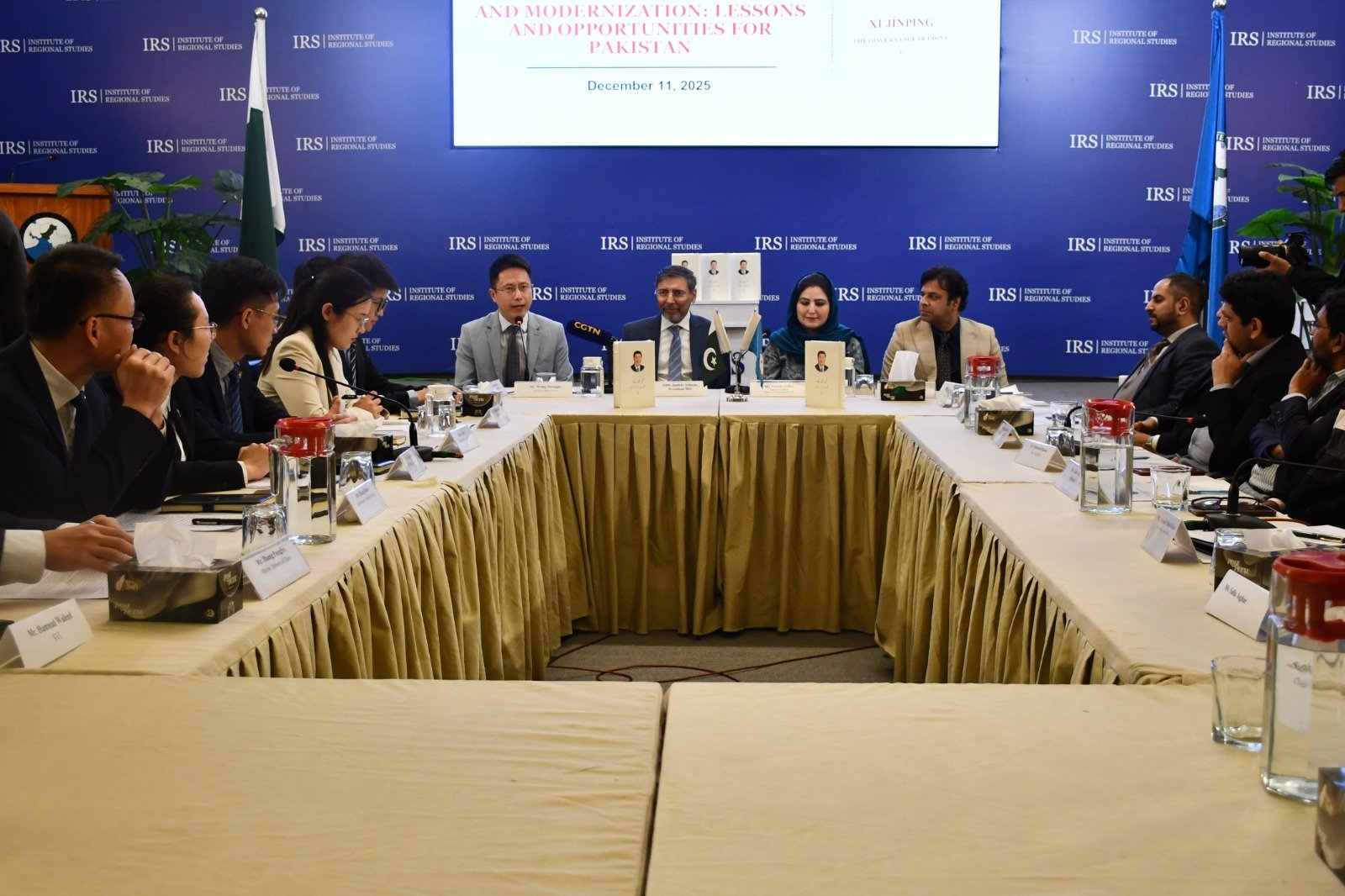
Islamabad: The Institute of Regional Studies (IRS), in collaboration with the Embassy of the People’s Republic of China, hosted a dialogue on “China’s Path to Development and Modernization: Lessons and Opportunities for Pakistan,” bringing together Chinese diplomats, Pakistani experts, and young scholars for a structured exchange on governance and economic development models.
Delegation highlights China’s governance and planning framework
The Chinese delegation, led by Counselor Wang Shengjie, included several attachés and secretaries from the embassy. They discussed the nation’s development approach, long-term governance structure, and priorities under its modernization agenda for 2035. Participants also reviewed the objectives of China’s upcoming Five-Year Plan (2026–2030), which focuses on high-quality growth, technological self-reliance, domestic consumption, and expanded global engagement.
IRS president outlines relevance for developing states
Ambassador Jauhar Saleem, President of IRS, opened the session by noting the relevance of the country’s sustained economic expansion and developmental planning for countries seeking stability and long-term growth. He emphasized the value of studying structured national strategies, particularly multi-year planning mechanisms, for improving development outcomes.
Review of new volume on China’s governance
A key component of the dialogue was the discussion of the fifth volume of Xi Jinping: The Governance of China, released in July 2025. The book compiles 91 speeches and writings from May 2022 to December 2024 and is organized into 18 thematic sections. Participants examined its focus on modernization, governance practices, and China’s evolving global role. The series, translated into multiple languages, has been circulated widely in international academic and policymaking circles.
Policy themes and cooperation areas discussed
Delegates also exchanged views on China’s people-centered governance, diplomatic approach, internal reforms, and initiatives such as the Belt and Road Initiative and CPEC. Speakers noted that these frameworks continue to shape bilateral engagement and economic cooperation with Pakistan.
Pakistani scholars share domestic perspectives
Pakistani participants—including academics, analysts, and policy researchers—discussed national governance challenges and opportunities for learning from China’s planning model. They highlighted issues such as policy consistency, skills-based education, and the need for long-term investment in technology and human development.
Focus on opportunities for Pakistan
The dialogue further explored how Pakistan could draw lessons from the country’s long-term planning, institutional reforms, and modernization tools. Participants identified potential areas for collaboration in education, technology, and policymaking.
Session ends with emphasis on continued cooperation
The event concluded with both sides expressing interest in maintaining dialogue and strengthening cooperation in governance research, cultural exchange, and development-focused initiatives.
Read related news here: https://thepublicpurview.com/category/world-news/china-insights/
For more stories and insights, visit The Green Post


 Today's E-Paper