
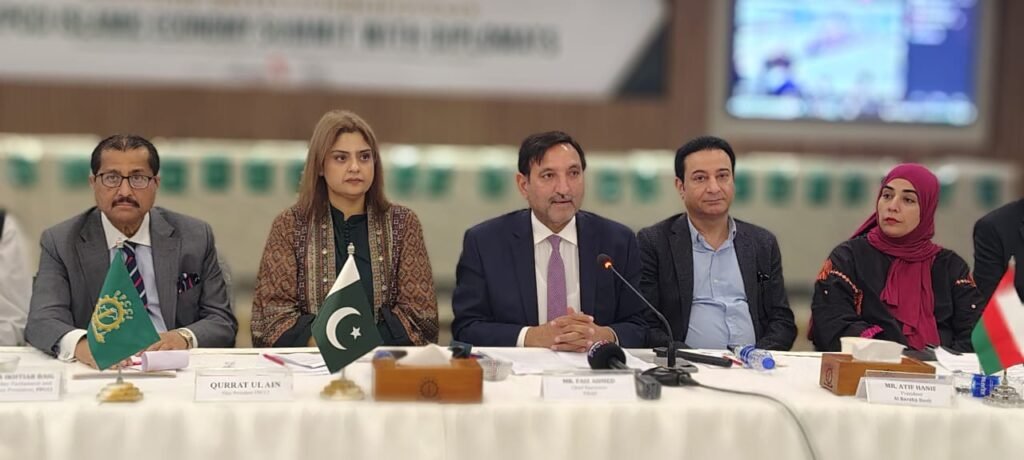
KARACHI: The Federation of Pakistan Chambers of Commerce and Industry (FPCCI) has called for stronger economic integration among Islamic countries through increased trade, investment, joint ventures, tourism and business connectivity, highlighting the economic potential of the 57 Muslim-majority and Muslim-member countries.
Addressing the FPCCI Islamic Economy Summit with Diplomats, FPCCI Vice President Qurat-ul-Ain, who presided over the event, urged Islamic countries to move beyond traditional bilateral trade and build a more integrated economic partnership based on business-to-business linkages, technology exchange, investment cooperation and improved connectivity.
Held under the theme “Promoting Islamic Economic Integration through Bilateral and Multilateral Cooperation for Community Development,” the summit brought together diplomats, commercial counsellors, business leaders, financial institutions, academics and other stakeholders.
Government Pledges Support for Trade Cooperation
Chief Guest Faiz Ahmed, Chief Executive of the Trade Development Authority of Pakistan (TDAP), assured participants that the government would support initiatives aimed at strengthening economic cooperation among Islamic countries.
He said Pakistan needed to deepen its economic relationships with Organisation of Islamic Cooperation (OIC) member states and improve trade and business connectivity.
Referring to intra-OIC trade, Faiz Ahmed said trade among member countries reached approximately US$1 trillion in 2024, compared with US$884 billion in 2023. He noted that intra-OIC trade accounted for around 20.36 per cent of member countries’ total foreign trade, against an OIC target of 25 per cent.
He emphasised the need to create an enabling environment for greater investment, private-sector collaboration and commercial partnerships across Islamic economies.
Pakistan’s Halal Export Potential Highlighted
Dr Mirza Ikhtiar Baig, MNA, said Pakistan had significant potential to expand exports of halal food, meat, pharmaceuticals, cosmetics and other halal-certified products to Muslim markets.
He highlighted opportunities for the country’s textile and garment industry to increase exports through competitive pricing, improved branding, value addition and compliance with international and halal standards.
He also identified opportunities in rice, fruits, vegetables, seafood, livestock and processed foods, particularly in Gulf markets, as well as pharmaceuticals and healthcare products in developing Muslim countries.
Dr Baig stressed that stronger international certifications, regulatory compliance and branding would be essential for Pakistani businesses to gain a larger share of these markets.
Islamic Finance and Business Connectivity
Sheikh Yousef Hassan Khalawi, Secretary General of the Islamic Chamber of Commerce and Development (ICCD), stressed the importance of economic connectivity and tourism, calling for innovative approaches to turn the economic potential of Islamic countries into practical business opportunities.
Ahmed El Wakil, ICCD Vice President and President of Bank Al Baraka, highlighted the role of Islamic financial institutions in facilitating investment, trade and cross-border economic partnerships.
Muhammad Irfan Ahmed, Head of Shariah Compliance at BankIslami, discussed the growing importance of Shariah-compliant financial instruments in supporting businesses, small and medium-sized enterprises (SMEs) and productive economic sectors.
Prof. Dr Irum Saba of the Institute of Business Administration (IBA) highlighted the importance of Islamic finance, financial inclusion, research and human capital development in building a modern Islamic economic ecosystem.
Diplomats Call for Stronger Institutional Cooperation
Ambassador Fawad Sher, Permanent Representative of Pakistan to the OIC, and Irfan Soomro, Director General at the Ministry of Foreign Affairs, said Islamic countries possessed complementary resources, markets, investment opportunities and human capital.
They stressed that stronger institutional mechanisms were needed to connect these resources and expand cooperation in trade facilitation, investment, Islamic finance, agriculture, food security, tourism, technology, education and business mobility.
Representatives of diplomatic missions from Afghanistan, Azerbaijan, Bangladesh, Oman, the Maldives, Iran, Indonesia, Côte d’Ivoire, Malaysia, Thailand, Mauritius, Türkiye, the United Arab Emirates, Sri Lanka, Uzbekistan and Jordan also attended the summit.
Participants highlighted opportunities for joint ventures and regional value chains in halal food, agriculture and agro-processing, textiles, pharmaceuticals, technology, energy, tourism, logistics and manufacturing.
FPCCI Pledges Continued Engagement
FPCCI reiterated its commitment to providing a platform for government institutions, diplomatic missions, chambers of commerce, financial institutions, academia and private businesses to identify investment opportunities and establish practical mechanisms for cooperation.
The summit concluded with a call to translate discussions into concrete trade initiatives, investment partnerships and joint ventures, with greater private-sector participation in building a more integrated Islamic economic partnership.