
China: Chinese entrepreneur Cheng Lu is exploring how multimodal artificial intelligence could help reduce communication barriers between people who use sign language and those who rely on speech.
Cheng, a former Google developer relations program manager and Hugging Face Fellow, has developed an AI accessibility concept called EchoBridge, which focuses on translating between sign language, speech and text.
The initiative comes as artificial intelligence applications expand rapidly across industries, with much of the current development focused on productivity tools such as coding assistants, content generation, customer service and data processing.
However, advances in multimodal AI — systems capable of processing text, audio, images and video together — are also creating opportunities to address accessibility challenges that have traditionally been difficult for technology to solve.
EchoBridge explores how computer vision, language models and multimodal AI could be combined to support communication between people who use different modes of interaction.
The concept is aligned with broader efforts in China to expand the adoption of artificial intelligence. According to this year’s Government Work Report, the country is accelerating its “AI+” initiative and promoting the large-scale commercial application of AI across key industries.
Accessibility remains a significant global challenge. The World Health Organization estimates that around 430 million people worldwide require rehabilitation for disabling hearing loss, with that figure projected to exceed 700 million by 2050.
Cheng noted that untreated hearing loss is estimated to carry an annual global economic cost of nearly $1 trillion. While these figures do not directly represent the number of sign language users, they highlight the broader scale of hearing-related accessibility needs.
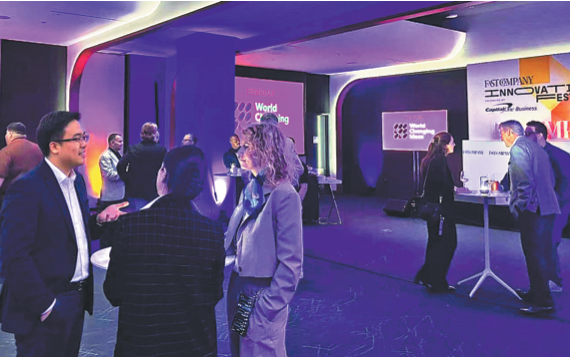
EchoBridge recently received international recognition when it was awarded an Honorable Mention in the social equity and accessibility category of Fast Company’s 2026 World Changing Ideas Awards.
Fast Company held a reception for the award honorees in New York on September 16, which Cheng attended.
The project also builds on Cheng’s earlier experience in developer and open-source technology communities.
During three years as a developer relations program manager at Google, Cheng launched Study Jams China, with two editions attracting nearly 4,000 participants. He later worked on the adoption of Google’s Flutter development framework in China, collaborating with more than 20 major technology companies on developer ecosystem initiatives.
After leaving Google, Cheng became a Hugging Face Fellow and expanded his involvement in the open-source artificial intelligence community. He is also a senior member of the Institute of Electrical and Electronics Engineers.
Cheng said his experience working with developer communities shaped his view that technological progress should ultimately be measured by its ability to solve real-world problems.
“When I was working with developer communities at Google, I saw many developers start by learning a new technology and eventually turn it into a real product,” Cheng said.
“Later, through the open-source AI community, I became convinced that the value of a technology lies not just in what it can do, but in whether people can use it to solve real-world problems.”
As multimodal AI capabilities continue to improve, Cheng said he has increasingly focused on whether technologies designed primarily to improve productivity can also help people who have historically benefited less from technological advances.
“A lot of AI products today are asking the same question: how can we help people do things faster and more efficiently?” he said.
“I wanted to ask one more question — can these same capabilities also help people who have historically benefited less from technological progress?”
EchoBridge is Cheng’s attempt to explore that possibility, using developments in vision, language and multimodal AI to investigate new ways of improving communication accessibility.