
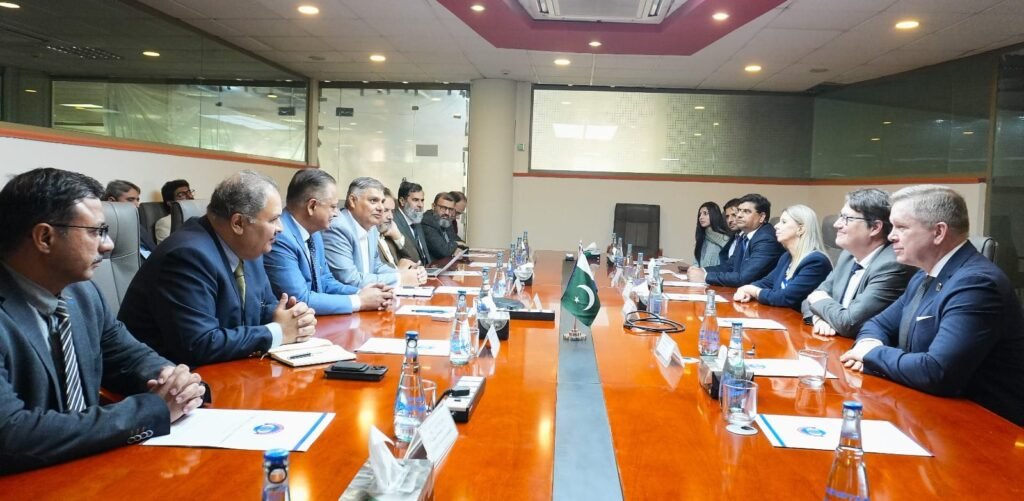
ISLAMABAD: COMSATS University Islamabad (CUI) and the European Organization for Nuclear Research (CERN) have held high-level talks to revive scientific cooperation, particularly the university’s participation in the ALICE experiment, opening new prospects for Pakistani researchers in particle physics and advanced detector technology.
The discussions focused on restoring long-standing institutional ties and exploring opportunities in detector development, advanced scientific equipment manufacturing, hardware and software engineering, and large-scale data analysis.
According to a statement issued by COMSATS University on Tuesday, the CERN delegation met CUI Rector Professor Dr Raheel Qamar, senior university officials and faculty members.
Rector Virtual University of Pakistan Professor Dr Arshad Saleem Bhatti, who laid the foundation for ALICE-related research at COMSATS, also attended the meeting.
The CERN delegation included Dr Christoph Schaefer, Head of Associate Member State Relations; Professor Dr Anadi Canepa, spokesperson for the CMS experiment; and Dr Kai Oliver Schweda, spokesperson for the ALICE experiment.
Reviving Scientific Cooperation
Professor Dr Arshad Saleem Bhatti highlighted COMSATS University’s previous contributions to the ALICE experiment, particularly the upgrading of its Inner Tracking System (ITS).
He said university researchers and technical specialists had contributed to silicon pixel detector design, electronics development, equipment testing and detector assembly.
However, financial constraints and difficulties in importing specialised scientific equipment had disrupted the university’s participation in the international research programme.
Dr Bhatti expressed support for renewed engagement, highlighting the university’s previous experience and technical expertise.
CUI Rector Professor Dr Raheel Qamar reaffirmed the university’s commitment to rebuilding scientific cooperation with CERN, emphasising that past challenges should not hinder future collaboration.
He stressed the importance of developing a practical and sustainable framework that addresses administrative and financial constraints while enabling researchers and faculty members to participate in CERN’s scientific programmes.
Dr Uzma Tabassum from the Department of Physics also briefed the delegation on the university’s existing research capabilities and potential contributions to CERN’s experimental programmes.
New Opportunities Under ALICE 3
Dr Kai Oliver Schweda acknowledged COMSATS University’s previous technical contributions and discussed opportunities for renewed cooperation in silicon detector development, hardware and software engineering, data analysis and specialised technical training.
He also outlined the future research agenda of the ALICE experiment, particularly the proposed ALICE 3 project, which could create new opportunities for scientific and technological collaboration.
Highlighting the multidisciplinary nature of CERN’s research, he said major particle physics experiments also require expertise in electrical engineering, materials science and computer science.
Strengthening Pakistan’s Research Capacity
The proposed collaboration could provide Pakistani researchers and technical specialists with opportunities to work on advanced scientific instruments, acquire specialised skills and participate in internationally recognised research programmes.
The meeting concluded with both sides reaffirming their commitment to strengthening scientific ties and exploring practical avenues for restoring COMSATS University’s participation in CERN’s experimental programmes.
Renewed cooperation could strengthen Pakistan’s scientific research capacity, promote technological innovation and expand international academic collaboration across multiple disciplines.