
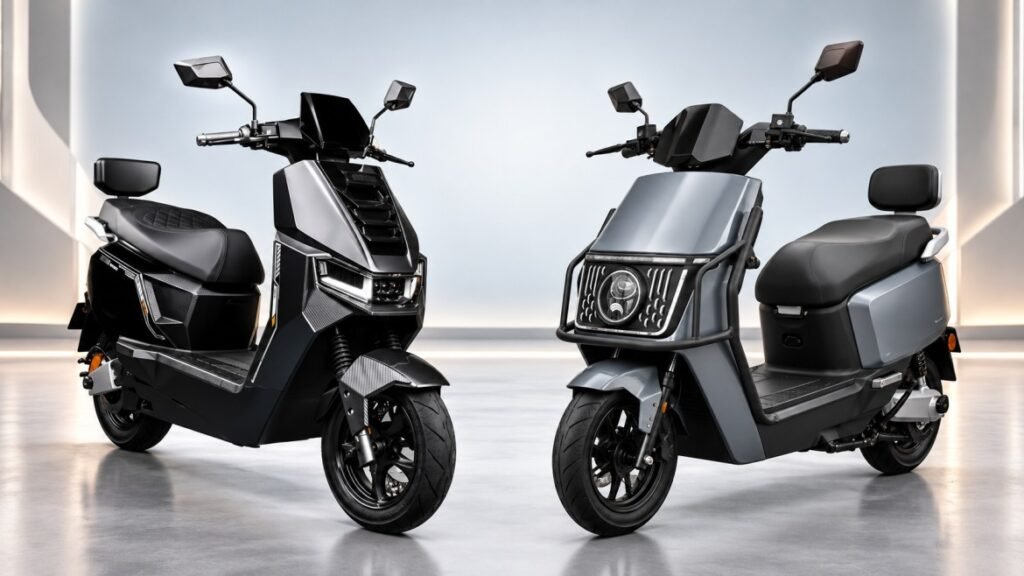
Islamabad: Electric scooters in Pakistan are no longer judged simply by how much petrol they can save. At around Rs300,000, buyers now expect practical range, decent performance, strong road presence and enough features to justify moving to electric mobility.
Two models competing closely in this price bracket are the EVEE S1 Air Lithium and the Crown Champion Pro.
PakWheels has experienced both models, making the comparison more meaningful than a simple side-by-side look at specification sheets.
So, which one makes more sense for everyday use?
Crown Champion Pro vs EVEE S1 Air Lithium specs
| Specification | Crown Champion Pro | EVEE S1 Air Lithium |
|---|---|---|
| Price | Rs335,000 | Rs319,900 |
| Motor | 1,500–2,200W brushless | 2,200W |
| Battery | 73.6V 60Ah | 76.8V 35Ah |
| Approx. Battery Capacity | 4.4 kWh | 2.7 kWh |
| Battery Type | Lithium LFP | Phylion Lithium |
| Claimed Range | 160–180 km in Eco | 90–110 km |
| PakWheels Range Experience | Around company-claimed 160–180 km | Around 80–85 km* on S1 Air Graphene |
| Top Speed | 60–70 km/h | 65–70 km/h |
| Charging Time | 6–7 hours | Around 5 hours |
| Riding Modes | 4 | Eco, Normal, Sport |
| Weight | 112 kg | Around 95 kg |
Price: just Rs15,100 separates the two
The EVEE S1 Air Lithium is priced at Rs319,900, while Crown lists the Champion Pro at Rs335,000.
That leaves a difference of only Rs15,100.
At this price level, the gap is relatively small. The real question is whether Crown’s larger battery and significantly higher claimed range justify paying extra, or whether the lighter EVEE provides enough performance and practicality for everyday city use.
Battery: Crown holds a major capacity advantage
This is where the comparison begins to tilt strongly towards the Crown Champion Pro.
The Champion Pro uses a 73.6V 60Ah LFP battery, which works out to roughly 4.4 kWh. Crown specifically identifies the battery chemistry as lithium iron phosphate, or LFP.
The S1 Air Lithium, meanwhile, uses a 76.8V 35Ah Phylion lithium battery with an approximate capacity of 2.7 kWh.
On paper, that gives the Crown roughly 60 percent more usable battery capacity.
The trade-off is weight. The Champion Pro weighs around 112 kg, while the S1 Air is noticeably lighter.
For short city commutes, the EVEE’s smaller battery may not be a major concern. But for riders covering longer distances every day, the difference in battery size becomes much more important.
Range: Crown creates a clear gap
Crown claims a range of 160–180 km in Eco mode for the Champion Pro.
More importantly, PakWheels has already tested the scooter and found its range performance to be in line with the company’s claim.
That makes the number particularly significant, as advertised EV ranges can often differ from real-world results.
EVEE claims 90–110 km for the S1 Air.
PakWheels also extensively tested an S1 Air. In that review, the Graphene version returned around 80–85 km in real-world use against EVEE’s claimed 90–110 km Eco-mode range. The scooter also reached a top speed of 69 km/h.
It is important to note that this test involved the Graphene S1 Air. For the S1 Air Lithium, EVEE’s current official claimed range remains 90–110 km.
Even when comparing only the manufacturers’ figures, the difference remains substantial:
- Crown Champion Pro: 160–180 km
- EVEE S1 Air Lithium: 90–110 km
For riders regularly covering 60, 80 or even 100 kilometres a day, the Crown’s additional battery reserve can significantly change the ownership experience.
Performance is much closer
While the range gap is considerable, outright speed is far more evenly matched.
Both scooters operate in roughly the 60–70 km/h bracket.
The EVEE uses a 2,200W motor and claims a top speed of 65–70 km/h. Crown, meanwhile, lists a 1,500–2,200W brushless motor with performance of 60–70 km/h.
For normal urban riding and keeping pace with city traffic, neither scooter has an obvious disadvantage in terms of speed.
Features: both offer a modern scooter experience
The Champion Pro comes equipped with NFC keyless unlocking, a digital instrument cluster, side-stand sensor, reverse mode, full LED lighting, CBS braking, under-seat storage, a glove box and front hooks.
Crown also equips it with dual front disc brakes and protective side bars.
The S1 Air takes a similarly modern approach, offering a digital display, cruise control, reverse mode, Power Mode, USB charging, dual disc brakes, tubeless tyres and a side-stand sensor.
In terms of equipment, the two scooters are fairly close.
The EVEE feels more focused on convenient city commuting, while the Crown comes across as a longer-distance commuter with greater battery capacity.
Design and road presence
Design is naturally the most subjective part of the comparison.
The EVEE S1 Air has a smooth, rounded and relatively clean design. It looks modern without appearing overly bulky.
Its lighter proportions may also make it easier to manage in dense urban traffic. For students, office commuters or riders looking for something easier to park and move around, this can be an advantage.
The Crown Champion Pro, by comparison, has visibly more mass.
Its circular LED headlamp, wider front body, protection bars and larger overall stance give it stronger road presence.
It looks more substantial beside smaller electric scooters, and that heavier visual character reflects what sits underneath: a considerably larger battery and higher overall weight.
Which scooter makes more sense?
The EVEE S1 Air Lithium remains a strong option for urban commuting.
It costs slightly less, delivers good performance, offers useful storage and provides enough range for most regular office or university journeys.
PakWheels’ experience with the S1 Air also showed realistic performance, with the tested scooter reaching 69 km/h.
However, if range is the main deciding factor, the Crown Champion Pro has a clear advantage.
For just Rs15,100 more, buyers get a 4.4 kWh LFP battery compared with roughly 2.7 kWh in the EVEE, along with Crown’s claimed 160–180 km Eco-mode range.
More importantly, PakWheels found the Champion Pro’s real-world range performance to be consistent with the manufacturer’s claim.
That makes the choice less about which scooter is faster and more about how far the rider needs to travel on a regular basis.