
ISLAMABAD: A new study by Mobilink Bank and the Sustainable Development Policy Institute (SDPI) has highlighted the financial vulnerability of women farmers in Pakistan, with many relying on borrowing to cope with climate-related shocks while facing limited access to formal financial services.
The study calls for gender-responsive climate finance and tailored financial products to help women farmers protect their livelihoods, recover from climate shocks and build long-term resilience.
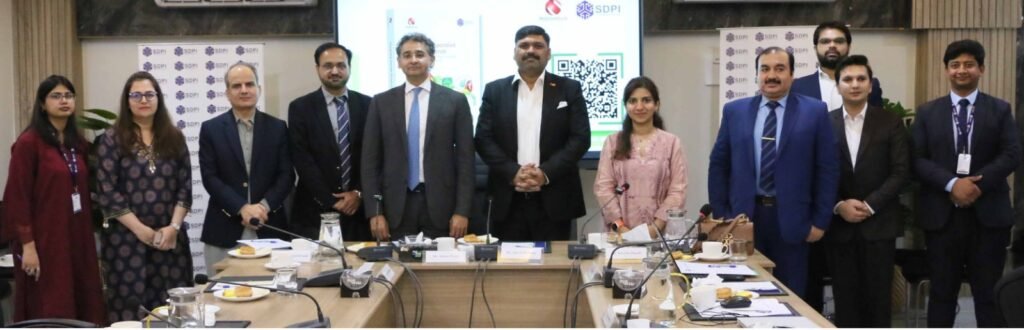
Titled “Designing Gender-Responsive Climate Finance: A Diagnostic Study and Product Framework for Women Farmers in Pakistan,” the research draws on fieldwork across eight districts in Punjab and Sindh. Its findings were presented at a policy dialogue jointly hosted by SDPI and Mobilink Bank in Islamabad, bringing together government officials, regulators, financial institutions and development partners.
Adviser to the Finance Minister Adnan Pasha, who attended the launch as guest of honour, stressed the need to formally recognize women farmers as economic contributors and key actors in Pakistan’s agricultural economy.
Pasha said the government was considering policy recommendations emerging from the study and urged financial institutions to develop products that address women farmers’ specific barriers, including limited access to finance, collateral constraints and climate risks.
Khowla Shoaib, Head of Strategy, Sustainability & Women Financial Services at Mobilink Bank, said agriculture accounts for approximately 60% of the bank’s gross loan portfolio (GLP), while women represent more than 21% of its borrowers.
She said the study reinforced the bank’s understanding of the financial and climate-related challenges faced by women farmers and would help inform the development of new gender-responsive financial products.
Climate Shocks Driving Borrowing
More than nine in 10 women surveyed had experienced an extreme climate-related event during the previous five years, including heatwaves, floods, heavy rainfall or drought-like conditions. More than 80% reported crop losses or other negative impacts on farming.
Borrowing emerged as one of the most common coping strategies across all surveyed districts. In Khushab, every woman who reported using a coping strategy had borrowed money, while more than half had also sold livestock, potentially weakening their future earning capacity.
The study also identified major structural barriers limiting women’s participation in the formal agricultural economy.
According to the research, 67% of employed women in Pakistan work in agriculture, yet only 1.5% of agricultural households are formally recorded as female-headed. Land ownership is also highly limited, with only about 2% of ever-married women aged 15 to 49 reported to own land either alone or jointly.
In Sindh, 99.1% of surveyed women did not own land either individually or jointly. The financial and digital gender gaps further restrict access to formal services: 56% of men have full-service financial accounts compared with 14% of women, while mobile-wallet ownership stands at 48% among men and 11% among women.
Call for Inclusive Financial Products
SDPI lead researcher Ayesha Naeem said the findings exposed structural and policy gaps that require urgent attention.
Dr. Sajid Amin Javed, Deputy Executive Director (Research) at SDPI, said the study was significant because it examined climate finance at the micro-farmer level and applied a gender lens to an agricultural workforce in which women remain largely unrecognized.
He emphasized the importance of strengthening agriculture and livestock to support Pakistan’s wider rural economy and said partnerships with financial institutions could help expand research through access to large-scale customer data.
Engr. Ubaid Zia, Head of the Energy Unit at SDPI, said women farmers were already performing agricultural work, absorbing climate-related losses and borrowing to survive, but formal financial systems often failed to reflect their realities.
The study comes amid rising climate risks in Pakistan. The 2022 floods caused more than $30 billion in damages and economic losses, while an estimated $16.3 billion was required for resilient reconstruction.
The researchers and financial sector stakeholders called for products designed around the realities of women farmers, including their limited land ownership, mobility and digital access, to strengthen agricultural and climate resilience.