
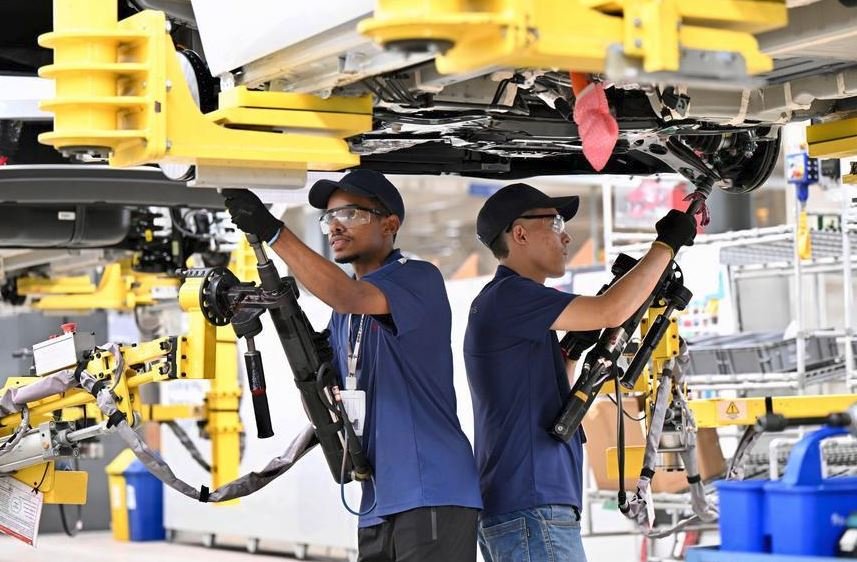
BEIJING, September 13: Chinese new energy vehicle manufacturers are accelerating their overseas expansion, moving beyond vehicle exports to establish factories, research facilities and local supply chains in markets across Europe, Africa, Latin America and Asia.
The shift comes as Chinese electric vehicle brands gain a larger share of global markets, supported by competitive pricing, battery technology and increasingly localised production strategies. China remained the world’s largest EV manufacturing hub in 2025, producing nearly three-quarters of the world’s electric cars, according to the International Energy Agency.
Chinese industry data cited for the first eight months of 2026 showed strong growth in both overall vehicle and new energy vehicle exports, reinforcing a broader push by manufacturers to expand beyond the domestic market.
Chinese Automakers Shift From Exports to Local Production
In Spain, Chinese automaker Chery has partnered with EV Motors in the revival of the Ebro automotive brand, bringing electric vehicle production back to facilities associated with the historic Spanish manufacturer.
The partnership has also generated local employment and reflects a wider strategy among Chinese automakers to manufacture closer to overseas customers rather than relying solely on exports.
A similar approach is taking shape in South Africa, where Chery announced plans to upgrade its Rosslyn manufacturing plant. The company said it would retain all 692 existing employees and expected the investment to support nearly 3,000 jobs across the wider supply chain.
Chery also plans to increase the use of locally sourced components as production expands.
BYD Builds Local Supply Chain in Brazil
Chinese electric vehicle manufacturer BYD has also been expanding production in Brazil, integrating manufacturing, research, sales and supply-chain operations into its local business.
Its Bahia operations are expected to support thousands of direct and indirect jobs as production increases, while the company has set targets for a greater proportion of components to come from Brazilian suppliers.
The localisation drive reflects a broader trend in which Chinese automakers are establishing deeper industrial footprints in overseas markets.
Chinese EV Brands Gain Ground in Emerging Markets
Chinese electric vehicles are also gaining market share across Southeast Asia, Latin America, the Middle East and Africa.
The IEA said Chinese automakers supplied about 60 percent of global electric car sales in 2025, while Chinese EV exports more than doubled to over 2.5 million units during the year.
More than half of electric cars sold in Southeast Asia in 2025 came from Chinese brands, according to the agency.
Manufacturers are increasingly adapting vehicles to local conditions. Chery, for example, has modified vehicles for mountainous terrain in South America and strengthened sealing systems for vehicles sold in desert environments in the Middle East.
EV Growth Reshapes Oil Demand
The rapid expansion of electric vehicles is also beginning to affect global energy consumption.
The International Energy Agency estimates that the global EV fleet displaced around 1.7 million barrels of oil demand per day in 2025, including roughly 1 million barrels per day in China alone.
Electric vehicles accounted for about one in four new cars sold globally in 2025, with worldwide sales exceeding 20 million units.
The IEA expects continued growth in electric mobility to further reduce demand for conventional transport fuels over the coming decade.
Chinese automakers, meanwhile, are expected to deepen overseas manufacturing as they compete for market share and seek closer integration with local economies.
Industry consultancy Roland Berger forecasts that overseas sales by Chinese passenger-car brands could reach around 10 million vehicles by 2030, with an increasing share produced in overseas factories rather than exported directly from China.