
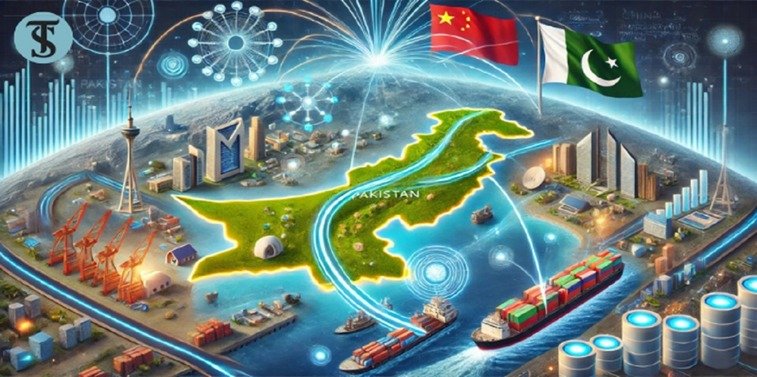
ISLAMABAD, March 24: China’s innovation-driven development strategy under its 15th Five-Year Plan (2026–2030) is opening new opportunities for Pakistan to strengthen its industrial base and improve export competitiveness, according to analysts and policy experts.
The plan places science, technology and innovation at the centre of economic growth, with increased public spending and targeted policies expected to expand high-tech industries, creating potential avenues for Pakistan to align its industrial strategy with emerging global trends.
Focus on technology and investment
According to official proposals, China will increase spending on science and technology to 426.4 billion yuan in 2026, with a 16.3% rise in basic research funding. Key sectors include artificial intelligence, green energy, advanced manufacturing and research and development.
Experts say this shift creates opportunities for countries like Pakistan to benefit through technology transfer, industrial partnerships and investment in export-oriented sectors.
Pakistan’s potential and challenges
Liaquat Ali Shah, a policy advisor and former project director at the CPEC Centre of Excellence, said China’s strategy reflects practical implementation backed by major projects, offering Pakistan a time-sensitive opportunity to upgrade its industrial framework.
He noted that Pakistan’s IT sector and universities could support technology adoption, particularly in applying artificial intelligence to existing industrial processes.
Also Read: “Pakistan has overcome early challenges with dignity”: Ambassador Albert Khorev
However, he stressed the need for developing mid-level technical skills, including engineering and automation expertise, to sustain long-term industrial growth.
Role of business environment and SEZs
Analysts highlighted that Pakistan’s ability to benefit depends on improving its business environment. Key concerns include policy consistency, investor protection, energy reliability and logistics infrastructure.
Special Economic Zones (SEZs) were identified as a key tool for attracting Chinese investment, though experts noted that their performance has been limited by economic instability, security concerns and policy gaps.
Sector-focused approach and regional advantage
Experts suggested that Pakistan should adopt a targeted industrial strategy, focusing on sectors such as higher-value textiles, agro-processing, light engineering and precision manufacturing.
Pakistan’s geographic position also offers access to regional markets in Central Asia, the Middle East, South Asia and Africa, which could support its role as a regional production hub if supported by improved trade and transit systems.
Need for technology-driven partnerships
Asad Rehmann, a policy analyst at S&P Global, said Pakistan should build knowledge-based partnerships with China to enhance productivity and competitiveness.
He emphasised that removing investment bottlenecks and improving the business climate are essential to attract and sustain industrial collaboration.
Experts noted that China’s experience demonstrates how sustained investment in innovation, combined with human capital development and industrial linkages, can support long-term economic transformation.



 Today's E-Paper